


No, remove dentures and clean your mouth at night instead of using adhesive.
Ahead of bed, denture removal might seem like a routine activity, but millions of denture wearers still wonder how to handle dental adhesive.
Although it might appear harmless to sleep with your denture adhesive on, it can actually give rise to many oral issues. To illustrate, consider how the soil in a flowerpot constantly requires breathing holes for air circulation and relief. Likewise, without breathing space for the soft tissue, it is not a big surprise that problems ensue when we leave the denture along with its sticky adhesive in contact with the mucosal surfaces 24/7, i.e., for a full day!
At Lema Dental Clinic, we observe the adverse effects of poor denture habits on the oral mucosa. It is not a rare thing for Professor Doctor Coşkun Yıldız to underline that the mouth requires some sort of nocturnal renewal just as the body does.
The Nightly Routine: How to Care for Your Dentures
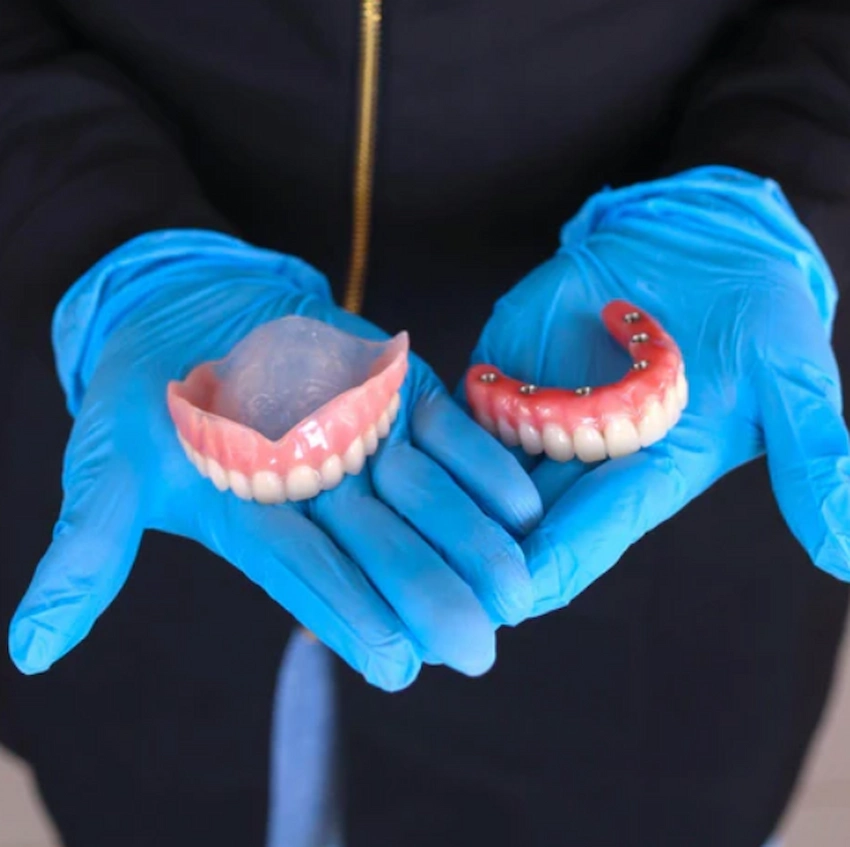
Wearing dentures at night is quite risky when you put fresh adhesive to glue the base strongly to your jaw ridge. You end up creating an artificial environment where saliva hardly works, and bacteria can multiply rapidly!
Dr. Polen Akkılıç and her team are very well-versed in identifying and treating oral fungal infections; for example, denture stomatitis is a major oral fungal infection that causes the palate to become red, painful, and very uncomfortable.
- Gum Tissue Deprivation of Blood: Pressure on a gum by the denture base reduces the flow of blood to those minuscule vessels, resulting in the loss of the supporting bone at a faster rate.
- Food/Bacteria Trapping: Adhesive is like closing a door, preventing food particles and bacteria from getting out. Hence, they ferment under the denture all night, resulting in undesirable effects.
- Fictitious Movement Fixation: If the only way you manage to keep your loose dentures on during the night is by the help of adhesive, probably the fit of the dentures is structurally the problem here, and the night routine shouldn’t be the blame.
Comparing Overnight Habits: Adhesive vs. No Adhesive
Each night, for a minimum of six to eight hours, at least, your gums will get to be bare, naked, clean, and happy to you. Here is what should be the bedtime routine:
- Rip off the gear: It would be a good idea to take your dentures out after dinner.
- The old adhesive is to go: Scrub your teeth and denture area to remove the old dental adhesive using a very soft-bristled toothbrush and very warm water. Do not use boiling water because your plastic dentures might distort when heated.
- Soaking your dentures: Either following dentists’ instructions or using a special cleaning solution or just water at night is necessary, as part of denture maintenance.
- Rub it to a point: Your oral parts (particularly the gums) must be stimulated in some way to keep them healthy through good blood circulation. Use a soft toothbrush or the edge of a hot cloth to rub your gums gently.
Different Ways of Denture Care at Night: Using Adhesive vs. Not
| Habit Method | Effect on the Gum | Risk of Getting Infected | Preservation of Jawbone Long-Term |
| Dentures are left with the adhesive on through the night | The area is tightly pressed; a restriction is placed on the circulation | Very high (great place for bacteria) | The worst (fast bone tissue loss) |
| Getting rid of dentures at night and scraping off the adhesive paste | The recovery of tissues and oxygen are provided | Low (fungal proliferation is prevented) | The most ideal (minimum pressure-induced resorption) |
Looking Beyond the Glue: Permanent Solutions in Turkey
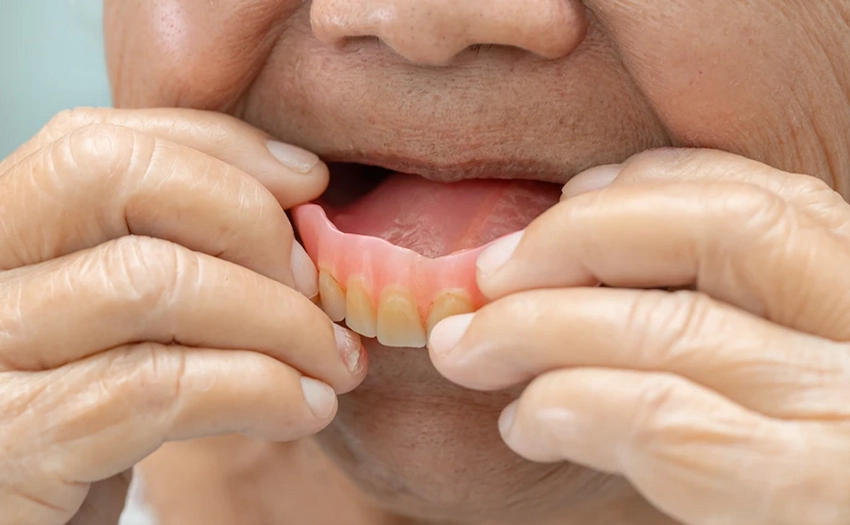
Modern medicine offers a permanent alternative to sticky pastes if you are fed up with them. Many overseas patients come to Turkey seeking a definitive, effective solution to their loose, uncomfortable removable dentures.
Unlike the conventional method, where a set of detachable teeth rests on the shrinking gums, contemporary implants are firmly embedded in the jaw. For instance, implant technologies like All-on-4 or All-on-6 provide a complete denture of 4 to 6 teeth which gets fixed and supported by just four or six dental implants.
The dental professional restores the entire arch with just 4 implants, placed in optimal locations so the prosthesis will be highly functional, esthetic, and stable. The dental arch that has been restored is just like natural teeth, so you brush the fixed dentures as you would your original teeth, meaning that the nightly removal of the dentures and wiping of the adhesive paste will be no more!
Frequently Asked Questions
Can I leave my dentures in overnight if I don’t use adhesive?
It is not recommended that you keep the dentures even without the adhesive during sleeping hours. Constant mechanical pressure is not the way to go if you want your gums to stay healthy and disease-free. You take the chance to help your soft tissues recover, to get oxygen, as well as to become resistant to fungi.
How do I safely remove stubborn adhesive from my gums?
Do not use your fingernails, hard objects, or similar tools to scrape off the adhesive on the gum. Instead, you should use a soaked cloth or a soft-bristled toothbrush, which you can gently move over the affected areas to lift the residue. Moreover, if you have the chance to do so regularly, it is better to use a saltwater mouth rinse to remove stuck-on adhesive particles.
Is it dangerous when I accidentally swallow some denture adhesive?
If only a small piece is swallowed, you will not be harmed at all, since adhesives nowadays mainly consist of non-toxic, food-grade components. However, if this occurs quite regularly, you are probably over-using the product. Swallowing denture adhesive can make you feel sick or like that.
Why do my dentures feel loose even with adhesive?
Gradually, the jawbone will lose its supporting structure. So the shape of the mouth will alter. A dental appliance glued with adhesive is nothing but a quick, temporary fix for a poorly supported fit. The problem here is the shape, which does not fit. It is necessary that you either have your dentures relined by a professional to fit your mouth better, or have your teeth fixed through implantology as the best alternative.
What is the frequency of checking my dentures by the dentist?
We suggest you go to the dentist at least once a year. Even after a few teeth are lost, we require that the fit of your appliance be assessed, the soft-tissue condition checked, and the occlusion balanced!
Academic References
- Avampato, A., et al. (2021). Microbial colonization of removable denture acrylic resins and the efficacy of nightly soaking solutions. Journal of Prosthetic Dentistry, 125(3), 412–419.
- Felton, D., et al. (2011). The safety and efficacy of denture adhesives: A review of the literature. Journal of the American Dental Association, 142(8), 918–926.
- Jeganathan, S., & Lin, C. (2022). Alveolar bone resorption patterns associated with removable versus implant-retained prostheses. International Journal of Oral & Maxillofacial Implants, 37(2), 245–253.
- Kulak-Ozkan, Y., et al. (2019). Clinical evaluation of denture stomatitis and associated hygiene habits in elderly populations. Gerodontology, 36(4), 310–316.
- Zarb, G. A., & Hobkirk, J. A. (2020). Prosthodontic Treatment for Edentulous Patients: Complete Dentures and Implant-Supported Prostheses (13th ed.). Elsevier.

