


Protect your child’s permanent molars early.
You, as a parent, may probably feel a bit of dental anxiety along with pride over your child’s first permanent molars. The so-called “six-year molars” are the hardest-working teeth in the mouth, meant to last a lifetime. However, there is a minor biological flaw in their design: their chewing surfaces are usually very uneven, having deep grooves and pits called fissures.
In our clinical experience at Lema Dental Clinic in Turkey, we see a clear divide between proactive and reactive care. Professor Doctor Coşkun Yıldız often notes that while fluoride strengthens the “walls” of the tooth, it often fails to penetrate the deep “canyons” on the biting surface. This is where pediatric dental sealants become not just an option, but a critical line of defense.
The Anatomy of the “Canyon”: Why Toothbrushes Fail
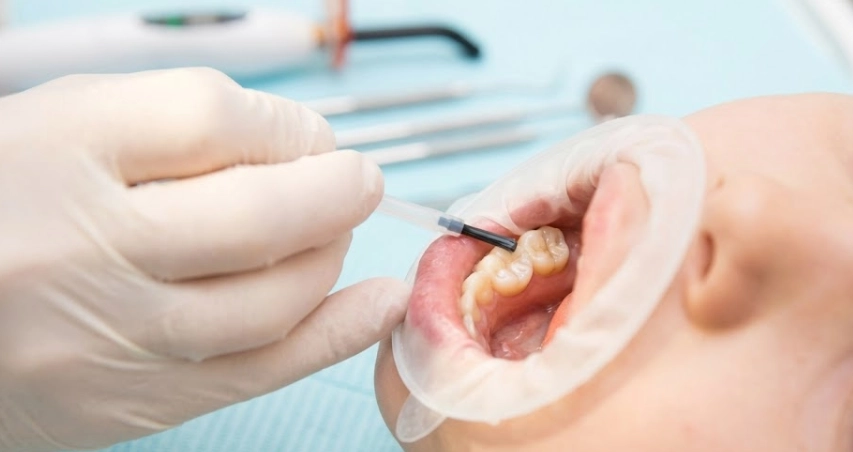
Imagine the chewing surface of a child’s molar as a jagged mountain range with deep, narrow crevices. Even the best toothbrush bristles are, in comparison, as thick as giant redwood trees. They just can’t reach the bottom of those tiny valleys to clean out food and bacteria that are trapped.
But in fact, almost 90% of cavities in permanent teeth are due to decay in pits and fissures. A dental sealant is basically a thin, medical-grade plastic film, like a “raincoat” for the tooth, that runs into these cracks and, after hardening, forms a smooth, impermeable barrier.
Dentist Polen Akkılıç and her team stress that this is a totally non-invasive procedure. There is no drilling, no cutting of the tooth, and perhaps most importantly to our young patients in Istanbul, it is completely painless.
Sealants vs. Traditional Fillings: A Comparison of Care
The question often arises: “Why seal a tooth that isn’t decayed yet?” To answer this, we look at the long-term structural integrity of the tooth. A sealant is a preventive shield; a filling is a repair to a damaged foundation.
| Feature | Dental Sealants (Proactive) | Dental Fillings (Reactive) |
| Invasiveness | Non-invasive; no drilling required. | Requires removal of decayed tooth structure. |
| Pain Level | Zero; no anesthesia needed. | Usually requires local anesthesia. |
| Purpose | Prevents bacteria from entering. | Replaces structure lost to bacteria. |
| Cost in Turkey | Highly affordable preventive care. | Higher cost depending on cavity size. |
| Durability | 5–10 years with proper maintenance. | Varies by material (Composite/Amalgam). |
The “Lema Protocol”: Timing the Treatment in Turkey
Timing is everything in pediatric dentistry. The most effective window for sealants is immediately after the permanent molars erupt, before bacteria have a chance to colonize the fissures.
- First Molars: Usually appear around age 6.
- Second Molars: Usually appear around age 12.
Well, let’s see what exactly we do at Lema Dental Clinic. We don’t just “paint” a tooth. Our team goes meticulously goes through cleaning and etching to make the bond so tight it is airtight and microscopic. In the ultramodern setting of our clinic in Turkey, we make sure that the sealant is hardened by the use of a special UV light, which means the child can eat and drink right after the appointment.
Beyond the Surface: Is Fluoride Not Enough?
The truth of the matter is that fluoride and sealants are teammates, not competitors. Fluoride is excellent at protecting the smooth surfaces (the sides) of the teeth. However, it is a chemical protector. Sealants provide mechanical protection. By filling the physical space where bacteria live, we eliminate the habitat required for decay to thrive.
FAQ: Clinical Perspectives from the Lema Team
Not at all,” says Professor Doctor Coşkun Yıldız. “Because the material is applied as a liquid and fills existing grooves rather than sitting on top of the tooth, most children forget they are there within minutes. We check the ‘bite’ immediately after application to ensure total comfort.
Modern dental sealants are incredibly safe,” explains Dentist Polen Akkılıç. “At Lema Dental Clinic, we use high-grade, BPA-free materials. The amount of exposure to any plastic-based compounds during a dental seal is significantly less than what a child encounters from common household items or food packaging.
It’s not an emergency,” the team notes. “While sealants are durable, they can wear down over the years of heavy chewing. During your regular check-ups in Turkey, we simply reapply a small amount of material to maintain the seal. Even a partially worn sealant provides more protection than no sealant at all
We can, but we usually reserve this for high-risk cases where the baby molars have exceptionally deep grooves,” says the clinical team. “The priority is almost always the permanent molars, as those teeth must serve the patient for the next 70 to 80 years.
It is never too late to protect a healthy, decay-free tooth,” notes Professor Doctor Coşkun Yıldız. “If the molars are free of fillings and cavities, we can seal them regardless of the patient’s age to prevent future issues.
- Ahovuo-Saloranta, A., et al. (2017). Pit and fissure sealants for preventing dental decay in permanent teeth. Cochrane Database of Systematic Reviews.
- Beauchamp, J., et al. (2008). Evidence-based clinical recommendations for the use of pit-and-fissure sealants. Journal of the American Dental Association (JADA).
- Griffin, S. O., et al. (2016). Vital Signs: Dental Sealants Prevented 80% of Cavities over 2 Years Among School-Age Children. Morbidity and Mortality Weekly Report (MMWR).
- Hiiri, A., et al. (2010). Pit and fissure sealants versus fluoride varnishes for preventing dental decay in children and adolescents. Cochrane Database of Systematic Reviews.
- Wright, J. T., et al. (2016). Evidence-based clinical practice guideline for the use of pit-and-fissure sealants. American Academy of Pediatric Dentistry (AAPD).

