


Painless tooth extraction in Turkey offers safe, modern tooth removal with comfort-focused dental care.
If just the idea of a “tooth extraction” alone makes you feel nervous, then you are definitely not the only one. A lot of folks imagine, right away, environments with rusty old tools, unbearable force, and then lots of pain for several days
Today, however, the truth is a lot more up-to-date. Dentistry has evolved drastically. We’ve stopped doing tooth removals by brute force; on the contrary, we focus on very careful, accurate work.
Among others, Turkey is one of the world’s leading destinations for advanced dental care. Comfort has become the main criterion in their clinics today more than ever. So, if you are going to have a tooth extraction in Turkey, this is how the procedure is usually changed from a scary nightmare to a nice and easy experience.
Understanding Comfort: The Secret Behind Pain-Free Modern Treatments
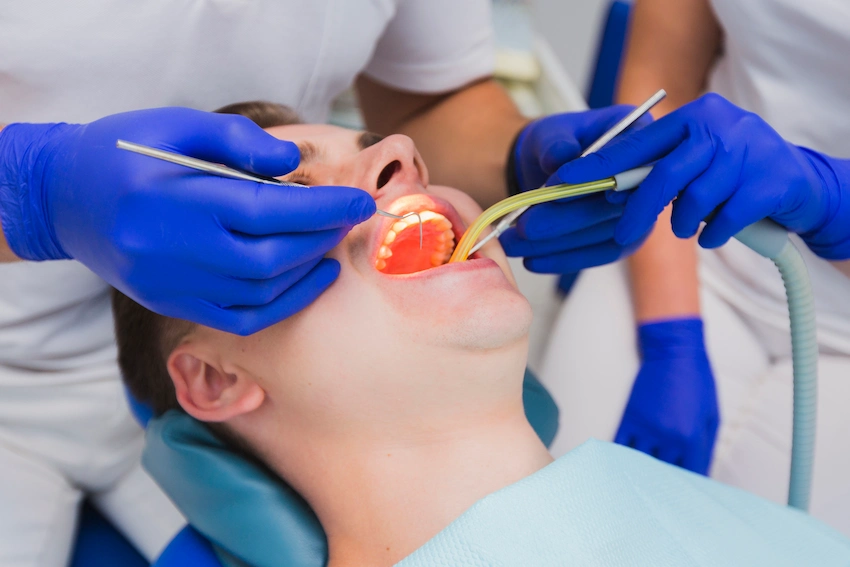
Our entire notion of how a tooth is fixed in the mouth should be changed. The tooth is not hammered into the bone of the jaw as a nail is driven into a piece of wood. The tooth rather nestles in a soft “hammock”, held with a system of very fine fibers.
Our goal is to make the extraction completely pain-free, so we always work conscientiously according to this fact of anatomy. We neither pull nor jerk the tooth out of the socket. Quite oppositely, we gently detach those small fibers first. After the soft “hammock” is loosened, the tooth gives way and comes out. The process is very similar to sliding a smooth stone out of wet clay.
Usually, at Lema Dental Clinic, when we meet patients who come in with severe fear, this fear often overshadows their initial attitude. As Professor Doctor Coşkun Yıldız says, fear is psychologically the most difficult thing to numb. To overcome the problem, we rely on very powerful local anesthetics. We also employ high-tech imaging. Besides, our clinic has been designed in such a way that it automatically reduces your heart rate as soon as you enter.
Perfect Planning Before We Start
It is impossible to guarantee a visit without pain if we do not know exactly what lies under your gums.
Depending on the case, Dentist Polen Akkılıç, with her team, has a habit of working with 3D scans. It is this special device that reveals to us how your tooth roots are shaped. We can also locate your major nerves. Furthermore, we can determine how near the tooth is to the sinus, which is as fragile and thin as the skin within an eggshell.
However, let us now focus more on the actual procedure during which you will be chair-bound.
Old vs. New: The Clinical Difference
When we put the old and new approaches side by side, this is what comes out, according to what we observe in the clinic:
| Feature | Old Extraction Methods | Modern Care at Lema Dental Clinic |
| Scans | Simple, 2D X-rays that do not expose hidden details | 3D Scans for precise mapping of nerves |
| Numbing | Rapid, harsh injections | Slow, tender administration of warm anesthesia |
| Method | Heavy force pulling | Cautiously loosening the tiny fibers around the tooth |
| Bone Health | Danger of severe bone damage | Bone is preserved for future implants |
| Healing Time | Significant swelling and discomfort for 5 to 7 days | Mild pain only for 1 to 3 days |
Keeping Your Smile Healthy

Why waste so much effort to remove a tooth? Likely,t removing a tooth will not be the final chapter of the story.
Aftercare is something you may be tempted to overlook; however, it is very important. Actually, it could be that your tooth extraction ends up being a tooth implantation, especially if you want artificially beautiful teeth in your mouth. An implant requires a jawbone that is strong and stable to be able to hold it firmly. But if a tooth extraction is done roughly, with great force, it may even lead to a bone fracture. We are not only stopping the bone from getting damaged but also making it possible to put in an implant by employing gentle methods. This can be likened to saving the foundation of a house so that later you can build a brand new and strong home on it.
For example, besides its other attractions, Turkey is a favorite spot for people seeking dental treatments. Consequently, our doctors and dentists are very well-trained in complicated cases and surgical procedures. We are more than happy to keep on repeating each gentle step, our skills develop through experience,e resulting in less pain and faster healing for you in the long term.
FAQs
You won’t experience a sharp pain. However, you will feel a pressing sensation quite strongly. Many times, I recommend to my patients to imagine a rather strong one being applied to their shoulders. You can sense the heaviness, but there is no pain. A contemporary extraction is precisely the same feeling.
If you only want a simple extraction, your local dentist is fine. Nevertheless, the patient may choose to come to Lema Dental Clinic for extractions since they are there to look for other dental solutions, such as full mouth implants or total smile makeovers. We provide world-class surgical care at very low prices.
We certainly understand that. Fear is an involuntary physical response. Dentist Polen Akkılıç and her team offer conscious sedation for patients with extreme fear. You will be just awake enough to perform simple activities while at the same time being deeply relaxed. You will most probably not even remember that you were there.
The numbness typically lasts between two and four hours. We recommend that you bring a smooth soup or a soft drink along with you when you leave the clinic. Remember, you should not eat solid food until the numbness has entirely worn off. In fact, the main reason we are advising this is to prevent you from inadvertently biting your lip.
When normal extractions are involved, it is perfectly safe to fly the next day after the procedure. If complex surgery is performed by us, then you will be asked to wait for 48 to 72 hours. It is the best course of action to avoid the cabin air pressure from being harmful to your healing gums.
- Malamed, S. F. (2019). Handbook of Local Anesthesia (7th ed.). Elsevier.
- Fragiskos, F. D. (2007). Oral Surgery. Springer-Verlag.
- Hupp, J. R., Ellis, E., & Tucker, M. R. (2019). Contemporary Oral and Maxillofacial Surgery (7th ed.). Elsevier.
- Coulthard, P., Horner, K., Sloan, P., & Theaker, E. (2013). Master Dentistry Volume 1: Oral and Maxillofacial Surgery, Radiology, Pathology, and Oral Medicine. Churchill Livingstone.
- Ogle, O. E. (2015). Perioperative management of the dental patient. Dental Clinics of North America, 59(4), 857-872.

