


Jaw Surgery for Overbite/Underbite in Turkey.
Look in the mirror and bite down. Do your top teeth overlap too far? Does your lower jaw jut out? We see thousands of patients at Lema Dental Clinic in Turkey who are confused about their bite. They’ve often been told that braces alone can fix everything. The reality is sometimes different. While orthodontics works wonders on teeth, it cannot magically reshape solid bone.
When your jaw is so misaligned that it throws your whole face out of balance, it’s not just a matter of looks; you are mainly dealing with a functional problem. You know, one of the challenges during your consultation that we will have to figure out is whether your issue is entirely dental or if there is a skeletal component too.
The Anatomy of Misalignment
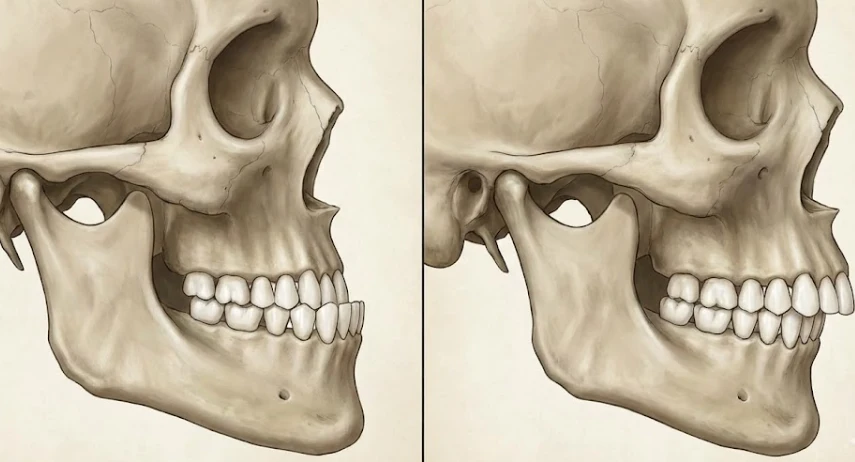
First of all, it is necessary to recognize what we are talking about. In our clinic, we have noticed that a lot of patients mix the terms “overbite” and “underbite”.
Overbite (the correct medical term is Class II malocclusion) is a condition where the upper jaw and teeth protrude a lot over the lower ones. A slight overlap is normal; a deep bite where you can’t see the lower teeth, or where the upper teeth protrude significantly (overjet), is not.
An underbite (Class III malocclusion) is the opposite and often more visually striking. The lower jaw sits forward, causing the lower teeth to overlap the upper teeth. This often gives the chin a prominent, protruding appearance.
The House Foundation Metaphor
Think of your mouth as a house. Your teeth are the furniture, and your jaws are the foundation. If the furniture is just rearranged chaotically, Dentist Polen Akkılıç and her team can use braces or aligners to move that furniture into the perfect position. That’s an orthodontic fix.
But what if the very foundation is out of line? What if the first floor is offset by two feet to the left of the second floor? Even if you change the furniture many times in such a house, it still won’t make the house stable. Instead, the main thing you should do is to fix the foundation. And that is what orthognathic (jaw) surgery is.
The Red Flags: When Braces Aren’t Enough
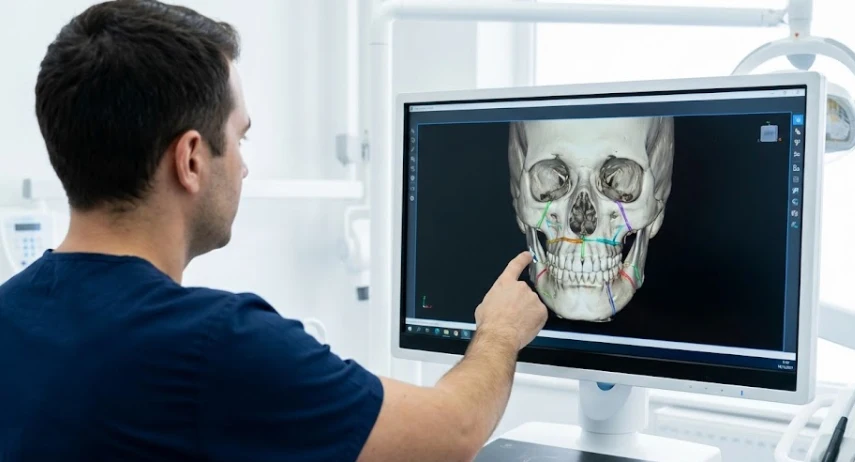
We often see patients who have tried “camouflage orthodontics” elsewhere—using braces to mask a skeletal problem—and are unhappy with the result. The teeth might be straight, but the face still looks unbalanced, or the jaw joint (TMJ) begins to hurt.
Professor Doctor Coşkun Yıldız often notes that forcing teeth to compensate for a jaw discrepancy can sometimes do more harm than good in the long term.
So, when do we recommend the surgical route here in Turkey? It usually comes down to the severity of the skeletal mismatch and the presence of functional issues.
Here are the primary indicators that surgery might be necessary:
- Severe Discrepancy: The separation of the jaws is so great (in many cases exceeding 7-9mm) that braces alone cannot close the gap.
- Facial Asymmetry: The chin is noticeably out of line with the face, or the profile is extremely unbalanced (for instance, a “weak” receding chin or a very prominent bulldog-like chin).
- Functional Difficulty: Difficulty in chewing hard food, biting an apple, or having a speech impediment due to the position of teeth are some of the problems.
- Sleep Apnea and Breathing: An extremely small lower jaw can limit the airway, thus leading to obstructive sleep apnea. Sometimes surgically repositioning the jaw to the front can cure this potentially fatal disease.
- TMJ Pain: Long-lasting jaw joint pain, popping, or locking associated with a bad bite.
The Lema Approach in Turkey: Precision and Teamwork
Choosing to undergo jaw surgery is a massive decision. We don’t take it lightly. At Lema Dental Clinic, this isn’t a one-doctor show; it’s a symphony of specialists.
A perfect team work between the orthodontist and the maxillofacial surgeon is a must for a successful outcome.Typically, Dentist Polen Akkılıç will spend 12 to 18 months using braces to align the teeth perfectly on their own arches. To the patient, their bite might actually look worse during this phase, because we are removing nature’s compensations.
Once the “furniture” is ready, Professor Doctor Coşkun Yıldız performs the surgery to move the foundation into its new, mathematically precise position. The operation is carried out under general anesthesia in a full hospital environment here in Turkey. The bone is cut and relocated then fixed with small titanium plates and screws that generally stay permanently.
Why do patients fly to Turkey for this? It’s a combination of high-volume expertise—our surgeons handle complex cases weekly that some dentists see yearly—and advanced 3D surgical planning technology, which allows us to visualize the final result before the first incision is made.
Comparing the Paths: Camouflage vs. Correction
It helps to visualize the difference between trying to hide the problem with orthodontics versus fixing the root cause surgically.
| Feature | Orthodontic Camouflage (Braces Only) | Orthognathic Surgery + Orthodontics |
| What it treats | Mild to moderate dental misalignments. | Moderate to severe skeletal discrepancies. |
| How it works | Tips teeth to “hide” the jaw gap. | Physically repositions the jawbones. |
| Impact on Profile | Minimal change to facial structure. | Significant, often dramatic improvement in facial balance. |
| Treatment Time | 18–24 months typically. | 24–36 months total (including pre- and post-surgical braces). |
| Invasiveness | Non-surgical. | Major surgery requiring hospital stay and recovery. |
| Long-term Stability | Relapse is possible if the skeletal force is strong. | Highly stable skeletal correction. |
The Question Remains: Is It Right For You?
If your bite is barely visible to others and your jaw functions normally without any troubles, then surgery would probably be too much. However, if you don’t recognize yourself when you look at your profile and your problems are more than just cosmetic, then you definitely need to see a surgeon.
Getting a surgical consultation is the next step if you find your profile in the mirror doesn’t represent you and you experience functional problems regularly. The objective at Lema Dental Clinic is not simply a flawless bite but rather the harmony of the two (form and function) achieved through the expertise that has made Turkey a world leader in medical tourism. llence.
FAQ: Straight Talk from the Doctor
You are asleep during the procedure, so you feel nothing. Post-surgery, pain is surprisingly manageable with intravenous medication in the hospital and oral painkillers later. Patients often report more discomfort from swelling and congestion than from acute pain. The nerve sensation returns slowly, which actually helps manage discomfort in the early days.
For the surgery itself, you need to plan for about 10 to 14 days in Turkey. This includes pre-operative final checks, the surgery (usually a 1-2 night hospital stay), and initial post-operative monitoring by Professor Yıldız to ensure healing is on track before you fly home.
We love clear aligners, but they have physical limits. Aligners are excellent at tipping and rotating teeth. They cannot grow bone or significantly slide a heavy jawbone forward or backward. If your issue is skeletal, relying solely on aligners often leads to disappointment and wasted time.
Yes, and that is usually the point. If you have a severe underbite, moving the upper jaw forward and lower jaw back will soften your profile significantly. We use 3D simulation software to show you the predicted aesthetic changes so we are aligned on the desired outcome. The goal is balance, not an unrecognizable new face.
We generally cannot perform orthognathic surgery until jaw growth is complete. This is typically around age 17-18 for females and perhaps slightly later, 19-21, for males. Operating too early risks the jaw continuing to grow after surgery, undoing our work.
- Proffit, W. R., Fields, H. W., & Sarver, D. M. (2018). Contemporary Orthodontics. Elsevier Health Sciences.
- Naini, F. B., & Gill, D. S. (2008). Facial aesthetics: 2. Clinical assessment. Dental Update, 35(3), 159-170.
- Posnick, J. C. (2013). Orthognathic Surgery: Principles and Practice. Elsevier Health Sciences.
- Cunningham, S. J., & Hunt, N. P. (2001). Quality of life and its importance in orthodontics. Journal of Orthodontics, 28(2), 152-158.
- Bell, R. B. (2009). Computer planning and intraoperative navigation in orthognathic surgery. Journal of Oral and Maxillofacial Surgery, 67(11), 2118-2129.

