


They stop chronic jaw pain.
Feeling like you’ve gotten into a fight with a boxer rather than a bed every time you get out of bed is a good indication that you might be among the many people who have TMJ disorders. The temporomandibular joint (TMJ) is the most complicated hinge in the human body. In case of misalignment, the resulting symptom is not just a “clicking jaw”-it is a domino effect of persistent pain in the face, earaches, and very painful tension headaches.
At Lema Dental Clinic in Turkey, we treat patients who have tried everything from massage to muscle relaxants, only to find that the root of their suffering is mechanical. Professor Doctor Coşkun Yıldız often notes that your jaw muscles are among the strongest in your body for their size; when they are locked in a cycle of nocturnal clenching (bruxism), the pressure is equivalent to hundreds of pounds of force.
The Biomechanics of the “Buffer”
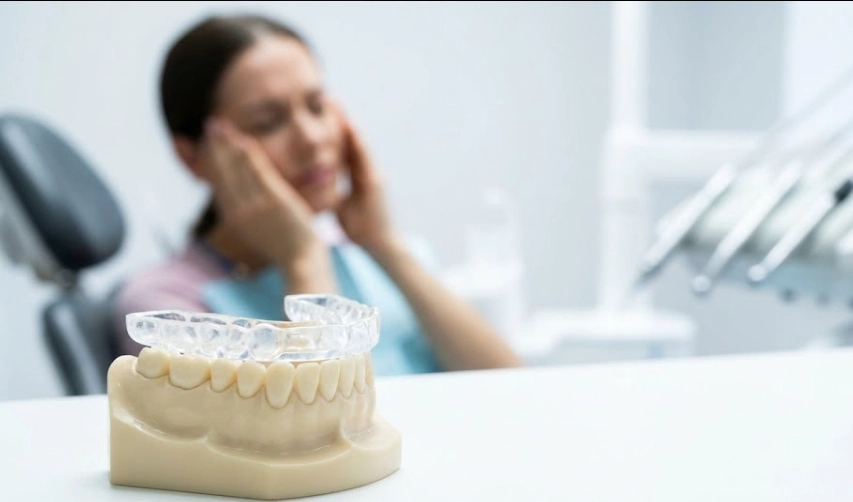
The question remains: how can a simple piece of medical-grade acrylic stop a lifetime of pain? The reality is that a night guard doesn’t just “cover” your teeth; it reprogrammes your neuromuscular system.
Think of your TMJ as a high-end kitchen cabinet hinge. If the door is misaligned, forcing it shut over and over will eventually warp the hinge and damage the wood. A custom night guard acts as a precision-engineered shim. It slightly increases the vertical dimension between your upper and lower teeth, placing the masticatory muscles in a “resting” position.
Dentist Polen Akkılıç and her team emphasize that by preventing the teeth from fully interlocking, the guard effectively “shuts off” the brain’s signal to clench at full power. It acts as a shock absorber for your skull.
Why “Boil and Bite” Guards Often Fail
Many patients come to our clinic in Istanbul after trying over-the-counter (OTC) guards from a pharmacy. But let’s look closer at why these can actually make TMJ worse.
Soft, squishy guards often stimulate the “chewing reflex.” Because the material is rubbery, the brain perceives it as food, causing you to chew and clench even harder throughout the night. In contrast, the hard-soft hybrids we use at Lema Dental Clinic provide a stable biting surface that encourages muscle deprogramming.
Custom Orthotics vs. Over-the-Counter Guards
| Feature | Lema Custom Night Guard | Pharmacy “Boil & Bite” |
| Material | Dual-laminate medical acrylic. | Soft thermoplastic or rubber. |
| Fit Precision | Digital 3D scan (micron-level). | Manual molding (imprecise). |
| Muscle Impact | Relaxes masticatory muscles. | Often increases “chewing” reflex. |
| Jaw Alignment | Corrects bite relationship. | Can shift teeth unexpectedly. |
| Durability | 3–5 years. | 3–6 months. |
The Headaches Connection: Referred Pain
One of the most profound “aha!” moments for our patients in Turkey happens when their chronic migraines disappear after two weeks of guard wear. But how are the teeth connected to the forehead?
The reality is that the temporalis muscle—the large, fan-shaped muscle on the side of your head—is a primary mover of the jaw. When you clench your teeth, this muscle stays in a state of hyper-contraction. This creates “referred pain” that mimics a classic tension headache.
By unloading the jaw joint, we aren’t just protecting your enamel from wear; we are releasing the tension in the entire craniofacial complex. As Professor Doctor Coşkun Yıldız explains, “We aren’t just treating a mouth; we are treating a neurological feedback loop.”
FAQ: Clinical Insights on TMJ Therapy
The question is best answered by your symptoms,” says Professor Doctor Coşkun Yıldız. “Many patients wear them indefinitely to protect their investment in crowns or veneers, while others use them during high-stress periods. However, for chronic TMJ, consistent wear is the key to preventing bone degradation in the joint.
There is a short adaptation period,” notes Dentist Polen Akkılıç. “Because our guards are digitally designed to be as low-profile as possible at our clinic in Turkey, most patients find that the relief from pain far outweighs the sensation of the guard. Within three nights, it usually becomes a ‘sleep signal’ for the brain.
The reality is that clicking usually indicates a displaced disc within the joint. While a guard can’t always “pop” the disc back permanently, it can stop the inflammation that makes the clicking painful and prevent the condition from progressing to “locking.
Actually, guards are even more critical for implant patients,” the team explains. “Implants don’t have the natural shock-absorbing ligament that teeth do. A night guard is the cheapest ‘insurance policy’ you can buy for your dental implants in Turkey.
Keep it simple,” says the clinical staff. “Rinse it with cool water and use a soft toothbrush with non-abrasive soap. Never use hot water, as it can warp the high-precision fit we achieved during your 3D scan.
- Okeson, J. P. (2019). Management of Temporomandibular Disorders and Occlusion. Elsevier Health Sciences.
- Greene, C. S., & Menchel, L. (2003). The use of oral appliances in the management of TMJ disorders. Oral and Maxillofacial Surgery Clinics.
- Dao, T. T., & Lavigne, G. J. (1998). Oral splints: the inefficacy of objective evidence and the reasons for their use. Journal of Orofacial Pain.
- Turp, J. C., et al. (2004). Efficacy of stabilization splints for the treatment of myofascial pain: a systematic review. Clinical Oral Investigations.
- Klasser, G. D., & Greene, C. S. (2009). Oral appliances in the management of temporomandibular disorders. Journal of the Canadian Dental Association.

