


Ease Invisalign pressure fast.
There is a specific sensation that every clear aligner patient knows. It is that distinctive, tight, aching pressure that arrives the moment you snap a fresh set of trays onto your teeth. While we often celebrate “Switch Day” as a milestone toward a perfect smile, the physical reality can be less than celebratory.
At Lema Dental Clinic in Turkey, we view this discomfort not as a side effect, but as a biological signal. It is the sound of your anatomy shifting. However, understanding the science doesn’t make the ache go away. Professor Doctor Coşkun Yıldız often explains to our international patients that while the aligners are high-tech plastic, the movement they trigger is a complex physiological remodeling of your jawbone.
The Science of the “Ache”: Why New Trays Tighten
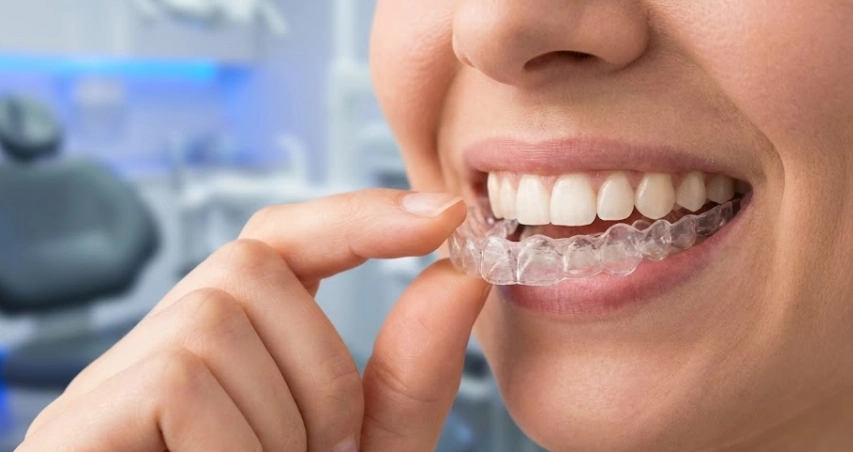
To manage the pain, you have to understand the mechanism. Think of your tooth as a pillar sitting in a foundation of dense sand. To move that pillar, you have to apply constant, unrelenting pressure to one side. This pressure creates a biological “war zone” in the periodontal ligament.
The side being pushed experiences a breakdown of bone (osteoclasts), while the side being pulled builds new bone (osteoblasts). This inflammatory response is what you feel as “pain.”
Dentist Polen Akkılıç and her team emphasize that this sensation usually peaks within the first 24 to 48 hours of a new tray. If you feel nothing, the “pillar” isn’t moving. The goal is to manage the inflammatory peak without stopping the progress.
Clinical Strategies for Immediate Relief
The reality is that you don’t have to suffer through the first two days of every cycle. Through our clinical experience in Istanbul, we have refined a protocol to minimize the “new tray shock.”
1. The “Sleep Through the Peak” Method
This is the most effective tactic we recommend. Do not switch to your new trays in the morning. Put them in right before you go to bed. By doing this, you allow your teeth to undergo the first 6–8 hours of the most intense initial pressure while you are unconscious. When you wake up, the “acute” phase has often transitioned into a manageable dull hum.
2. Cold Therapy: The Internal Ice Pack
Inflammation hates the cold. Drinking ice-cold water while your trays are in can provide a localized numbing effect. Some of our patients at Lema Dental Clinic find relief by gently sucking on a smooth ice cube.
3. The Role of “Chewies.”
It sounds counterintuitive to bite down on something when your teeth hurt, but “chewies” (small silicone cylinders) are essential. Biting on these for 5–10 minutes a day helps seat the tray perfectly against the teeth. A tray that isn’t fully seated creates “unbalanced” pressure, which actually hurts more than a tray that fits like a glove.
Pain Management Comparison: What Works Best?
| Method | Best Used For | Clinical Effectiveness |
| Acetaminophen (Tylenol) | General dull aching. | High. Does not interfere with bone remodeling. |
| Cold Compresses | Acute soreness in the first 12 hours. | Moderate. Provides instant but temporary numbing. |
| Orthodontic Wax | Irritation on the tongue or inner cheeks. | High. Essential for “sharp” tray edges. |
| Soft Food Diet | Reducing pressure during meals. | Moderate. Prevents “bite-shock” while eating. |
| Chewies | Ensuring proper tray seat. | High. Reduces “misfit” pain significantly. |
When Discomfort Becomes a Concern
Let’s look closer at the difference between “pressure” and “pain.” Pressure is a heavy, tight feeling. Pain is sharp, stabbing, or prevents you from sleeping. If a tray is cutting into your gingiva (gums) or causing a bleeding ulcer, it is likely a manufacturing burr on the plastic, not a biological movement issue.
In our clinic in Turkey, we advise patients that if the intensity does not drop by at least 50% after the third day, a virtual or physical check-up is necessary. Interestingly, some patients have a higher “pain threshold” in the upper arch than the lower arch, often due to the difference in bone density between the maxilla and the mandible.
FAQ: Managing Invisalign Discomfort & Tray Pressure
We actually prefer you don’t,” says Professor Doctor Coşkun Yıldız. “Ibuprofen is an anti-inflammatory that works by blocking prostaglandins. Since tooth movement requires inflammation to remodel bone, taking too much Ibuprofen can theoretically slow down your treatment. Stick to Acetaminophen (Tylenol) when possible.
This is a common trap,” warns Dentist Polen Akkılıç. “When you take the trays out, the teeth ‘spring’ back slightly. When you put them back in, you start the pain cycle all over again. The best way to end the pain is to keep the trays in for the full 22 hours.
The reality is that Invisalign doesn’t move every tooth at once. Each tray is programmed to focus on specific movements. If only one tooth hurts, it simply means that this specific 2-week window is that tooth’s “turn” to move.
Usually, no. The first 3–4 sets are typically the most uncomfortable because the bone is “waking up.” Once the remodeling process becomes a regular cycle, many patients find subsequent tray changes much easier.
If you are in Turkey and can visit us, we can fix it in seconds,” the team notes. “If you are home, a clean, new nail file can be used to very gently smooth down a tiny rough plastic edge. Just be careful not to file away the actual shape of the tray.
- Bollen, A. M., et al. (2003). The effects of orthodontic forces on the periodontal ligament and alveolar bone. University of Washington Press.
- Kravitz, N. D., et al. (2007). How well does Invisalign work? A prospective clinical study evaluating the efficacy of tooth movement with Invisalign. American Journal of Orthodontics and Dentofacial Orthopedics.
- Ngan, P., & Fields, H. W. (2000). Management of pain in orthodontics. Journal of the American Dental Association.
- Proffit, W. R., & Fields, H. W. (2018). Contemporary Orthodontics. Elsevier Health Sciences.
- Wong, B. H. (2002). Invisalign A to Z. American Journal of Orthodontics and Dentofacial Orthopedics.

