


Use denture adhesive in small amounts on clean dentures and never as a fix for poor fit.
Millions of people wake up every day and instinctively grab the small, familiar tube. It is not really about the paste; more accurately, it is about gaining the confidence to be able to speak, smile, and share your food with others. That is a very personal and universal ritual.
Besides the fact that the adhesives allow a certain level of stability, they are also one of those things people do daily without even thinking about it. Most times, the misunderstanding is a real factor. Misuse is also a regular factor. With the passage of time, all this misuse can cause serious, yet hidden, health problems.
This is how things go at Lema Dental Clinic: first of all, the patients are frustrated because they have not found a solution yet,t but meanwhile they keep on using more adhesives trying to fix their dentures.
But let us try to figure out what exactly is going on, nd in this process help you know how safe and proper you can use these denture adhesives.
The Grip Mechanism: What You Are Actually Applying

We can look at the jawbone as a foundation of a house. When you lose your natural teeth, that foundation, the jawbone, gets its main source of support knocked off. Consequently, the bone loses height over time and eventually shrinks.
Six years ago, the acrylic denture was a perfect fit. At this time in your life, it is like a loose window in a wooden house because it only fits with great difficulty.
That is why patients use denture adhesives mainly to cover the gaps. These adhesives take up saliva. When the denture and the gingival mucosa touch, the denture adhesive will fill the spaces. However, this is only meant to have the microscopic buffer. It is never the solid pillar.
When Professor Doctor Coşkun Yıldız looks out for an indicator of mismanagement by the patients, one of the most common things to be pointed out is patients using too much of a denture adhesive to hide the bone loss.
The Danger with Zinc: Turning Your Advantage Against You
The first ingredient that makes a denture adhesive a good hold is Zinc. However, for such a mineral, a small amount is what the body needs, and actually it is an important one for the immune system.
Patients tend to use heavy amounts of denture adhesive throughout the day for the reason of fixing the denture they are not satisfied with the denture. That means that along with the excessive amount of zinc, they are going to swallow the paste also.
A gradual and prolonged intake of zinc may cause you to not absorb copper in your body, which is essential. The outcome is that the copper deficiency leads the nervous system to a condition of malfunction.
A neurological disease will be the outcome which symptoms like hand/foot numbness, tingling and even sudden loss of balance will come along with.
One question is still remaining: is the use of these products, for as long as is needed for a comfortable life, without any health complications?
Clinical Advice for the Right Way of Using Denture Adhesive
At Lema Dental Clinic in Turkey, we focus most of our effort on patient education about how to use denture adhesive safely. Our patients have always followed our rules to the letter,r as we emphasize the importance of these points strictly.
- Fewer Means Less Risk: You need only a few small drops of the glue, three or four at the most. Do not pour the denture adhesive in a long continuous line. It is only supposed to be in very tiny dots.
- Spilling Test: Take a bite of your denture without using too much force. If adhesive gets pushed out from the sides of the denture after this step, it indicates you used too much of it. You probably applied a very big amount of paste at the denture base.
- New Start Only: Do not put new denture paste on top of the old one. Give the denture a good scrubbing. Brush away the paste residue gently every night on your gums.
- Label Information: Be vigilant. If you use denture adhesive every day, select zinc-free products on a regular basis.
Modern Solutions: When to Get Rid of the Paste
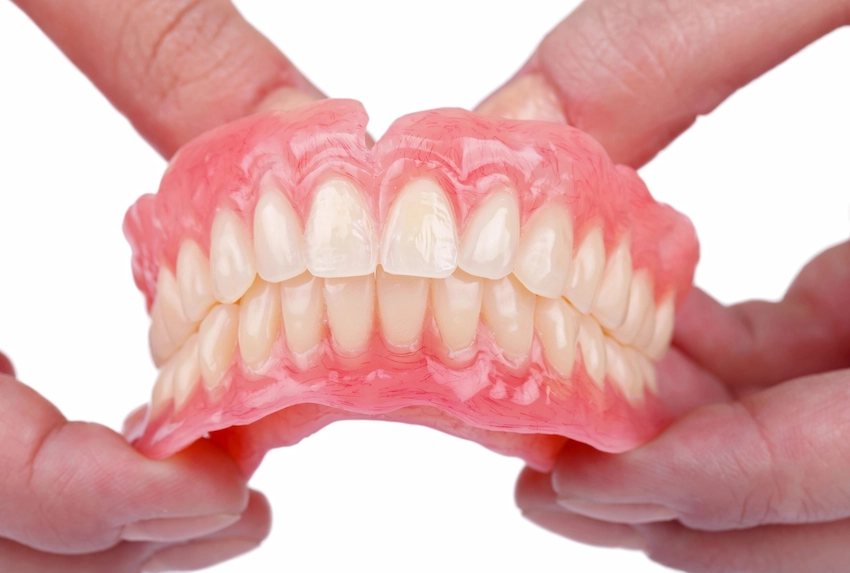
No matter how correctly you use it, a denture adhesive with time becomes an in adequate stop-gap for the gradual deterioration. The bone loss will just continue; a denture resting on it in the old-fashioned way is no help.
Dentists Polen Akkılıç and her clinical team in Lema Dental Clinic support a lot of worn patients who have come to the clinic to switch off from the daily, tedious, pasty routine; fixed, complete-arch restorations such as All-on-4 or All-on-6 implant systems are examples.
Placing titanium roots within the jawbone effectively prevents the degradation. We attach a fixed bridge to those roots. Such a bridge will operate as naturally as your real teeth. Moreover, the need for toothpaste has been eliminated.
Clinical Comparison: Denture Adhesives vs. Permanent Implants
| Feature | Removable Denture (with Denture Adhesive) | Fixed Zirconium Bridge (All-on-6 / All-on4) |
| Everyday Routine | Very time-consuming (clean, glue, etc.) | Simple (normal brushing and water flossing) |
| Eating Efficiency | About 30% of chewing is done by these devices | More powerful: up to 95% of what a human can chew |
| Effects on Bone | Speeds up the jawbone loss | Protects and saves jawbone volume |
| Toxicity Risk | Severe if you have been using a denture with paste made with Zn | None (biocompatible titanium and zirconia) |
| Feel and Taste | The denture covers the palate, which results in the loss of taste | Bare palate, full sensory experience |
Frequently Asked Questions
Doctor, is it okay to sleep with a denture held tightly by denture adhesive?
My recommendation is never to sleep with one’s denture. Your gums need to have a rest because if the dental appliance is left in place constantly,y the soft tissue underneath will get very sore. Not to mention that you will also not have time to remove any plaque, which will lead to fungal problems.
Three times a day is my usual denture adhesive dose,se and I just wonder if it’s really okay?
We would say that is an indicator that your denture should be looked at. Your denture adhesive has to be able to last an average of eight hours a day. When it wears off so fast, it means that your denture has gone so off track in shape that it no longer conforms to your jaw. It is time for you to seek professional assistance, not just use a glue!
I accidentally swallow a piece of a denture adhesive. Is doing that likely to cause a stomach problem?
A few milligrams of saliva-mixed denture adhesive can be a perfectly normal way of getting rid of some of the stuff,f which will be swallowed, ed as manufacturers consider the practice normal for safety. However, big chunks that are swallowed can definitely be a source of abdominal discomfort besides the zinc-related imbalances that are described above.
Are the denture powders safer to use when compared to the cream-like pastes?
Powder denture adhesives are not necessarily safer. However, powders can be applied in thin and even layers easily,y whereas creams are very tempting for one to accidentally overuse. So regardless of what type you use, the very first and foremost safety factor that you should consider is choosing a product free from zinc-containing ingredients.
How long is the transition time in Turkey from having my denture glued to having my fixed implant teeth?
In Lema Dental Clinic, we implement advanced digital planning. Through this technique, we can complete the operation and the temporary fixed bridge at the same time,e s aswe do these in several days. In addition, the first set of teeth you get with this method are the ones that you keep with you forever and do not let go of even for a bit of sleep or a meal. On the other hand, after a few months,s you get the final beautiful Zirconium teeth that have an aesthetic value on top,p which is the same as the natural teeth!
Academic References
- Davenport, J. C., Basker, R. M., Heath, J. R., & Ralph, J. P. (2000). The use of denture adhesives. British Dental Journal, 189(9), 468-472.
- De Visschere, L., Grooten, L., Theuniers, G., & Vanobbergen, J. (2006). Oral hygiene of elderly people in long-term care institutions—a cross-sectional study. Gerodontology, 23(4), 195-204.
- Nations, S. P., Boyer, P. J., Love, L. A., Burritt, M. F., Butz, J. A., Wolfe, G. I., … & Trivedi, J. R. (2008). Denture cream: an unusual source of excess zinc, leading to hypocupremia and neurologic disease. Neurology, 71(9), 639-643.
- Papadiochou, S., & Polyzois, G. (2015). Hygiene practices in removable prosthodontics: A systematic review. International Journal of Prosthodontics, 28(3), 228-240.
- Zhao, K. X., Karpac, J., & Lee, J. S. (2011). Zinc toxicity: A review of the literature and its relationship to denture adhesives. Journal of the American Dental Association, 142(7), 800-806.

