


Remove and clean your grillz every four hours to prevent bad breath.
Customized gold grillz truly make a statement and catch the eyes of many. They represent the pinnacle of individual dental opulence. However, what is usually left unsaid is that occasionally, beneath the gleaming metal, there could be a nasty smell. Medically, this problem is known as halitosis,s and it ranks among the most common effects of wearing removable dental jewelry.
In other words, placing a gold grill on your set of teeth is akin to sealing a living space in plastic. The saliva present in your mouth serves as the natural cleanser of your teeth and the neutralizer of acids. When a grill is worn, saliva is hindered from its cleaning action. The dark, sealed area becomes a perfect haven for harmful bacteria that lead to tooth decay is the bacteria that produce VSCs (volatile sulfur compounds), a type of gas that smells very unpleasant.
The Biology Behind “Grillz Breath”
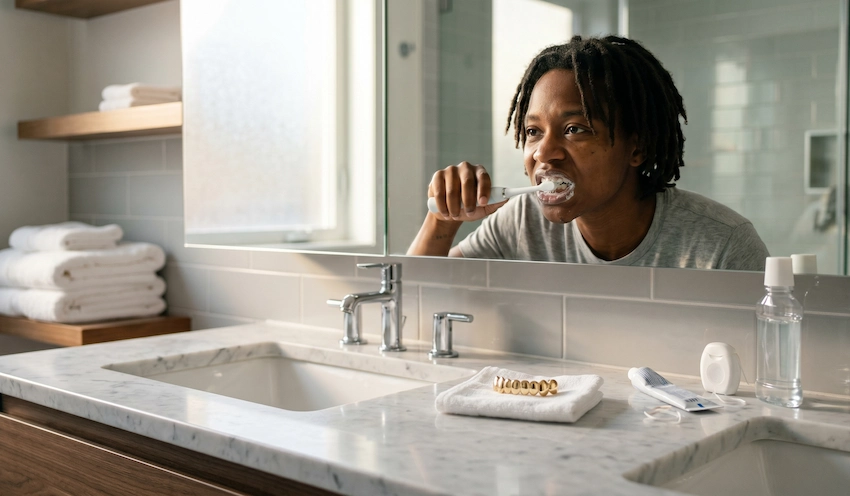
Doing away with the smell means working on the gums as well. Around every single tooth is a very small piece of gum tissue. The grill fits tightly, and so a small trap is created.
Professor Doctor Coşkun Yıldız frequently points out that the meta,l per,se is not the culprit for the odor. What really causes the smell are the food particles and dead cells that get trapped. Pure gold is extremely safe for the mouth. It neither rusts nor corrodes. But let us have a look at the fitting. Even a perfectly fitting custom grill will have a microscopic opening. This is enough for very small food particles and bacteria to get in, especially after eating or speaking.
Once this trap is left unattended, bacteria begin consuming the trapped food. As they do so, they emit hydrogen sulfide. The smell of this gas is identical to that of rotten eggs.
The Lema Dental Clinic Prevention Protocol
The main issue is: can we have a great time wearing gold teeth and yet have fresh breath? This is the reality we encounter at the clinic. Simply using mints is not characteristic of those with good breath. What they do is, they get rid of the bacteria every single day.
Dr. Polen Akkılıç and her team recommend a very strict cleaning schedule. We also share this same information with our international patients who come to Turkey specifically for high-end dental care:
- Temporary removal of the grill is necessary every four hours. After that, rinsing the jewelry and your mouth with fresh water is needed.
- Sound waves produced by an ultrasonic jewelry cleaner loosen the hidden bacteria that a normal toothbrush can not reach. This is because gold has minute pores that a normal toothbrush cannot reach. So, you need a small ultrasonic jewelry cleaner to ensure thorough cleaning.
- Flossing is even more necessary now. The gaps between the teeth are where the grill is held in place. These areas also hold the highest concentration of bacteria.
- Using an alcohol mouthwash is a big no as it dries your mouth and can make bad breath worse. Instead, use an oxygenating rinse, which is excellent at killing bad smells instantly.
Material Selection and Plaque Risks

Various metals behave differently in your mouth. One metal may encourage the growth of bacteria more than another one.
| Grill Material | Plaque Risk | Bacteria Trap Level | Cleaning Routine |
| High-Karat Gold (18k – 22k) | Low | Very Small | Brush twice daily. Ultrasonic wash once a week. |
| Low-Karat Gold (10k – 14k) | Medium | Average | Brush after wearing. Ultrasonic wash twice a week. |
| Base Metals | High | Large | Brush after every meal. Soak in a cleaner daily. |
| Diamond-Encrusted (Pave) | Extreme | Very Large | Professional ultrasonic cleaning daily. Water floss often. |
Frequently Asked Questions
Absolutely not. During sleep, your mouth produces much less saliva. If you keep the grill i, your mouth will be unable to clean it.
Use a clear, unflavored dental retainer soak. Never use bleach, household chemicals, or hot water. Harsh chemicals can damage the gold and alter how the grill fits your teeth.
The sulfur-like stench is the direct outcome of bacteria that are enclosed in the oxygen-deprived space of your teeth and the metal. Such a scent is an unmistakable caution. It indicates that you are doing a really bad job of cleaning your grill.
No. Doctors use strong dental cement to seal permanent gold crowns. These cement blocks keep bacteria from entering the gap. Removable grillz leave an open space. That open space constantly traps new food and bacteria.
Those who wear their grill daily should see a specialist every three months. Our center in Istanbul, Turkey,y uses professional ultrasonic tools to smooth out tiny scratches in the gold. This removes the hidden spots where bacteria live and resets the metal to a perfectly clean state.
- Al-Ahmad, A., Wunder, A., Auschill, T. M., May, M., Hellwig, E., & Arweiler, N. B. (2007). The in vivo dynamics of Streptococcus mutans and Streptococcus sanguinis in multispecies biofilms. Journal of Antimicrobial Chemotherapy, 60(4), 741-747.
- Cortelli, J. R., Barbosa, M. D. S., & Westphal, M. A. (2008). Halitosis: a review of associated factors and therapeutic approach. Brazilian Oral Research, 22(1), 44-54.
- Loesche, W. J., & Kazor, C. (2002). Microbiology and treatment of halitosis. Periodontology 2000, 28(1), 256-279.
- Quirynen, M., Zhao, H., & van Steenberghe, D. (2002). Review of the treatment strategies for oral malodour. Clinical Oral Investigations, 6(1), 1-10.
- Rosan, B., & Lamont, R. J. (2000). Dental plaque formation. Microbes and Infection, 2(13), 1599-1607.

