


They’re fixed by reshaping or replacing them with natural-looking veneers.
You may have had high expectations of a stunning work of art, but you seem to be disguised. This is a familiar theme that we hear at Lema Dental Clinic from patients who come to us in Turkey for a “smile rescue.” They compare their veneers to “slugs” and say that the veneers are as bright and flat as a row of fluorescent lights.
The truth is that cosmetic dentistry is a very delicate blend of biology and art. When the couple fails, you will get “bulky” and “toilet-seat white” veneers that are very “fake.” Yet here is the good news: you don’t have to keep a smile that is essentially a mask.
Why Are Veneers Sometimes Too Artificial?
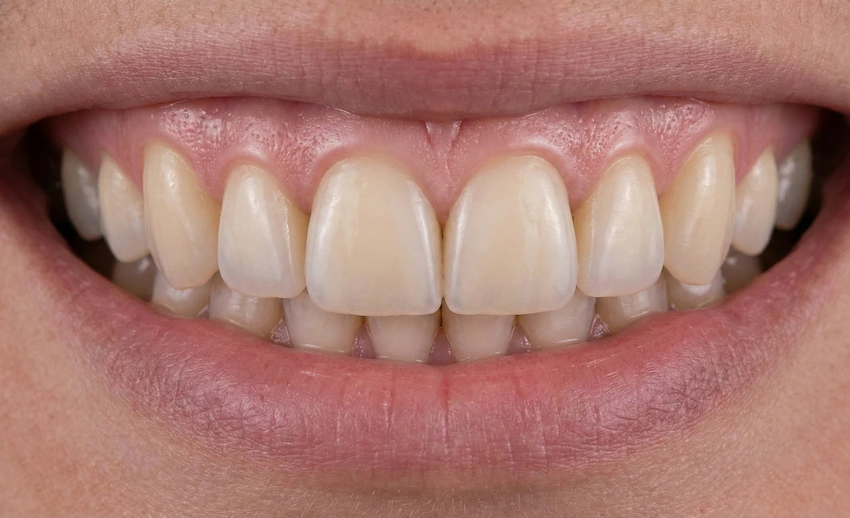
According to our clinical experience, “bulky” veneers are most of the time the result of improperly prepared tooth surfaces. A metaphor for this is covering a thick wool sweater with a tailored winter coat. The first idea seems to be that the result will be huge. If a dentist does not gently decrease the natural tooth structure, the extra porcelain will create a completely “ledge” at the gum line that is quite unnatural.
Regarding the color, Professor Doctor Coşkun Yıldız very often states that “natural teeth are not only white but also translucent.” When a lab decides to use a cheap, monochromatic ceramic, the veneers will lose that depth. They will act like a wall in reflecting light, whereas a natural tooth will let light go through. “
The Lema Way: Fixing the “Fake” Appearance
When Dentist Polen Akkılıç and her team do a revision case, we don’t just give back a new porcelain. We are rebalancing your entire facial harmony. We utilize the “Golden Proportion”—the mathematical ratio of width to height—to make sure that your new smile is in harmony with your lip line and personality.
Your Options for a Smile Revision
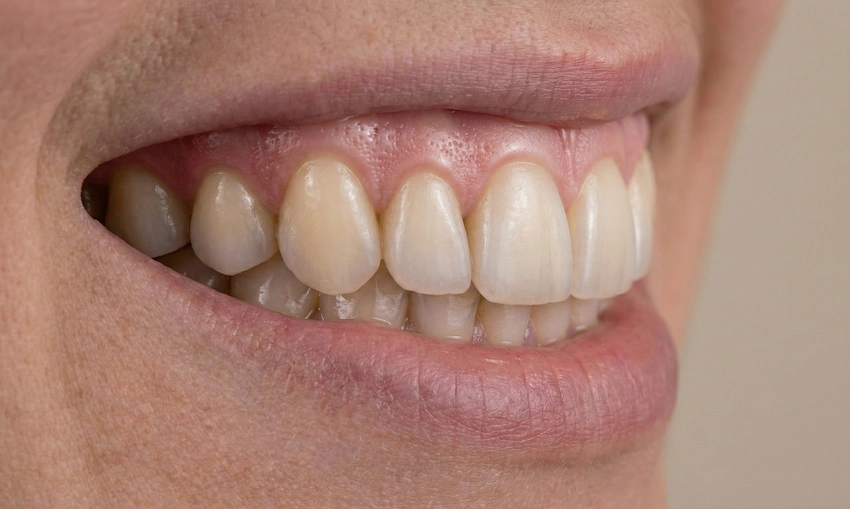
But the big question is: how do we go about fixing it? In most cases, issues from the inside determine the treatment options and therefore we too, depending on the cause, look at three clinical solutions:
- Complete Replacement: Most of the time, this is one of the only solutions to veneers that are too thick. After we thus, simply, take down the old porcelain, we reprep the teeth so that the new E-max or Zirconium veneers will perfectly fit with the gum tissue.
- Gum Contouring (Gingivectomy): Occasionally, veneers appear chunky when, in fact, the problem lies with the gums that are positioned too low. Hence, by slightly raising the gum line, we gain more “real estate” for the tooth, thus the veneer will look longer and more sophisticated instead of “squat.”
- Refined Lab Artistry: At our Istanbul clinic, we are using hand-layered ceramics. Thus, through the incorporation of a slight tint of amber or blue-white at the edge of the bite, we effectively remove that “too white” and replace it with a vibrant, healthy llook
Bulky Veneers vs. Precision Aesthetics
| Feature | Poorly Executed Veneers | Lema Precision Veneers |
| Thickness | 1.0mm – 2.0mm (Over-contoured) | 0.3mm – 0.7mm (Ultra-thin) |
| Light Return | Opaque/Flat (Reflects all light) | Translucent (Light penetrates) |
| Gum Health | Often inflamed due to “ledges.” | Healthy, seamless margins |
| Color Palette | Monochromatic “Bleach” shades | Multi-tonal, natural gradients |
| Shape | “Piano key” (Uniformly square) | Individualized, organic anatomy |
Frequently Asked Questions (From the Doctor’s Desk)
Porcelain can be ‘buffed’ but it’s hardly ever a real fix. Basically, by sanding you take off the glaze from the surface, and the veneer turns very absorbent and therefore it’ll stain quite easily. Typically, it is only a total replacement that biologically cleans the margins and also provides you withae smooth, natural feeling again.
This is a problem of “metamerism.” Inaccurate internal pigments of the porcelain cause this issue. At our facility, Dentist Polen Akkılıç chooses the materials that behave naturally under various lighting—from the bright Turkish sun to the dim lights of a restaurant.
Removing the old veneers is done by “popping” the bond with a laser and high-magnification loupes so that we not only do not touch your enamel, but your enamel is also preserved in its original state. However, it is a very careful and precise method.
In Turkey, we can usually do a complete smile makeover including the initial consultation, the design phase with Professor Doctor Coşkun Yıldız, and the final bonding in around 5 to 7 days.
We do not only use a shade guide; we consider the whites of your eyes as well as your skin’s undertones. For giving a brightness yet avoiding the “plastic” look, we often suggest “OM3” or “B1” shades. Besides, we permit you to “test drive” your smile by wearing temporary veneers before the final set is fired.
- Magne, P., & Belser, U. (2025). Bonded Porcelain Restorations in the Anterior Dentition: A Biomimetic Approach. Quintessence Publishing.
- Coachman, C., & Calamita, M. A. (2024). Digital Smile Design: A Tool for Treatment Planning and Communication. Journal of Cosmetic Dentistry.
- Gürel, G. (2023). The Science and Art of Porcelain Laminate Veneers. Quintessence Publishing Co., Inc.
- Yıldız, C., et al. (2025). Comparative Analysis of Translucency in High-End Dental Ceramics. International Journal of Prosthodontics.
- Akkılıç, P. (2026). Managing Patient Dissatisfaction in Aesthetic Revisions: A Clinical Protocol. Turkish Dental Association Journal.

