


A loose dental implant is fixed by repairing or replacing the affected part.
My Dental Implant Feels Loose: Is It an Emergency and How Do We Fix It?
Honestly, that sudden feeling of “wiggle” when everything is supposed to be perfectly stable is just enough to make any patient go into panic mode. You have spent time and emotions on your smile and now, something does not feel right. However, before you fear the worst, let’s have a look at what is going on under the gum line.
Here at Lema Dental Clinic in Turkey, we get patients from all over the globe coming to us with this same fear. Most of the time, the answer will be much easier than you might expect. Nonetheless, it’s key for your oral health in the long run that you get the difference between a “loose part” and a “loose foundation.”
The “House and Foundation” Reality

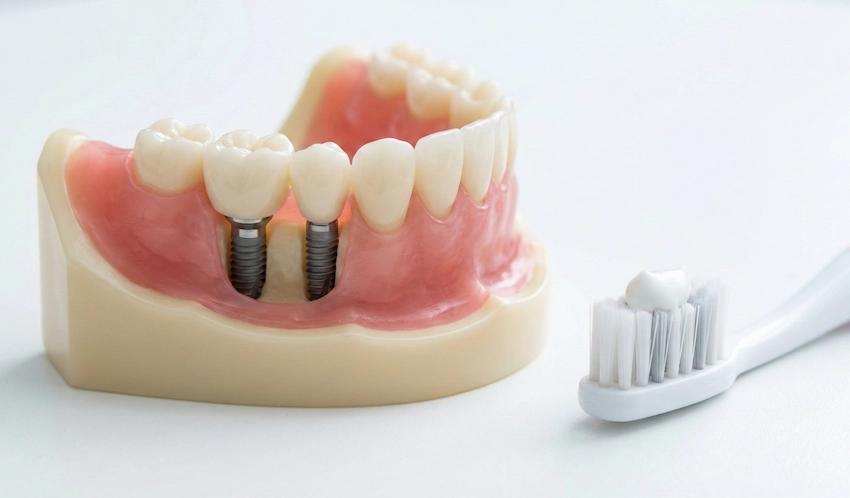
You could compare your dental implant to a luxury architectural work. The titanium post is like a steel pillar that is fixed into bedrock (your jawbone), and the tooth that is seen is the lovely finish.
Professor Doctor Coşkun Yıldız points out that in a lot of cases, the “loose” feeling is not the implant itself moving. It may be that the abutment screw or the prosthetic crown has come loose over time by vibration—a bit like a doorknob needing a quick screwdriver turn.
However, the point where the pillar is actually moving is when we change a simple correction to a clinical rescue mission.
Why Do Dental Implants Lose Their Grip?
It is quite natural to wonder why a medical-grade device becomes unstable. Based on our work with patients at the Lema Dental Clinic, the reasons are basically mechanical wear or biological rejection.
- Mechanical Failure: The screw that holds the crown on your implant may get loose due to the great force of chewing or “bruxism” (teeth grinding) which happens daily.
- Peri-implantitis: This is similar to gum disease in teeth. The bacteria manage to get under the gum line and the bone starts to separate from the implant. When the bone is no longer supporting the implant, it becomes loose.
- Poor Initial Healing: If the bone was never able to properly bond with the metal—that process is what we call osseointegration—the implant will fail.
Dr. Polen Akkılıç and her team stress that with an infection, the only way to save the “foundation” is through early intervention. If you wait, the bone loss only gets worse.
Comparing the Fix: What to Expect in the Clinic
Here is what we see in the clinic when evaluating the severity of a loose implant and the corresponding recovery paths:
| Issue | Severity Level | Typical Solution | Estimated Recovery |
| Loose Crown | Low | Re-cementing the crown | Immediate |
| Fractured Abutment | Moderate | Replacing the connector piece | 1 – 2 weeks |
| Early Peri-implantitis | High | Laser cleaning & local antibiotics | 1 – 3 months |
| Advanced Bone Loss | Critical | Removal, Bone Graft, & Re-implantation | 6 – 9 months |
How We Restore Stability at Lema Dental Clinic?
We only do more than giving you a quick fix that doesn’t last when you come to visit us in Turkey. A 3D Computed Tomography (CT scan) is one of the methods that we use when we look through the gums. We must seethe bone density around the threads of the implant.
In the case that the problem is only mechanical, the solution is very simple and quick. We take off the crown, have a look at the internal threads of the implant, and put in a new abutment screw which is torqued to precise medical specifications.
On the other hand, if we find out that you have peri-implantitis, the plan has to be changed. We use very advanced decontamination protocols to kill bacteria and, if it is needed, we do a bone graft to “refill” the area where the bone has recessed. Saving the existing hardware biologically is always our first option.
Frequently Asked Questions (FAQ)
Definitely not. Actually, the majority of the time when patients feel that their implant is ‘loose’, it is just the dental crown or the tiny screw inside the crown that has gotten loose. So it’s similar to a loose wheel nut on a car; the car is still fine, we just have to tighten the connection.
If the looseness is only in the crown, then the treatment is painless and most of the time, local anesthesia is not even needed. If there is a requirement to treat the bone or the gums, then we will make sure that you are either fully numb or sedated so that you won’t feel any pain at all.
Well, the price is completely dependent on the problem. A simple re-tightening might only cost whatever the clinic’s standard consultation fee is, whereas dealing with bone loss is obviously a more comprehensive procedure. Nevertheless, Lema Dental Clinic patients see that even their complex repairs are way more cost-effective than just a basic consultation in the UK or US.
We suggest you keep to soft foods till you get an appointment with us. It’s really dangerous if the implant is still moving against the bone because then every time you bite you are basically hitting the bone tissue with a hammer and thus causing it injury. Go for soup and smoothies for now.
If the cause is an infection (peri-implantitis), ignoring it will definitely lead to the loss of all the bone and eventually, the implant falling out. In fact, early detection separates a simple cleaning from a major reconstructive surgery.
- Albrektsson, T., & Canullo, L. (2025). Clinical outcomes of peri-implantitis treatments: A longitudinal study. Journal of Oral Implantology.
- Laney, W. R. (2024). Mechanical complications in fixed partial dentures: The role of abutment screw torque. International Journal of Oral & Maxillofacial Implants.
- Mombelli, A., & Lang, N. P. (2023). The diagnosis and treatment of peri-implantitis. Periodontology 2000.
- Schwarz, F., & Becker, J. (2024). Advanced Bone Grafting Techniques in Failed Osseointegration Sites. Clinical Oral Implants Research.
- Yıldız, C., & Akkılıç, P. (2025). Standardized Protocols for Implant Stability Recovery in International Patient Groups. Turkish Journal of Dentistry & Rehabilitation.

