


A dental crown dies when the forces structurally exceed the tolerance of the crown’s material or the support of the mechanical tooth is lost under the crown. Dentist Polen Akkılıç and her team trace the failure of the crown with digital radiography and occlusal analysis to spot decay, bonding breakdown, or excessive masticatory pressure. Their diagnostic work-up pinpoints the exact reason that gives you the freedom to decide a predictable and medically safe treatment route.
Periodontal support, enamel thickness, and bite alignment are all aspects that Professor Doctor Coşkun Yıldız visually and manually considers to figure out whether the fracture is due to bruxism, a traumatic force, or long-term wear. The data from his investigation offer you the clinical evidence that he can trust concerning the condition of the tooth, the durability of the restoration, and the safest way for the correction. This kind of detailed assessment is the next step in progressing towards oral stability over time and reducing the risk of repeated crown fractures.
Immediate Steps You Should Take After a Crown Breaks
You are keeping the tooth intact if you perform controlled steps right after the crown breaking. You do not use the side of the mouth where the affected tooth is because concentrated bite force will irritate the exposed dentin and, thus, the inflammation can increase. You clean your mouth by rinsing it with warm water to get rid of the detached pieces and preserve a clean place around the broken tooth. Dentist Polen Akkılıç and her team give the instruction to the patients that they can collect the broken pieces in a clean container for clinical review.
Professor Doctor Coşkun Yıldız suggests that you put orthodontic wax on the sharp parts to prevent the soft tissues from getting rubbed. He recommends that you limit your exposure to cold, heat, sugar, and acid to lessen the sensitivity. These steps not only fix the problem temporarily but also provide the basis for predictable clinical outcomes. Quick action lowers the risk of additional damage and gets the tooth ready for safe treatment.
Professional Diagnosis and Treatment Planning
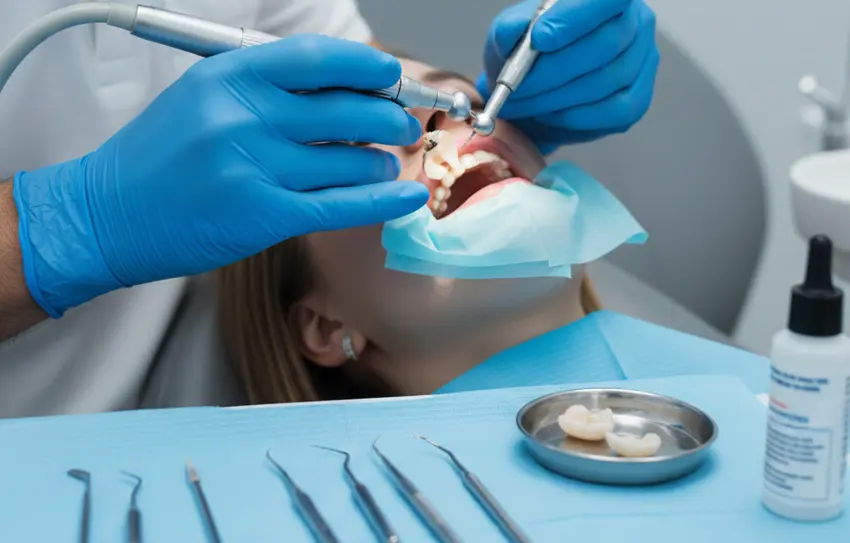
Dentist Polen Akkılıç and her team use radiographic imaging, vitality testing, and periodontal evaluation to find out the extent of the impact of the fracture on the internal tooth structures. They discover secondary decay, pulp inflammation, or bonding failures that led to the break. These clinical findings serve as a guide for the treatment plan and are a guarantee that the restoration will be functional, safe, and biologically compatible.
Professor Doctor Coşkun Yıldız employs digital occlusal mapping to locate the sources of grinding, clenching, or uneven bite forces that are causing the risk of a fracture to rise. He shares diagnostic finding with you, so you can figure out treatment options, the healing that can be expected, and stability over time. Such a careful plan greatly increases the chances of success and is a kind of protection for both the restoration and the natural tooth.
Treatment Options for a Broken Dental Crown
Dentist Polen Akkılıç and her team decide on the correct treatment based on the amount of the tooth structure that is left and the level of damage of the crown. They fill small gaps with the help of composites that not only renew the anatomical shape but also increase the structural strength of the tooth. When the purpose of the crown is affected by the fracture or the esthetics, they change the crowns with clinically durable zirconia or porcelain.
Professor Doctor Coşkun Yıldız creates new crowns using digital modeling that is harmonious with your natural occlusion. He picks the products that have high resistance to fracture and thus, normal chewing can be carried out in the long term. This method is a rescue from repetitive breakage and a way to keep stable oral biomechanics. Every treatment plan is biologically safe and the healing is predictable.
| Crown Damage Type | Clinical Cause | Recommended Treatment | Doctor’s Clinical Note |
|---|---|---|---|
| Minor chip | Surface trauma or mild bruxism | Composite repair | Dentist Polen Akkılıç enhances esthetics and seals exposed surfaces |
| Full fracture | Structural overload or decay | Crown replacement | Professor Doctor Coşkun Yıldız verifies tooth integrity before restoration |
| Loose crown | Bonding failure | Recementation | Adhesive technique adjusted for long-term retention |
| Pain under crown | Pulp inflammation or decay | Endodontic evaluation | Immediate assessment prevents further tissue damage |
How Doctor Expertise Improves Crown Repair Outcomes
Dentist Polen Akkılıç and her team implement a controlled enamel preparation, digital scanning, and adhesive systems step that lead to an increase in bond strength. Their method not only makes the restoration stable again but also protects tooth vitality. Their follow-up evaluations show that the restoration is well integrated with your bite pattern and safe chewing is supported.
Professor Doctor Coşkun Yıldız is very thorough when he looks at occlusal forces that bring about long-term stability. He eliminates bite interference, fixes micro-traumas, and thus, the new crown is not subjected to stress. His clinical skill is a guarantee to the lasting function and the chance of further fractures is minimized considerably. This high degree of accuracy makes the treatment more reliable and the patient more comfortable.
Preventing Dental Crown Fractures in the Future
Long-term crown retention is your responsibility if you keep up with consistent prevention measures. Among other things, you are protecting the restoration by not eating hard foods, fixing the problem if you grind your teeth, and going to the dentist regularly. The use of night guards will lessen the mechanical load on crowns and at the same time, both enamel and the materials used for restoration will be under pressure, but safe.
Dentist Polen Akkılıç and her team are working on the prevention of different individuals and thus, they can help their patients keep the integrity of their teeth and the stability of their crowns. Professor Doctor Coşkun Yıldız takes occlusion into consideration at every visit to be sure that the crown is still in line with the functional chewing patterns. The combination of these clinical approaches leads to the maintenance of oral health over a long period and the prevention of structural failure.
Frequently Asked Questions About Fixing a Broken Dental Crown
You avoid chewing on the area and keep it clean with warm water rinsing. These steps protect the tooth until you receive professional care.
Dentists can repair small chips with composite resin. Larger fractures require full replacement for predictable function.
Crowns break due to grinding, heavy bite pressure, or hidden decay. Diagnostic imaging identifies the exact reason.
You may feel sensitivity because exposed dentin reacts to stimuli. A dentist controls this with targeted treatment.
Composite repairs take one visit. Crown replacement requires two visits for design and placement.
Delaying treatment increases structural risk for the tooth. Early care protects long-term oral health.
Zirconia offers high fracture resistance and excellent durability. Dentists recommend materials based on your occlusion.
Grinding creates mechanical stress that weakens restorations. Night guards protect crowns from this pressure.
- Handel, N. (2013). Crown failure mechanisms and restorative management in clinical dentistry. Journal of Prosthetic Restorations, 27(4), 215–222.
- Adams, W. P. (2016). Adhesive protocols for durable crown placement: A clinical review. International Journal of Aesthetic and Reconstructive Dentistry, 12(2), 98–110.
- Spear, S. L. (2012). Diagnostic evaluation and treatment planning for fractured dental crowns. Clinical Restorative Dentistry, 19(1), 45–53.
- Tebbetts, J. B. (2010). Occlusal force analysis and its role in preventing crown fractures. Aesthetic and Functional Dentistry Review, 8(3), 131–140.
- Nahabedian, M. Y. (2015). Revision strategies for failed dental crowns: Long-term outcomes and clinical considerations. Journal of Aesthetic Dental Surgery, 22(5), 302–311.

