


The key to dental longevity.
A dental bridge is a masterpiece of restorative engineering. It restores your smile and your ability to chew, but it also creates a unique architectural problem in the mouth. Unlike a natural tooth, which stands alone, a bridge consists of “pontics” (artificial teeth) that sit just above the gumline, held in place by “abutments” (crowned teeth).
The reality is that this design creates a small gap—a tiny tunnel between the artificial tooth and your gums. In our clinical experience at Lema Dental Clinic, we find that while the top of the bridge looks sparkling clean, the area underneath can become a “trap” for food particles and plaque. Professor Doctor Coşkun Yıldız often reminds our patients in Istanbul that if you ignore this hidden space, the very teeth supporting your bridge could fall victim to decay.
Why a Standard Toothbrush Isn’t Enough
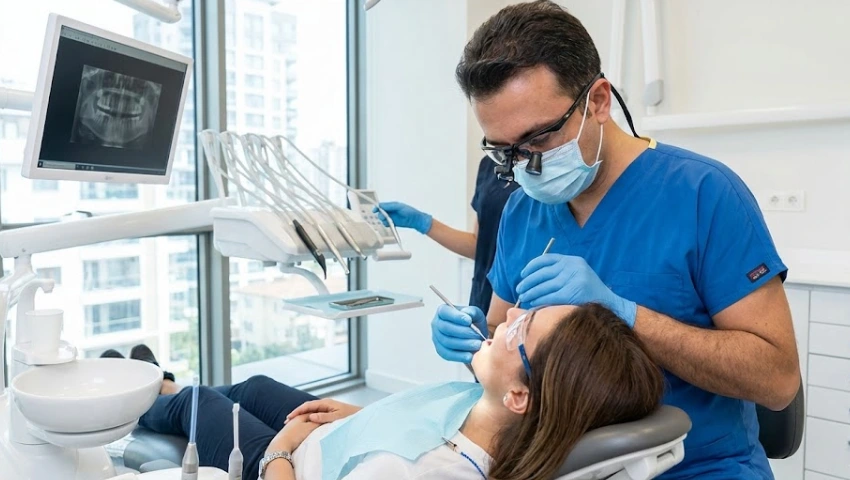
Think of your dental bridge like a pier built over a river. You can scrub the top of the wooden planks all day, but the debris and barnacles accumulate on the pillars underwater. A regular toothbrush simply cannot reach the “underside” of the bridge.
When food stays trapped, it begins to ferment. This leads to what we often call “bridge breath”—a persistent bad odor that mouthwash can’t fix. But let’s look closer at the biological risk: the bacteria produced by trapped food can cause the gums to pull away, eventually reaching the roots of the anchor teeth. Once those anchor teeth are compromised, the entire bridge fails.
The Essential Toolkit for Bridge Maintenance
At Lema Dental Clinic, Dentist Polen Akkılıç and her team teach our international patients a specific set of maneuvers to keep their restorations pristine. You don’t need a medical degree to do it, but you do need the right tools.
- Superfloss: This is a specialized floss with a stiff end (the “threader”), a fuzzy middle, and regular floss at the end. You “sew” the stiff end under the bridge and use the fuzzy part to sweep away debris.
- Interproximal Brushes: These look like tiny “bottle brushes” for your teeth. They are incredibly effective at sliding into the gaps at the base of the bridge where a toothbrush can’t reach.
- Water Flossers: If you find manual flossing difficult, a water flosser is a game-changer. It uses a targeted stream of pressurized water to “power wash” the underside of the pontic.
Bridge Cleaning Tools: Efficiency Comparison
| Tool | Ease of Use | Effectiveness | Best For |
| Superfloss | Moderate (Requires practice) | High | Deep cleaning under the pontic. |
| Water Flosser | High (Very intuitive) | Very High | Removing loose food and massaging gums. |
| Interproximal Brush | High | High | Cleaning the sides of the anchor teeth. |
| Standard Floss | Low | Low | Useless under a bridge without a threader. |
| Mouthwash | Very High | Low | Freshening breath, but won’t remove debris. |
Expert Perspectives: 5 Tips for a Healthy Restoration
Initially, yes,” says Professor Doctor Coşkun Yıldız. “If you haven’t been cleaning that area, the gums become inflamed. It’s like a minor infection. After about a week of consistent cleaning at our clinic in Turkey, the bleeding usually stops as the tissue heals.
The question remains one of consistency,” explains Dentist Polen Akkılıç. “You should clean under your bridge at least once a day, preferably before bed. If you leave food there overnight, you’re essentially giving bacteria an eight-hour head start.
Sometimes bridges are fitted too tightly against the gum or ‘over-cemented,'” notes the team. “If you can’t get superfloss through, don’t force it. Visit us at Lema Dental Clinic so we can check if the fit needs a professional adjustment.
In the case of bridges, a water flosser is excellent, but it’s even better when combined with an interproximal brush,” the team suggests. “The brush provides ‘mechanical scrubbing’ that water alone sometimes misses.
This is a common fear,” says Professor Doctor Coşkun Yıldız. “A professionally seated bridge in Turkey is held by medical-grade cement. Flossing or using a water flosser will not loosen it; in fact, it protects the bridge by keeping the supporting teeth healthy
- Pader, M. (2012). Oral Hygiene Products and Practice. Cosmetic Science and Technology Series.
- Claydon, N. C. (2008). Current concepts in toothbrushing and interdental cleaning. Periodontology 2000, 48(1), 10-22.
- Rosema, N. A., et al. (2011). The effect of a water flosser on plaque removal and gingival health. Journal of International Academy of Periodontology.
- Shillingburg, H. T., et al. (2012). Fundamentals of Fixed Prosthodontics. Quintessence Publishing.
- Zarb, G. A., & Hobkirk, J. (2012). Prosthodontic Treatment for Edentulous Patients. Elsevier.

