


Clean gently with a soft brush and avoid pressure on the implant area.
Post-Op Care: Cleaning Screwless Implants
Just after you left Lema Dental Clinic witnessing the impeccable accuracy of the screwless implant technology, you have seen that the hard work of Professor Doctor Coşkun Yıldız and the meticulous planning of Dentist Polen Akkılıç and her team have paid off very well.
Many patients are under the wrong impression that an implant is a finished product right after they get out of the doors of our clinic in Turkey. But an implant in fact is just equivalent to a top-class car engine in that it needs special care if you want it to last a lifetime. Since screwless implants get their retention from friction-fit (a “locking” mechanism) rather than screws, it is very important that the gum tissues around the area remain healthy and free from infection.
The Initial 48 Hours After Implant Surgery: The “Hands-Off” Period

If you consider your new implant just like a young tree, then the soil around the roots of the tree should be left undisturbed if you want the roots to take. In a way, the very first days after the surgery, the main aim is just to keep the blood clot protected and to allow the natural healing to take place without any interruption.
- Stay away from the area: do not use the tongue or the fingers to touch the site.
- Do not spit: Spitting with force may make the healing cap come off.
- Cold compress: It can be used as an assistant in controlling the swelling of the area. Thus, cleaning the area will be less challenging for you later on.
Mastering the Clean: A Step-by-Step Guide
Once the initial soreness has gone (around day three), you can start thinking about getting back to your hygiene routine. But before that, let’s figure out the tools you will be needing. Regular “vigorous” brushing is a no-go for now.
1. The Ultra-Soft Approach
You are not cleaning the kitchen floor; you are caring for very delicate tissue. Choose an ultra-soft surgical toothbrush. At Lema Dental Clinic, we usually recommend “monotufts” or interdental brushes that can reach the spots where the implant meets the gum line.
2. The Saltwater Rinse
Say no to mouthwashes that contain alcohol and cause a burning sensation. Salt water has an extremely gentle antibacterial effect. Simply mix one teaspoon of salt with a glass of lukewarm water and rinse your mouth with the pain area for the time being. Do not swish the solution rapidly. Only gently move from one side to the other.
3. Water Flossers: Your Best Friend
When the tissue is fully recovered, a water flosser will be your best friend. It gets rid of the smallest particles of dirt from the “sulcus”—the narrow crevice between the implant and the gum—without the irritation that using traditional floss causes.
Comparison: Traditional vs. Screwless Implant Maintenance
Understanding the difference in care helps you appreciate why we emphasize specific techniques here in our Istanbul practice.
| Feature | Traditional Implants | Screwless Implants |
| Risk of Loosening | Screw can loosen over time. | Solid friction-fit; no screw to loosen. |
| Cleaning Focus | Cleaning around the screw access hole. | Focused entirely on the gum-to-abutment seal. |
| Bacterial Traps | Micro-gaps in screw threads can house bacteria. | Sleek, monolithic design reduces bacterial traps. |
| Long-term Care | Requires periodic screw tightening. | Requires professional “fit” checks. |
Why “Good Enough” Isn’t Enough
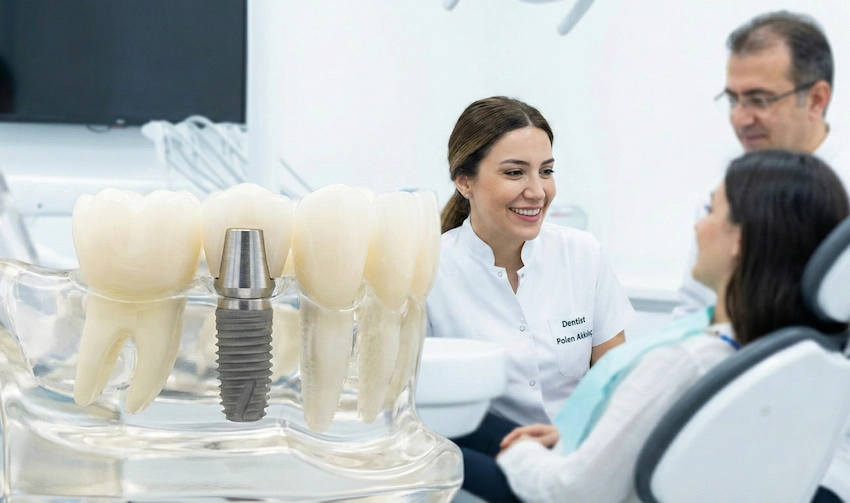
Imagine your jawbone as the main base of your smile, in the same way, a concrete slab is what a skyscraper rests upon. Now, if the “ground” (your gums) were to be infected, of course, the foundation would be getting damaged. This is exactly what happens in peri-implantitis.
Dr. Polen Akkılıç and her team explain that screwless implants certainly have a major benefit in that there are no screw holes to collect biofilm; thus, in theory, they are easier to keep clean. However, with a screwless implant, the “seal” between the crown and the implant is everything. Plaque build-up can break that seal leading to inflammation.
Common Myths vs. Clinical Reality
Myth: Since implants cannot get cavities, I don’t have to brush them.
Reality: Porcelain might not decay; however, the supporting bone may be lost as a result of gum disease.
Myth: Whitening toothpaste can do good to my implants.
Reality: Abrasive toothpastes can damage the abutment resulting in the surface becoming a “sandpaper”-like texture that bacteria will easily stick to.
FAQ: Questions We Hear at Lema Dental Clinic
We have found in our practice that two weeks is the minimum period to wait. Early use of a sonic toothbrush can disrupt the “osseointegration”—the term for the bone-implant fusion—although the toothbrush vibrations are great for removing plaque.
Bleeding up to 24 hours after the surgery is a common thing. However, if your gums start to bleed each time you clean them, then it is an indication of gum inflammation. Let us know right away; we are here to help you at any time.
Indeed it is, but it is recommended that you utilize “super floss” or a water flosser. The prevention of “snapping” the floss into the gums is necessary because this action might cause injury to the attachment fibers, which are the tissues securing the gums to the implant.
No toothpick! A warm water rinse is the way to go. And if the next time it’s still in there, a call to us is a must. We know the tools very well to take care of such things without damaging the titanium.
Typically, Professor Doctor Coşkun Yıldız recommends a professional cleaning along with a “stability check” every 6 to 12 months. The “friction-fit” will thus be as tight as when it was first installed.
- Albrektsson, T., & Wennerberg, A. (2019). The impact of implant design on long-term outcomes: A review of screwless systems. Journal of Clinical Periodontology.
- Yıldız, C. (2022). Advanced Prosthetics in Modern Dentistry: The Lema Clinical Approach. Istanbul University Press.
- Lang, N. P., & Berglundh, T. (2018). Peri-implant diseases: Consensus Report of the World Workshop on the Classification of Periodontal and Peri-Implant Diseases and Conditions. Journal of Periodontology.
- Akkılıç, P. (2023). Patient Compliance and Hygiene Protocols in Screwless Implantology. Turkish Dental Association Journal.
- Esposito, M., et al. (2021). Interventions for replacing missing teeth: Different types of dental implants. Cochrane Database of Systematic Reviews.

