


Daily hygiene for full arch success.
Investing in full mouth dental implants can completely change your life. On the other hand, how long you can enjoy this restoration depends largely on whether you can effectively control biofilm formation and avoid the harmful effects of mechanical stress. Professor Doctor Coşkun Yıldız points out that implants themselves do not get cavities, but the soft tissue around them can still get inflamed. At Lema Dental Clinic, the main point in our treatment plan for patients in Turkey is the preservation of the fragile “mucosal seal” that acts as a barrier for the bone underneath.
A thorough daily oral-care protocol
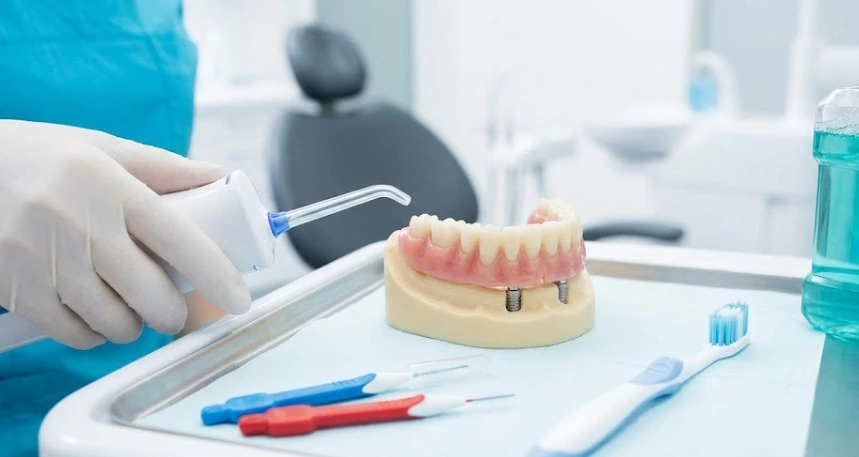
The regular brushing that you do is not enough if you have full arch bridges (like All-on-4 or All-on-6). Besides, Dentist Polen Akkılıç and her team encourage us to practice daily hygiene with a multi-layered routine:
- Oral Irrigators (Water Flossers): Apparently, it is the gold standard for a full mouth care. High-pressure jets of water are very effective in removing the food particles hidden in the tiny perspirational space between the prosthetic bridge and the gum line.
- Interproximal Brushing: Try to follow the brush hold method with small, plastic-coated, interdental brushes for cleaning the abutment areas. Remember, you mustn’t use metal-core brushes in this case, for they will scratch the titanium surface and cause microscopic grooves that will become bacteria-laden spots.
- Non-Abrasive Dentifrice: Go for a toothpaste brand that has a low-RDA (Relative Dentin Abrasivity). If you use one with a lot of abrasive ingredients, it will not be long before the zirconia or porcelain crowns lose their sheen.
- Antimicrobial Rinses: Try to find alcohol-free therapeutic mouthwashes that inhibit the growth of certain germs while at the same time supporting the indigenous microorganisms without drying out the mucosal tissues.
Professional post-operative care for foreign implant recipients
Once it is time for you to leave Turkey, you will have to keep your implants in good condition by getting regular cleanings with a local hygienist who knows about implantology. Here are the details of what the doctor advised:
- Specialized Debridement: The use of carbon fiber or ultrasonic tips to remove plaque and tartar around the implant should be the standard of care in professional cleanings so that no damage is done to the prosthetic.
- Occlusal Evaluation: Checking your bite is something that should be done every 6 to 12 months. Just as the natural teeth change position over time, the prosthetic can get “high spots” which will eventually cause wear and tear on the restoration or loosening of the fixation screws.
- Radiographic Monitoring: Taking X-rays from time to time will give your clinicians, wherever they may be (at Lema Dental Clinic or with your local provider), the ability to see the level of marginal bone and thus diagnose the problem even before it has manifested clinically.
Maintenance Checklist: Daily vs. Professional Care
| Task | Frequency | Objective |
| Water Flossing | Twice Daily | Remove sub-bridge debris |
| Interproximal Brushing | Daily | Abutment biofilm control |
| Soft Tissue Massage | Daily | Stimulate gingival blood flow |
| Professional Cleaning | Every 6 Months | Deep debridement & scaling |
| Screw Torque Check | Every 12-18 Months | Ensure mechanical stability |
FAQ: Clinical Realities of Full Mouth Care
Yes, but with a soft-bristle head. Dentist Polen Akkılıç and her team advise using the electric brush at a lower intensity setting around the gum line to avoid irritating the peri-implant mucosa.
Smoking is the leading cause of late-stage failure. It impairs blood flow and slows down the immune response in the gums. Patients visiting Turkey are strongly encouraged to switch to nicotine-free alternatives to protect their investment.
This is often a sign that a prosthetic screw needs re-tightening (re-torquing). Do not ignore this. Contact Lema Dental Clinic or a local specialist immediately to prevent damage to the implant platforms.
Absolutely. The goal of cleaning is not just for the “teeth” but to prevent peri-implantitis, which can lead to bone loss and the eventual loss of the entire implant system.
The principles are the same, but All-on-6 provides more support points, which can sometimes make flossing slightly more detailed. Regardless of the “X” number, the water flosser remains your most important tool in Turkey and beyond.
- Humphrey, S. (2006). Implant Maintenance: A Guide for the Dental Hygienist.
- Misch, C. E. (2007). Contemporary Implant Dentistry. Elsevier Health Sciences.
- Gulati, M., et al. (2014). Implant maintenance: Role of dental hygienist. Journal of Clinical and Diagnostic Research.

