


The 22-Hour Aligner Rule: Timing Your New Smile.
It is perhaps the most common question we encounter during the initial consultation at Lema Dental Clinic in Turkey. Patients are often excited about the discreet nature of clear aligners, but that excitement is sometimes met with a bit of “compliance shock” when we mention the 22-hour rule.
The reality is that clear aligners are not a “part-time” commitment. Unlike traditional braces, which are physically glued to your teeth and work 24/7, aligners give you the freedom to take them out. However, that freedom is a double-edged sword. Professor Doctor Coşkun Yıldız often notes that the biological success of orthodontic movement depends entirely on a concept called “continuous light force.”
The “Tug-of-War” Metaphor: Why 22 Hours is the Magic Number
To understand why you need to wear your aligners for nearly the entire day, think of your teeth as being held in place by thousands of tiny, elastic bungee cords (the periodontal ligaments). Moving a tooth is like trying to win a tug-of-war against those cords.
When you wear your aligners, you are pulling the tooth toward its new, ideal position. But the moment you take the aligner out to eat or drink, those “bungee cords” start pulling the tooth back toward its original, crooked home. If you leave the aligners out for too long, you aren’t just pausing your progress; you are actively losing ground.
The Biological “Reset” Button
In our clinical experience at Lema Dental Clinic, we see that the bone around the tooth root needs constant pressure to “remodel” itself. This remodeling is like guiding a growing vine along a trellis. If you remove the trellis for six hours a day, the vine begins to droop and grow in the wrong direction. Dentist Polen Akkılıç and her team emphasize that wearing aligners for only 16 or 18 hours creates a “rollercoaster” of movement that can actually lead to root resorption or stagnant progress.
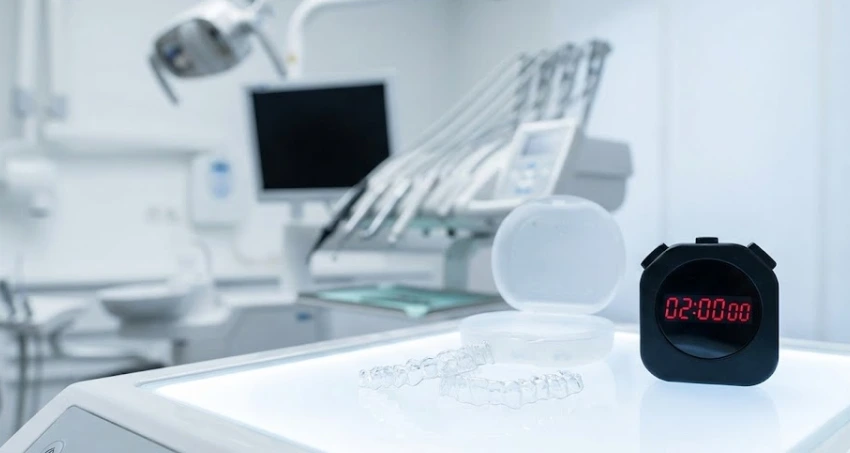
[Image description: A person holding a clear aligner tray next to a digital clock highlighting the ’22’ hour mark, symbolizing the daily commitment required.]
Compliance vs. Results: A Clinical Overview
But let’s look closer at how the number of hours directly correlates to your time spent in the chair here in Istanbul. When patients travel to Turkey for their smile transformation, they usually want the most efficient path to a perfect result.
| Daily Wear Time | Biological Impact on Teeth | Impact on Treatment Timeline |
| 22+ Hours | Optimal bone remodeling; teeth stay on track. | On schedule (Fastest results). |
| 20-21 Hours | Minor “rebound” occurring; movements are sluggish. | Slight delays (1-2 months extra). |
| 18 Hours | Teeth spent 25% of the day moving backward. | Significant delays; aligners may stop fitting. |
| <16 Hours | The “Biological Reset”; progress is nearly zero. | Treatment failure/Need for new scans. |
The Question Remains: Can I Take Them Out for Special Occasions?
We understand that life happens. Whether it’s a wedding, a long business dinner, or enjoying the world-class cuisine here in Turkey, you will occasionally want to keep them out longer.
Here is what we see in the clinic: the most successful patients treat their “out time” like a stopwatch. You have roughly two hours a day to split between breakfast, lunch, dinner, and cleaning. If you have a four-hour event where you must leave them out, you need to compensate by wearing that specific tray for an extra day or two before moving to the next one in the series. Professor Doctor Coşkun Yıldız often advises that “tracking”—how well the tray fits the tooth—is the only metric that matters. If the tray doesn’t fit perfectly because you skipped hours, the science simply stops working.
Maximizing Your Time at Lema Dental Clinic
When you choose Lema Dental Clinic for aligner treatment, we utilize AI-driven monitoring to ensure your teeth are moving exactly as planned. This technology allows Dentist Polen Akkılıç and her team to see if you are hitting your 22-hour goal without you even having to tell us—the fit of the aligner tells the whole story.
The reality is that the “discipline” of 22 hours is what buys you the “freedom” of a lifetime with a straight smile.
FAQ: Direct From the Doctor
Yes, absolutely! Sleep is actually the most productive time for your aligners because your jaw is at rest and the pressure is completely uninterrupted. Think of your sleep hours as the “heavy lifting” portion of your treatment.
We strongly advise against it. Hot liquids can warp the medical-grade plastic, turning your precision tool into a useless piece of warped film. Additionally, liquids get trapped between the aligner and your teeth, which can lead to rapid tooth decay.
Don’t panic, but don’t make it a habit. If you have a “bad” day, simply add an extra day of wear to your current tray. The biggest risk is that the next tray in the series won’t fit, which can be painful and set you back weeks.
The more times you take them out, the more likely you are to forget to put them back in. We recommend sticking to three main meals. Constant snacking often leads to “compliance fatigue” where you end up wearing them for only 18 hours without realizing it.
The biological principles of tooth movement don’t change by geography. While some clinics say 20 hours to sound “easier,” at Lema Dental Clinic, we aim for 22 because it provides a safety buffer. Aiming for 22 usually results in at least 20 hours of actual wear.
- Bollen, A. M., et al. (2008). The effects of orthodontic therapy on periodontal health. Journal of the American Dental Association, 139(4), 413-422.
- Chisari, J. R., et al. (2014). Variables affecting patient compliance with orthodontic clear aligner therapy. American Journal of Orthodontics and Dentofacial Orthopedics, 145(6), 820-827.
- Galan-Lopez, L., et al. (2019). Clinical efficacy of Invisalign aligners: A systematic review. Journal of Clinical and Experimental Dentistry, 11(2), e188.
- Proffit, W. R., et al. (2018). Contemporary Orthodontics. Elsevier Health Sciences.
- Tamer, İ., et al. (2019). Orthodontic treatment with clear aligners and the scientific reality behind their marketing. Turkish Journal of Orthodontics, 32(4), 241-246.

