


With proper care, screwless implant roots last a lifetime, while the crowns last 10-15 years.
Most dentists notice patients tend to become nervous quite easily at the first sign of the dental chair. No doubt, tooth replacement is an important decision, and who would consent to surgery only to have it done again 10 years later if need be?
So, the question is… for how long does the implanted tooth really last?
Screwless dental implants are quite flexible. For instance, they are mostly made of solid one-piece zirconia or use a press-fit design. As far as the professionals at Lema Dental Clinic are concerned,a well-placed implant may very well last a lifetime. Only the visible artificial tooth on top might need to be replaced after 10 to 15 years.
So, what exactly does it entail in terms of your smile and your health?
Rethinking the Foundation: What Is a Screwless Implant?

If you consider, your jawbone is like the foundation of a house, isn’t it? Just think of a traditional implant as a steel beam tightly bolted to the ground. It employs tiny screws to secure the crown. This is a time-tested and very effective method. Nevertheless, the screws tend to loosen, and bacteria may find a way into the area.
On the other hand, a screwless implant works in a totally different way. It behaves as a unique, solid shaft.
Removal of the hole for the screw results in a very smooth surface. Via this uninterrupted design, soft tissue regenerates fast, as Professor Doctor Coşkun Yıldız remarks. Plaque doesn’t stand a chance! In fact, your gum tissue is just like the skin of an eggshell. It clings to the very base just as tightly as the biological seal that safeguards the underlying bone.
The Longevity: What the Research Indicates
Actually, the new tooth consists of two main parts: the root (implant) and the tooth/crown.
- The implant root (20+ years to life): The post made of titanium/zirconia naturally integrates with your jawbone, a process known as osseointegration, and the implant thus becomes part of your body. If you don’t get serious gum disease, this foundation will remain permanently.
- The dental crown (10 to 15 years): The crown is the one that gets all the work. It is there when you chew, speak, and grind your teeth. Even top dental materials break down over time. You will probably need to have the crown changed at some point, but the strong root is safely under it.
Here’s what the numbers tell us in the clinic regarding standard options comparison:
| Feature | Screwless Implants | Traditional Implants |
| Connection | Solid one-piece or press-fit | Internal screw |
| Gum health | Tight, natural seal | Good, but has tiny gaps |
| Root lifespan | 20+ years (often lifetime) | 20+ years (often lifetime) |
| Crown wear | Replace after 10-15 years | Replace after 10-15 years |
Let Your Smile Be Your Armor
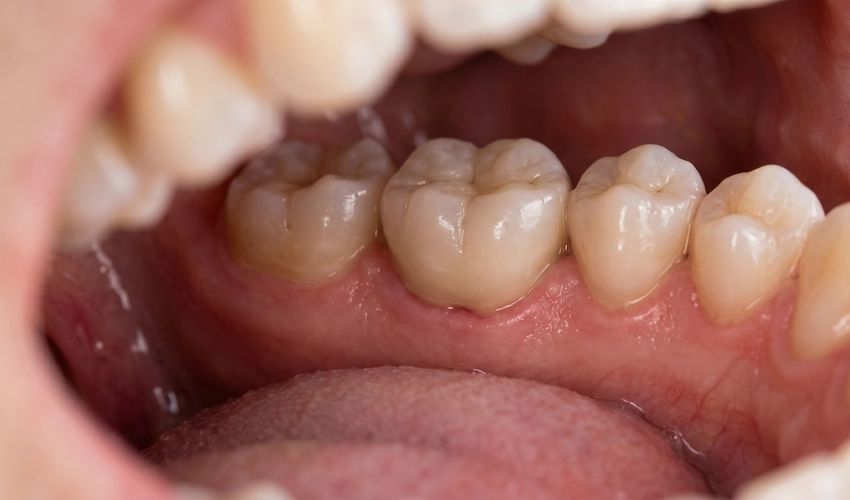
You would definitely like your tooth to last 20 years, right? In fact, if based on the statistics, implants fail, but it’s hardly their doing. It is typically the condition of your mouth.
Bad oral hygiene, uncontrolled diabetes, or heavy smoking are big-time troublemakers. Dentist Polen Akkılıç and her staff identified a distinct trend. Patients who consider their implants and treat them like their natural teeth are the ones who have the best results.
Here is a simple daily routine to get a healthy, vibrant smile:
- Brush your teeth twice a day with a soft toothbrush to protect your gums.
- Floss daily to lift plaque from tooth surfaces close to the gums.
- Check-up visits: We recommend seeing our professional hygienist for cleanings twice a year.
No screw holes mean no food-tooth entrapment. Thus, for many patients, maintaining the perfect cleanliness of the screwless design is actually easier.
Top Level Care in Turkey
Advanced restorative dentistry is what Lema Dental Clinic Turkey is all about. Lema Dental Clinic Team, we don’t simply give you an implant; We really put together a long-term solution for your mouth.
Besides that, we conduct a thorough examination of your bone density and bite forces. We maintain our expert team and top-notch technology suppliers make us very proud as a provider of lasting, confident smiles.
Frequently Asked Questions
Definitely not. After you have healed totally, you’re not going to sense a difference. The implant will be part of your bone. Bite force will be the same as with your natural teeth. Go ahead and enjoy your favorite meals without fear.
Initially, both types have a very similar cost. The materials used to make implants are very advanced, and the surgery is usually much quicker. We’ll always provide you with a detailed cost breakdown during your first visit.
Highly unlikely. Initial failure occurs if the bone fails to heal properly. It can also be due to gum disease, many years later. For that matter, daily brushing and regular visits to your dentist are necessary.
The crown is not screwed in but bonded. If it breaks, we progressively remove the damaged ceramic, but the solid implant root remains untouched. Afterwards, we bonded a brand new crown on the post.
This is largely determined by the amount of bone that is missing. Screwless implant systems require an immediate solid base. Should your bone be very thin, a minor bone grafting procedure could be considered initially. This way, the security of your implant is guaranteed for many years to come.
- Albrektsson, T., & Donos, N. (2012). Implant survival and complications: The Third EAO consensus conference 2012. Clinical Oral Implants Research, 23(Suppl 6), 63-65.
- Buser, D., Sennerby, L., & De Bruyn, H. (2017). Modern implant dentistry based on osseointegration: 50 years of progress, current trends and open questions. Periodontology 2000, 73(1), 7-21.
- Linkevicius, T., & Vaitelis, J. (2015). The effect of zirconia or titanium as abutment material on soft peri-implant tissues: a systematic review and meta-analysis. Clinical Oral Implants Research, 26(S11), 139-147.
- Misch, C. E. (2015). Dental Implant Prosthetics (2nd ed.). Elsevier Mosby.
- Zitzmann, N. U., & Marinello, C. P. (2002). A review of clinical and histological indications for the use of press-fit and screw-retained implant systems. The Journal of Prosthetic Dentistry, 87(5), 513-519.

