


Dental implants are the only permanent solution that preserves your jawbone, unlike temporary bridges or dentures.
Losing of a tooth is not merely losing something that you had in addition to the fact that one of your teeth is missing. It is the beginning of the so-called “hidden catastrophe,” which is the slow decomposition of your jawbone that occurs underneath. Most people just go for dental prostheses primarily for aesthetic reasons, completely ignoring the fact that their jawbones have started to degenerate. The different options for replacing a missing tooth often seem too overwhelming and complicated to choose.
However, the point is not just about how long the restoration lasts or its initial cost, but what the long-term effects of the type of restoration be on your jawbone? When you choose between temporary and permanent restoration of your bone defect, it is your jawbone that will be affected first.
In order to grasp the difference between implants, bridges, and dentures, you should take a look at your own jawbone as if it is a living, breathing, foundation. Professor Doctor Coşkun Yıldız, a well-known specialist in dental and bone related topics, has stated that your jawbone is actually similar to a muscle in many ways. So, like any muscle, it needs some degree of activity to stay strong and dense. Naturally, the roots of a single tooth are exercising your jawbone every time you chew. Once a tooth is lost, a piece of the jawbone in that area remains unexercised.
The Fallacies of Dentures and Bridges
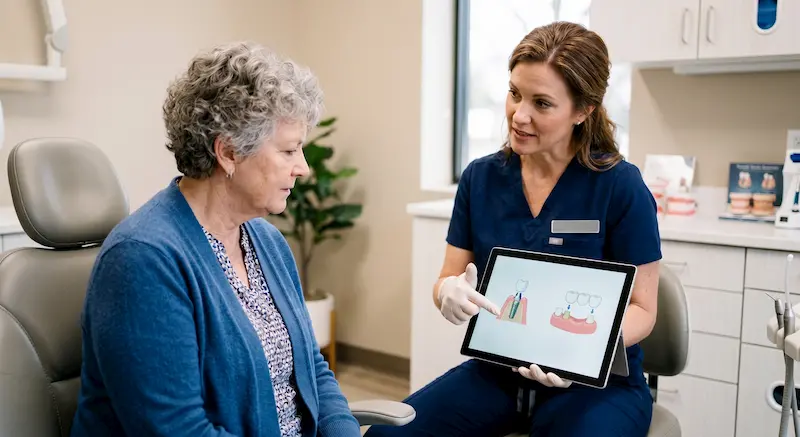
Classic full-arch dentures literally do not interact with anything below the surface level. They just lie on top of your gums like a thick cover that conceals, rather than cures, the problem. Although dentures return your chewing ability to a reasonable level and give you a good smile, they do not stimulate any part of the toothless jaw area at all. This leaves the underlying bone to simply decay.
The concept of dental bridges is not all that different. The artificial tooth is suspended above a toothless segment by using the adjacent real teeth. But in doing so, they make a person lose something precious. Choosing a common bridge or a removable denture means taking on a number of invisible trade-offs:
- Permanent destruction of teeth: Placing a dental bridge requires perfectly normal, healthy side teeth to be ground down forever, just so they can serve as supporting pillars.
- Jawbone disappearance without you knowing it: Since the imitation tooth does not exert pressure on your jawbone when you chew, the bone underneath will keep shrinking and becoming weaker.
- Regular replacements: Prostheses made of acrylic resins are just short-term coverings. Compared with a titanium root that lasts indefinitely as part of the bone, these devices wear out quicker and do not last a lifetime.
The question remains: why permanently sacrifice two adjacent healthy teeth just because one tooth is missing?
The Advantage of Using Implants for Bone Tissue Regrowth
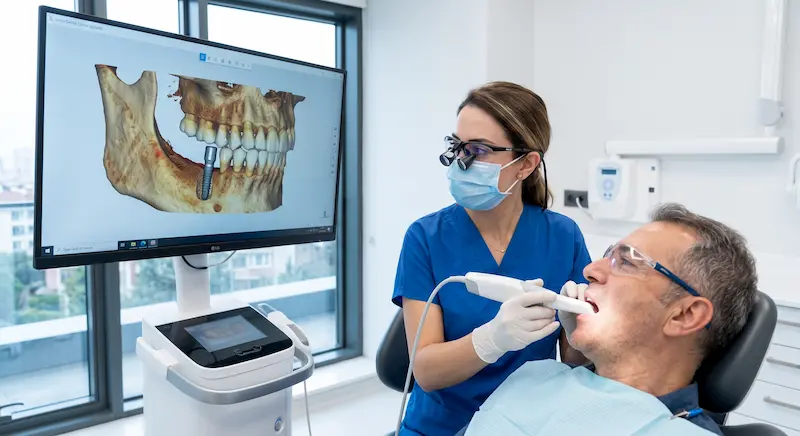
Dental implants are the only procedure in contemporary dentistry that can imitate not only a full natural tooth but also the biological process of its development. The tooth root is represented by a tiny but sturdy titanium post that is biocompatible and well-accepted by the body. This post is firmly inserted into the jaw, where the bone gradually surrounds it over 3 to 6 months in a natural process termed ‘osseointegration’.
Here is what we see in our experience: people who opt for implants end up maintaining their facial structure, with very little risk of looking older due to jawbone shrinkage. At Lema Dental Clinic, our patients traveling to Turkey are not coming just for a quick cosmetic job. They desire to have their bite force, speech, and self-confidence completely restored in a manner that does not involve sacrificing any healthy teeth. Dentist Polen Akkılıç and her surgical team employ high-resolution volumetric CT imaging to accurately locate the implant. This ensures the surgical trauma is minimal, and the outcome is incredibly precise.
Comparing Your Tooth Replacement Options
| Replacement Option | Jawbone Preservation | Impact on Adjacent Teeth | Average Lifespan | Daily Maintenance |
| Dental Implants | High. Stimulates bone growth and prevents facial sagging. | None. Surrounding teeth are left completely untouched. | Lifetime (with proper oral hygiene). | Standard brushing and flossing. |
| Dental Bridges | None. Bone continues to erode beneath the artificial tooth. | High. Adjacent healthy teeth must be permanently shaved down. | 10–15 years. | Requires special floss threaders to clean underneath. |
| Removable Dentures | None. Can accelerate bone loss due to friction. | Moderate. Clasps can wear down supporting teeth over time. | 5–10 years. | Must be removed daily for soaking and cleaning. |
Frequently Asked Questions
1. Does the dental implant procedure hurt?
We use advanced local anesthesia, meaning you will not feel any pain during the actual placement. Most of our patients are surprised to find that extracting a tooth is often more uncomfortable than placing an implant. You might experience mild swelling or tenderness for a few days, which is easily managed with over-the-counter medication.
2. How long will I need to stay in Turkey for this treatment?
Implant treatment is usually completed in two separate visits. The first visit takes about 3 to 5 days for the surgical placement of the titanium roots. We then wait 3 to 6 months for the bone to fuse to the implant. Your second visit will take about a week to design and attach your permanent ceramic crowns.
3. Can I still get an implant if I lost my tooth many years ago?
Yes, but we need to evaluate your bone density first. If your jawbone has shrunk significantly over the years, we can perform a minor bone grafting procedure to rebuild the foundation before placing the implant. We handle this routinely in our clinic.
4. Will the implant feel like a real tooth?
Absolutely. Because the titanium post is fused directly to your skeleton, it functions exactly like a natural tooth root. You will be able to bite into an apple, chew a steak, and speak clearly without ever worrying about the tooth shifting or slipping.
5. Why should I choose an implant over a bridge if a bridge is faster?
A bridge might give you a tooth faster today, but it costs you the health of your adjacent teeth tomorrow. Shaving down healthy enamel makes those neighboring teeth vulnerable to decay and root canals in the future. An implant is a standalone solution that protects the rest of your mouth for a lifetime.
Academic References
- Buser, D., Sennerby, L., & De Bruyn, H. (2021). Modern implant dentistry based on osseointegration: 50 years of progress, current trends and open questions. Periodontology 2000, 86(1), 7-21.
- Pjetursson, B. E., Sailer, I., Makarov, N. A., Zwahlen, M., & Thoma, D. S. (2022). All-ceramic or metal-ceramic tooth-supported fixed dental prostheses (FDPs)? A systematic review of the survival and complication rates. Clinical Oral Implants Research, 33(S23), 141-155.
- Misch, C. E. (2020). Contemporary Implant Dentistry (4th ed.). Elsevier Mosby.
- Avila-Ortiz, G., Chambrone, L., & Vignoletti, F. (2023). Effect of alveolar ridge preservation interventions following tooth extraction: A systematic review and meta-analysis. Journal of Clinical Periodontology, 50(S24), 23-41.
- Carlsson, G. E. (2024). Responses of jawbone to changing functional demands: From tooth loss to implant therapies. Journal of Dentistry, 105, 103567.

