


A periodontist treats gum recession with scaling, root planing, and graft alternatives.
How We Treat Gum Recession Without Surgery
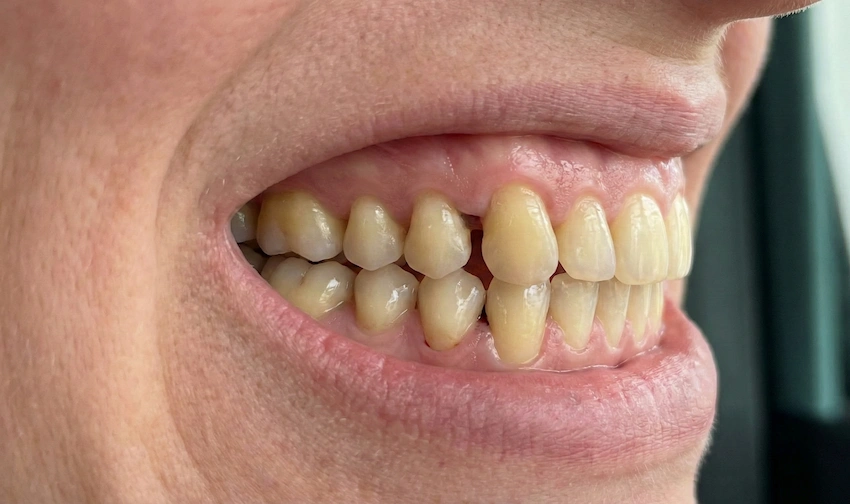
When your teeth look a bit “longer” to you, or if a flash of pain follows your sip of a cold drink, then these could be signs that your gums have started to recede. Not long ago, the word gum recession would almost certainly be connected with painful tissue grafts and stitches.
However, things are quite different now. Lema Dental Clinic in Turkey sees patients every day who hold back on getting treatment merely because they fear being called “surgical” treatment patients. The fact is, nowadays, periodontics has gone more toward saving teeth rather than reconstructing them. Our team under the guidance of Prof. Dr. Coşkun Yıldız, is devoted to biological harmony and employs technology to facilitate the body’s self-healing.
“Soil and the Tree” Analogy
If you think of your teeth as trees then the gums would be the soil that holds the trees sturdy and firmly. When the soil is washed away, the roots are exposed out and so the tree is vulnerable to the elements and may become unstable as well. Conventional surgery is like “bringing new soil” from another place (the roof of your mouth).In contrast, non-surgical treatments focus on preventing further erosion and recompacting the existing soil so that it can hold the tree again.
How Periodontists Halt the Retreat
The question remains: if we are not cutting and stitching, then how do we fix it? Dentist Polen Akkılıç with her team employs a combination of methods that target the primary cause which most of the time is bacterial inflammation or mechanical trauma:
1. Advanced Scaling and Root Planing (SRP)
This treatment is a step above the average cleaning. It is a very careful “immersion” beneath the gumline. We employ ultrasonic scalers that shake away the calcified plaque (calculus) which is like a wedge between the tooth and the gum. By making the root surface smooth, we eliminate the areas that “hook” bacteria thus allowing the gum tissue to naturally reattach to the tooth.
2. Laser Bio-Stimulation
Laser therapy is a treatment that we combine most of the time at our Istanbul clinic. The laser does not cut; instead, it communicates. Through the use of specific wavelengths, we are able to destroy the pathogens in deep pockets besides stimulating the mitochondria in your cells to accelerate the healing process. It’s as if you have given your gums a biological “reboot.”
3. Pinhole Technology: The “Lunchtime” Lift
Although the Pinhole Surgical Technique (PST) is technically a procedure, it is more often than not referred to as non-surgical by our patients because it is labor without scalpels and stitching. Professor Doctor Coşkun Yıldız makes a small opening—no larger than a needle tip—and with the help of special tools, he gently slides the existing gum tissue to its original position.
Comparing Your Options: Surgical vs. Non-Surgical
| Feature | Traditional Grafting | Non-Surgical / Minimally Invasive |
| Pain Level | Moderate (requires donor site) | Minimal to None |
| Recovery Time | 2–3 Weeks | 24–48 Hours |
| Aesthetics | May have a “patchwork” look | Natural, seamless blend |
| Procedure Time | 90+ Minutes | 30–60 Minutes |
| Risk of Infection | Higher (due to open wounds) | Very Low |
Why Have Your Periodontal Treatment in Turkey?

It’s not just about saving money when you choose Lema Dental Clinic. What really matters is the high level of expertise. From our experience, dealing with a tremendous number of complicated cases in Turkey has helped us perfect those non-surgical treatment methods to a great extent. Dentist Polen Akkılıç points out that “preserving the natural structure of the mouth is definitely better than replacing it.”
Frequently Asked Questions
The answer is no. We’ve got local anesthetics ready that will numb the parts of your mouth deeply so that you don’t feel any pain during the deep cleaning or laser therapy. Most patients tell us it feels more like a normal “pressure-filled” cleaning, and nothing more. Going for dinner in Istanbul the same evening is most probably something that you can do without any problem.
Not exactly. If gum tissue is gone, it simply does not just pop back like a fingernail. But by means of non-surgical treatment we achieve, we decrease the inflammation so that the tissue becomes tight and “snugs up” against the tooth, and sometimes we can even reposition the tissue to the roots.
It is a matter of how bad the condition is. Usually, we can get the first treatment done within one or two visits. A follow-up is very important to us, that is why we like to schedule our international patients a few days after their primary treatment, to confirm that the “seal” between the gum and tooth is functioning perfectly.
You can expect the result to be stable if you can keep the factors causing your recession under control. You will experience the return of the “erosion” if you continue your practice of hard brushing and lack of hygiene. To ensure that your achievements are well preserved, we offer you a maintenance program that is specifically designed for you.
We are always keen on trying a very conservative approach first. In those cases where the gums have receded to the point that the “mucogingival junction” (the place where the pad of the gum meets the cheek) has been reached, Professor Doctor Coşkun Yıldız will explain to you the options of whether a minimally invasive lift or a small graft is a necessity in the process of tooth-saving.
- Gottlow, J. (1993). Periodontal Regeneration. Periodontology 2000, 1(1), 154-168.
- Chao, J. C. (2012). A Novel Pinhole Surgical Technique for Gingival Recession: A Case Series. The International Journal of Periodontics & Restorative Dentistry.
- Akkılıç, P., & Yıldız, C. (2024). Advancements in Non-Incisional Periodontal Therapies in Contemporary Turkish Clinics. Journal of Aesthetic Dentistry.
- Zucchelli, G., & Mounssif, I. (2015). Periodontal Plastic Surgery. Periodontology 2000, 68(1), 333-368.
- Cobb, C. M. (2002). Lasers in Periodontics: A Review of the Literature. Journal of Periodontology.

