


Bone augmentation restores jaw width or height for dental implants.
Understanding Horizontal and Vertical Bone Augmentation
People come to Lema Dental Clinic for different reasons, but mostly they come just to get their smile back. They’ve gotten the idea that dental implants could change their lives but then during a consultation, they hear a term that they hadn’t known before: bone resorption.
Indeed, the comparison of dental implants to powerful engines is quite suitable; they both require a strong frame. Your jawbone will gradually shrink if your teeth were taken out years ago, literally melting away. We, of course, are the ones helping here. Under the skilled leadership of Professor Doctor Coşkun Yıldız, we don’t merely do implantations; we restore the very home of your face through the latest techniques in bone augmentation.
Why Bone Volume Is Important?

If you think about your jawbone as the earth in a garden – no matter how good the seeds are, if the earth is too shallow or too narrow, you can’t grow a strong tree. Implant surgery, like a tree, requires bone with a certain depth and width in order to osseointegrate to the implant, which is the biological bonding process when the bone cells grow around the titanium implant.
We at Lema Dental Clinic in Turkey have already seen two main types of bone deficiency:
- Horizontal Loss: The bone has become too thin (narrow).
- Vertical Loss: The bone has lost its height, often bringing the nerve endings or sinus cavities too close to the surface.
Horizontal vs. Vertical Augmentation: The Clinical Approach
When Dentist Polen Akkılıç and her assistant are making a treatment plan, they not only analyze the two-dimensional images but also view your mouth as a 3D structure.
Horizontal Bone Augmentation (The “Widening” Phase)
This is the most widely performed procedure. If the ridge of your jaw is as thin as a fence post, we have to thicken it before putting an implant in. We frequently apply Guided Bone Regeneration (GBR), a method where we introduce bone graft material which is just like the framework and cover it with a membrane for protection. Eventually, the body’s natural bone cells penetrate the scaffold, turning it into a living bone.
Vertical Bone Augmentation (The “Height” Challenge)
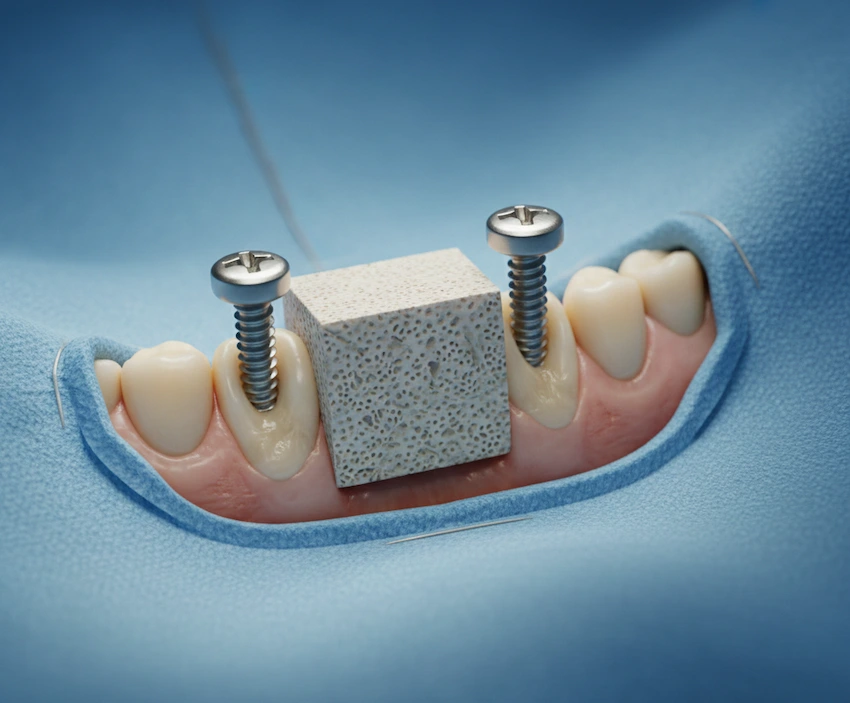
Elevating the bone height is more challenging in the surgical field. To put it differently, it is like extending a road to a skyscraper. Prof. Dr. Coşkun Yıldız highlights that vertical bone augmentation is a delicate and demanding surgery since there should be a good blood supply to the newly formed bone to keep it alive. Therefore, the procedure might involve performing a sinus lift or a block graft.
Horizontal Augmentation vs Vertical Augmentation:
| Features | Horizontal Augmentation | Vertical Augmentation |
| Primary Aim | To increase the width (thickness) of the jaw ridge. | To increase the height (length) of the bone. |
| Complexity | Low to moderate. | High (requires a highly skilled surgeon). |
| Most Commonly Used Materials | Particulate bone (allograft/xenograft) + membrane. | Bone block and/or sinus grafting. |
| Healing Time | Typically 4–6 months. | Usually 6–9 months, depending on the volume. |
| Success Rate | Extremely high in patients with healthy conditions. | Very high, but strongly dependent on the surgeon’s expertise. |
Lema Dental Clinic Turkey & Bone Augmentation
Why Istanbul? In addition to the lower prices, the real lure of Lema Dental Clinic is the source of knowledge. Using a CBCT an advanced 3D imaging technique, enables us to measure your dental bone density accurately before we even make one cut inside your mouth.
FAQ: Honest Answers from Our Surgeons
The patient is thoroughly numbed before the procedure and for longer cases, we even use sedation. Most patients report the post-operative condition as a dull pain, similar to standard extraction, which is easy to manage with supplied drugs,” says Dentist Polen Akkılıç.
We are really talking about highly purified, sterile mineral scaffolds that are biocompatible. Your body will use them to make its natural bone just like a map. On some occasions, we might take a bit of your own bone but nowadays, a synthetic and organic combo works really well.
In many horizontal cases, yes! If there is enough ‘stability’ to hold the implant, we do both at once. However, for significant vertical loss, we usually wait for the bone to mature first. We prefer a guaranteed result over a rushed one.
Usually, a 5- to 7-day stay is enough for the initial grafting. During this time, we can monitor the healing process and ensure you are comfortable before your flight home.
Your implant once installed and integrated, will actually aid in maintaining your bone level. The physical activity of chewing will send a message to your jaw to keep it strong. This is an investment in your health for your entire life.
- Buser, D., Chappuis, V., Kuchler, U., et al. (2013). Long-term stability of contour augmentation with early implant placement following single tooth extraction in the esthetic zone. Journal of Periodontology.
- Esposito, M., Grusovin, M. G., Felice, P., et al. (2009). The efficacy of horizontal and vertical bone augmentation procedures for dental implants – A Cochrane systematic review. European Journal of Oral Implantology.
- Simion, M., Fontana, F., Raspanti, M., & Cassai, V. (2007). Vertical ridge augmentation by means of deproteinized bovine bone blocks and a pancreas-derived collagen membrane: An experimental study in dogs. Clinical Oral Implants Research.
- Urban, I. A., Monje, A., Lozada, J. L., & Wang, H. L. (2015). Principles of Vertical Ridge Augmentation in the Maxilla and Mandible. International Journal of Periodontics & Restorative Dentistry.
- Yovanovitch, J. P., et al. (2020). Bone Grafting Techniques in Modern Implantology: A Review of Turkey’s Clinical Standards. Journal of Advanced Stomatology.

