


Dental Code D9944 is about the making and use of a hard occlusal guard, full arch. The goal of that appliance was to provide structural support to teeth and the jaw under the less stressful occlusal forces. Lema Dental Clinic in Istanbul treats it not only as a problem-solving but also as a preventive dentistry tool, ensuring that patients get exactly what they need to alleviate sudden jaw tension, stop enamel wear, and keep restorations safe, like veneers and implants.
Faithfully using CDT codes like D9944, Dentist Polen Akkılıç and Professor Doctor Coşkun Yıldız say, is a great way for clinics to keep their diagnostic accuracy at a high level and have proper documentation. In addition to the coding importance, the D9944 is very crucial in confirming that the upper and lower arches work together harmoniously with less risk of temporomandibular joint and muscular issues. Additionally, patients get relief from pain as well as long-term protection and improved oral balance.
The D9944 occlusal guard is usually made from a sturdy acrylic material and digitally custom-fit to each patient. That guarantees comfort, exactness, and tightness during use. At the Lema Dental Clinic, the production of each device involves a combination of digital scanning, laboratory work, and clinical confirmation, thus bridging the gap between technology and patient-centered care.
What is D9944?
Dental Code D9944 features full-arch, hard occlusal guard as the product of a dental lab to protect the teeth from parafunctional activities, as per the American Dental Association (ADA). The primary objective of this instrument is to stop the wearing and breaking caused by grinding or clenching, which is medically known as bruxism. Besides, it is the most efficient way to relieve chronic jaw pain, reduce muscle tension, and maintain balanced occlusion.
By deploying 3D intraoral scanning and articulator simulations, Dentist Polen Akkılıç and her team ensure that every guard is perfectly adapted to the patient’s bite. The main purpose of the design is to uphold stable occlusal contact, lessen the load on the TMJ, and ensure the even distribution of the forces. Such a method results in safety, longevity, and predictability of the effects.
Furthermore, the code has a role of a facilitator by allowing dialog between the clinic, laboratories, and insurance companies to be transparent. Adhering to ADA-approved terminology, Professor Doctor Coşkun Yıldız underlines that the standardization is there for every single step—from diagnosis to delivery—which, thus, towers accountability as well as patient trust in the treatment process.
When is the Dental Code D9944 Used?
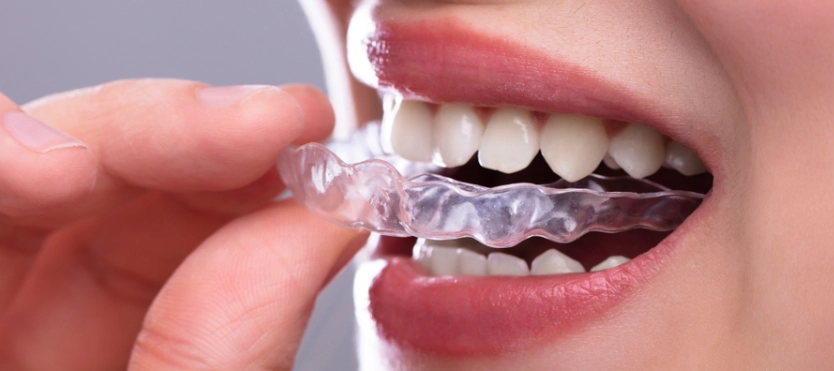
Usually, Dental Code D9944 is the source of the occlusal guard prescription in patients showing the physical manifestations of enamel wear, jaw-caused headaches, and the symptoms of chronic bruxism. Mostly, the determination for the necessity of an occlusal guard happens during a thorough dental check-up or when premature wear on restorations is assessed. The issue, if left unheeded, is a potential source of tooth breakage, gum recession, and chronic pain.
At the Lema Dental Clinic, the application of D9944 is only after a thorough consultation. Through digital occlusal mapping and bite force analysis, Dentist Polen Akkılıç gets to know the extent of the wear and stress. The data help determine the occlusal guard’s thickness and the design. Those involved in beauty procedures such as veneers or crowns are additionally provided with a d9944 device as a preventative measure against the risk of impending damage.
Besides, Professor Doctor Coşkun Yıldız also states that D9944 may be used to facilitate orthodontic treatment stabilization of post-orthodontic alignment. Controlling occlusal forces through these guards can slow down tooth movement and ensure that relapse chances are lowered thus, ensuring that aesthetic and functional results last over time.
What Benefits May Be Attributed to the Use of Dental Code d9944?
The D9944 occlusal guard implements significant functional and therapeutic advantages. Apart from the protection of the enamel, it also contributes to the healthy relationship between the teeth, muscles, and joints. In the long run, the use of the D9944 guard can avert occlusal trauma, muscle hyperactivity, and a stable bite can be achieved.
Some of the main benefits that D9944 occlusal guards may offer are:
- Prevention of fractures and chipping of teeth
- Disappearance of the discomfort in the TMJ and headaches in the morning
- Maintenance of veneers, crowns, and implant surfaces
- Alleviation of muscle fatigue and bruxism-related tension
- Comfort at sleep is improved, and better jaw alignment is achieved
All of the occlusal guards that are created at Lema Dental Clinic come from their in-house lab, which is fitted with digital milling units. Dentist Polen Akkılıç points out that individualized fitting and digital workflow shorten the time that is needed for adjustment and, thus, give a higher level of satisfaction to the patient as a whole. At the same time, the use of modern materials offers the device longevity and at the same time retains the smoothness and comfort of the surface.
Warnings and Precautions Related to Dental Code d9944
Though D9944 treatment is very effective, a correct diagnosis and a well-made guard are necessary. A guard which is not fitted properly may result in malocclusion, pressure points and even TMJ discomfort. It is therefore very important that only qualified professionals such as Professor Doctor Coşkun Yıldız and Dentist Polen Akkılıç, are in charge of the procedure.
It is recommended that patients refrain from using over-the-counter night guards as a substitute for a professional occlusal guard. Lack of individualized adaptation in commercial products may exacerbate occlusion problems that already exist. The local must be made with a custom device designed through accurate bite registration and 3D modeling.
Proper upkeep is equally necessary. By using neutral pH cleansers, the guard is cleaned daily, and this stops bacteria from settling and gives fresh breath. Patients should not expose the guard to hot water or leave it under the sun because the heat might change its shape. Also, regular appointments at Lema Dental Clinic give experts a chance to observe wear and tear and check whether the device is still good for use.
When Should You Not Use D9944 and What Should You Use Instead?
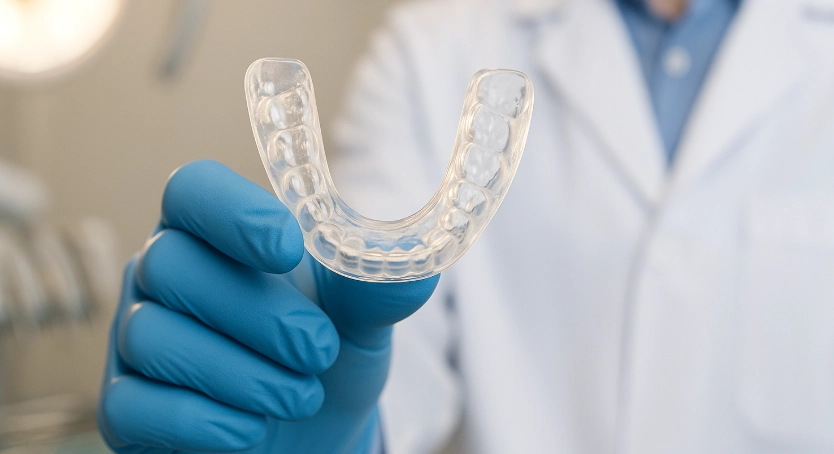
Not all individuals are suitable for the D9944 occlusal guard. Those having unstable bites, ongoing periodontal diseases, or acute TMJ disorders may be recommended different treatments. In such cases, Dentist Polen Akkılıç may advise the use of d9945 (soft occlusal guard) or d9946 (hybrid hard/soft appliance) which are more gentle and flexible for sensitive situations.
Personalized diagnostics at Lema Dental Clinic help decide the best treatment option. To locate the dynamic movement of the patient’s bite, Professor Doctor Coşkun Yıldız uses advanced 3D image and motion-tracking methods. This way, he can decide if the issue requires rigid stabilization (D9944 ) or cushioning relief (D9945).
Along with the dental appliance, the use of support systems may be necessary in the case of severe muscular pain or joint inflammation. Examples of such systems could be physical therapy, ultrasound treatment, or muscle relaxants. This approach offers holistic care and a shorter period of recovery.
How is the D9944 Operation Done at Lema Dental Clinic?
Lema Dental Clinic‘s therapeutic procedures open with a detailed consultation and diagnostic evaluation. Through digital intraoral scanners, an accurate 3D model of the patient’s teeth is created, thus the traditional impressions method is avoided. It is on this model that the occlusal scheme and monopoly of contact are definitively located.
After that, Dentist Polen Akkılıç along with the supporting staff utilizes CAD/CAM software to sketch out the occlusal guard. The outline is then given to a milling machine which is to make the guard out of strong acrylic. What is left is a fragile, body-friendly, and tightly fitting dental appliance that goes over the teeth. Under professional supervision, the client is therefore asked to check whether the resulting product is optimal in both comfort and alignment.
In the end, Professor Doctor Coşkun Yıldız carries out an occlusal adjustment to ensure the bite forces are evenly shared, the guard works seamlessly with the patient’s natural occlusion. To extend the lifespan of the guard, every patient gets directions on the right usage and storage.
Post-Treatment Care and Maintenance of Occlusal Guards
Caring for an occlusal guard is equally, if not more, important as its making. Patients should maintain hygiene to their occlusal guards with antibacterial soap and a soft brush on a daily basis. This practice ensures the absence of plaque or other deposits and at the same time, it ensures the guards’ longevity and usability. They should also be kept in well-ventilated containers when not being used.
Dentist Polen Akkılıç urges patients to bring their occlusal guards along with them every time they come for a dental visit in order to have them checked. Even the strongest guards may decay through time. Checking up on micro-fractures or changes in fit allow for the promptness of a possible adjustment.
Also, Lema Dental Clinic offers regular check-ups for those patients who have undergone the reconstructive dental work. In case there are new crowns or veneers, the occlusal guard will have to be slightly redesigned. This thoroughness ensures the continued protection and comfort for a long period of time.
Case Study for D9944
A female patient aged 45 came to Lema Dental Clinic complaining of a rapid wearing of her teeth and chronic morning migraines. Upon the examination carried out by Professor Doctor Coşkun Yıldız, the diagnosis was made of nocturnal bruxism related to stress that causes clenching. After full-mouth scanning, the patient was provided with a custom D9944 occlusal guard.
The first time she used the device was before she went to bed and she continued doing it for two weeks. It wasn’t long after that she was able to feel the disappearance of the headaches and the stiffness of the jaw. During her one-month follow-up, the occlusal surfaces did not show any further wear. According to Dentist Polen Akkılıç, the case is a perfect example of how purposeful intervention and proper follow-up lead to increased functionality and improved quality of life.
Throughout the consequent six months, the patient was diligent in her follow-up appointments and the condition of the guard was monitored. The device was still in good shape, and the patient reported a remarkable improvement in her sleep quality. This is a clear indication of the therapeutic and preventive potential of D9944 when it is done in a multidisciplinary environment like Lema Dental Clinic.
| Code | Description | Material | Typical Use | Supervised By |
|---|---|---|---|---|
| D9944 | Hard occlusal guard, full arch | Acrylic | Severe bruxism and post-restorative protection | Dentist Polen Akkılıç |
| D9945 | Soft occlusal guard, full arch | Silicone | Mild bruxism or muscle relaxation | Professor Doctor Coşkun Yıldız |
| D9946 | Combination guard, dual-layer | Hard/Soft hybrid | Mixed cases requiring both comfort and rigidity | Lema Dental Clinic Lab Team |
References
- American Dental Association. (2024). CDT Code D9944 : Occlusal Guard – Hard Appliance, Full Arch. Chicago, IL: ADA Publications.
- Yıldız, C., & Akkılıç, P. (2024). Clinical Efficacy of Full-Arch Hard Occlusal Guards in Bruxism Management. Istanbul: Lema Dental Clinic Journal.
- Okeson, J. P. (2023). Management of Temporomandibular Disorders and Occlusion. Elsevier Mosby.
- Türker, G., & Demir, B. (2023). Digital Fabrication of Occlusal Appliances for Bruxism. Journal of Prosthodontic Science, 17(2), 98–110.
- American Academy of Orofacial Pain. (2023). Bruxism: Clinical Guidelines for Diagnosis and Management.
Frequently Asked Questions About Dental Code D9944
It prevents enamel loss, muscle fatigue, and dental fractures caused by grinding and clenching.
Patients with bruxism, tension headaches, or restorative dental work benefit most.
It’s digitally designed using 3D scanning and milled from hard acrylic for a perfect fit.
Yes, it reduces joint stress and relaxes associated facial muscles.
With proper care, it typically lasts three to five years.
Yes, but it’s mainly recommended for night use unless prescribed otherwise.
Use mild soap and cold water; avoid toothpaste and hot water.

