


Yes, dentists still offer gold.
The question basically takes us back to the past. When the subject matter is gold teeth, people most likely associate it with their grandparents or perhaps the glitzy world of 90s movies. Here at Lema Dental Clinic, several patients have come in and asked straightforwardly: ‘Are dentists still doing that?'”
The short answer is a resounding yes. But the context has changed.
The reality is that gold hasn’t disappeared; it has simply transitioned from being the only option to being the ultimate option. While the dental world has been flooded with white ceramics and porcelains, gold remains the “old guard” that refuses to be outclassed. In our clinical experience in Istanbul, we don’t just “give” gold teeth—we prescribe them for those who want a restoration that might actually outlive them.
The Engineering Marvel: Why Gold is Still in the Chair
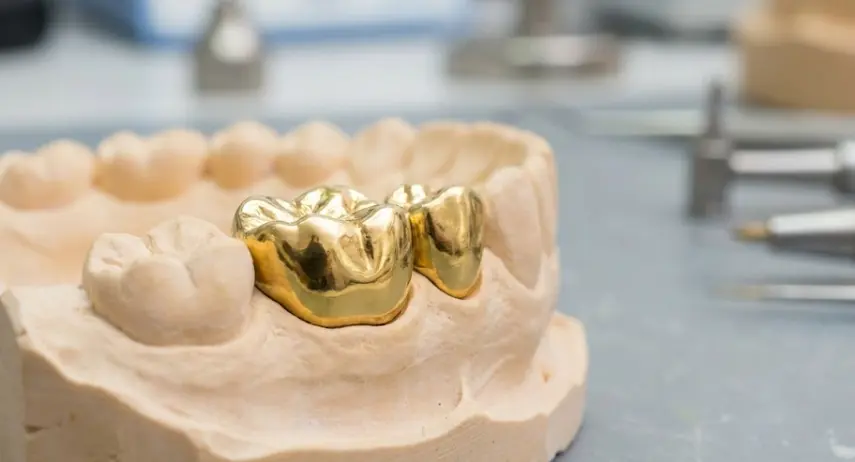
You might wonder why, in an age of 3D printing and digital zirconia, we still keep gold alloys in our toolkit. Professor Doctor Coşkun Yıldız often notes that from a purely mechanical standpoint, gold is the most “tooth-like” material we have.
Think of your natural teeth as a precision-engineered set of gears. If you introduce a gear made of a material that is too hard or too brittle, the whole system eventually fails. Gold is the “bespoke suit” of dental materials.
Dentist Polen Akkılıç and her team often recommend gold for back molars because of its unique physical properties:
- Malleability: Gold can be “burnished.” This means we can thin the edges of the crown down to a microscopic level, creating a seal against the tooth that is tighter than an eggshell’s skin.
- Kindness to Neighbors: Unlike some hard ceramics that can wear down the teeth they bite against, gold wears at almost the same rate as natural enamel.
- Strength in Thinness: We can make a gold crown very thin and it still won’t crack. This means we have to shave away less of your natural tooth structure compared to other materials.
The Fashion Comeback in Turkey
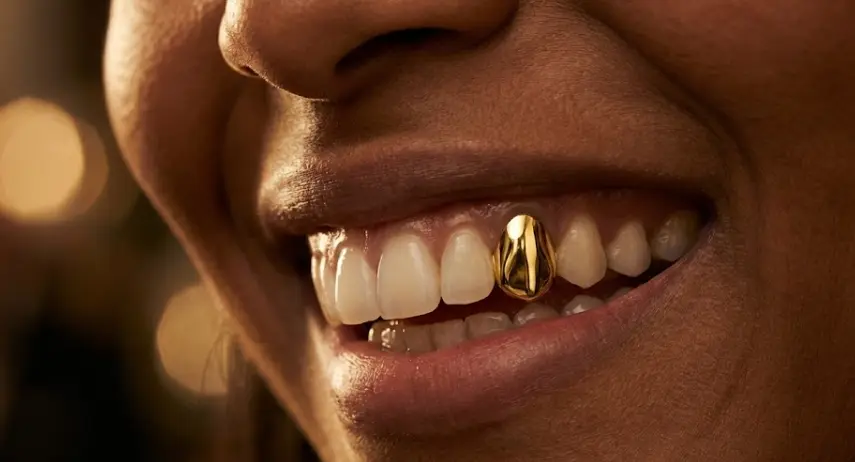
But let’s look closer at the other side of the coin. In Turkey, we are seeing a massive resurgence of gold not just for function, but for flair.
The question remains: is it just a trend? At Lema Dental Clinic, we see it as a shift in how people view their bodies. A gold tooth is a permanent piece of jewelry. It’s a statement of individuality. For some of our international patients, the flash of gold is a sign of “quiet luxury”—knowing that even their medical restorations are made of the finest precious metals.
Comparing the Modern Choices
When a patient asks if they should go with the “new” white materials or the “old” gold, we look at the data.
| Material Type | Is it still used? | Best For… | Lifespan | Aesthetic |
| High-Karat Gold | Yes (Premium) | Back molars, grinders | 30+ Years | Bold, Luxury |
| Monolithic Zirconia | Yes (Standard) | General durability | 15-20 Years | Natural, Tooth-colored |
| PFM (Metal-Ceramic) | Fading Out | Budget restorations | 10-15 Years | Natural with dark edges |
| E-Max Porcelain | Yes (High-End) | Front teeth, veneers | 10-15 Years | Highly translucent |
The Skill Behind the Shimmer
The truth is, many modern dentists don’t give gold teeth anymore because they’ve lost the skill to work with them. Designing a gold crown requires a different level of manual artistry than just clicking “print” on a machine.
At Lema Dental Clinic, we maintain that artisanal edge. Whether Professor Doctor Coşkun Yıldız is treating a patient who needs durability because they grind their teeth at night, or Dentist Polen Akkılıç is helping a patient achieve a specific “look,” the quality of the gold alloy we use in Turkey is of the highest medical grade, containing platinum and palladium for added stability.
FAQ: Straight Talk on Gold Teeth
This is a common myth. A gold crown itself cannot rot a tooth. Decay only happens if the seal between the crown and the tooth fails, allowing bacteria inside. Because gold allows for the tightest possible seal of any material, it is actually one of the best defenses against recurrent decay, provided you maintain good hygiene.
We focus on fixed prosthodontics—meaning permanent medical restorations like crowns and bridges that are cemented onto prepared teeth or implants. We generally do not craft removable “grillz” for purely cosmetic temporary wear, as our focus is on long-term oral rehabilitation.
High-quality dental gold is an alloy containing metals like platinum and palladium to stabilize it. In the vast majority of patients, there is absolutely no metallic taste. If you have a specific sensitivity to certain metals, we discuss alloy compositions during your consultation in Turkey to ensure safety.
Your back molars exert hundreds of pounds of pressure when you chew. They are the workhorses of the mouth. Gold’s ability to withstand this crushing force without fracturing, while being gentle on the teeth opposite them, makes it the ideal material for that high-stress environment.
Absolutely, provided you choose a reputable clinic. Turkey has become a global hub for premier dental care. At Lema Dental Clinic, we operate under stricter protocols than many European clinics, utilizing internationally recognized experts like Professor Doctor Coşkun Yıldız and advanced technology to ensure patient safety and results that last decades.
- Anusavice, K. J., Shen, C., & Rawls, H. R. (2013). Phillips’ science of dental materials. Elsevier Health Sciences.
- Donovan, T. E. (2016). Longevity of the tooth-supported metal-ceramic and all-ceramic fixed dental prostheses: A systematic review. Journal of Esthetic and Restorative Dentistry, 28(S1), S3-S5.
- Goodacre, C. J., Bernal, G., Rungcharassaeng, K., & Kan, J. Y. (2003). Clinical complications with implants and implant prostheses. The Journal of Prosthetic Dentistry, 90(2), 121-132.
- Milleding, P. (2018). Fixed Prosthodontics: Principles and Clinics. Quintessence Publishing.
- Rosenstiel, S. F., Land, M. F., & Fujimoto, J. (2015). Contemporary fixed prosthodontics. Elsevier Health Sciences.

