


Gold braces are effective, but their higher cost is mainly cosmetic.
Gold Braces: Luxury Orthodontics in Turkey
Fixing your smile is a significant decision. It’s a step towards a more confident future, a better reflection in the mirror and, let us face it, an investment in your own self. Although the first thing that comes to most people’s minds is the traditional “train track” ugly silver metal, orthodontics has brought us an extremely fashionable substitute nowadays. With the reliable traditional braces but at the same time with a warmer and more elegant finish, gold braces have become the top choice of patients at Lema Dental Clinic in Turkey.
But the question is, is it all about the “bling” or is it that there are medical reasons to go gold? The fact of the matter is that the choice of a bracket system is not only a question of fashion; it is all about how those materials are going to be in your mouth for the next one or two years.
What Are We Actually Talking About?
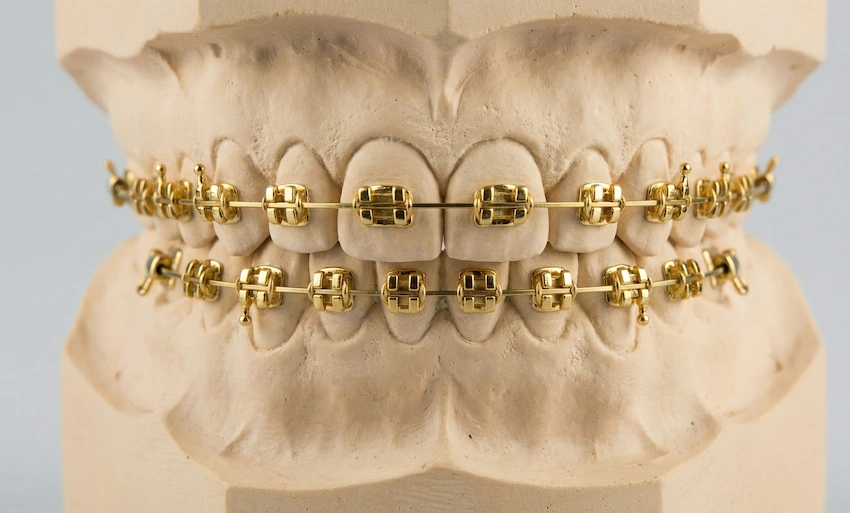
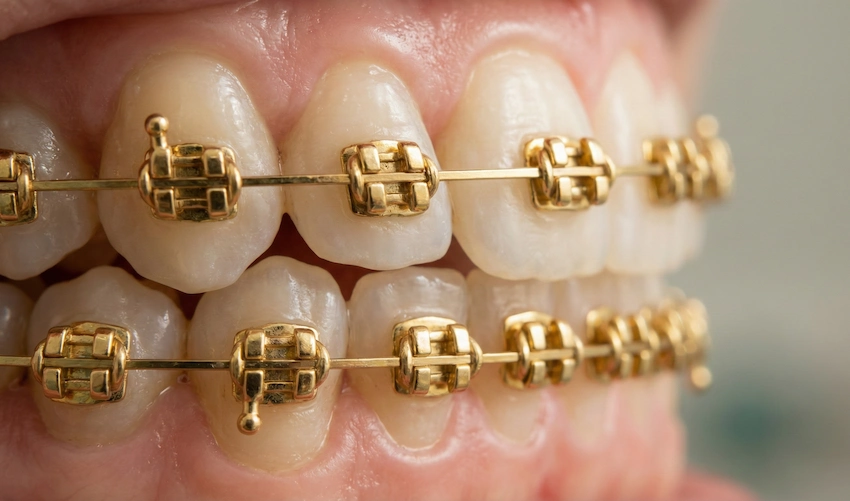
First of all, let’s get rid of the confusion in the air. Gold braces are not made of solid gold—that would be too soft to actually do the job of moving your teeth. They are, rather, high-grade, medical stainless steel covered with a lavish 24-karat gold layer. It’s like a top-notch Swiss watch. The internal parts are made for the heavy lifting and lasting precision; the outside is just meant to be looked at and admired for its elegance.
During the daily work at Lema Dental Clinic, Professor Dr. Coşkun Yıldız emphasizes that gold has a “quiet” luxury. Patients with metal braces do not suffer in silence but rather live in a gold-like calm, silky charm. Gold does not emit the terrible clinical sparkle of silver; instead, it beautifully blends with the natural enamel of your teeth and the gentle colors of your skin. It takes a medical appliance and turns it into something that feels more like a piece of jewelry that you have chosen to wear.
The Secret Benefit: It’s Not Just for Show
But if we take a closer look at the biology, things will become clearer. One of the most common cases that we usually see is patients with very slight sensitivities to nickel which forms part of the standard stainless steel. This is then followed by gum irritation or a “metallic” taste that does not go away.
Polen Akkılıç, the dentist, along with her staff, in the case of patients who have very delicate teeth and gums, they would choose gold-plating as their preferred option since gold is very much biocompatible. It is like using hypoallergenic-covered, smooth, and very compatible protection. Metaphorically speaking: if standard braces are heavy-duty work boots, gold braces are individualized leather loafers. They perform the same function, but the “upkeep” on your gums is much more sophisticated.
Breaking Down the Options: Which One Wins?
The question remains: does the performance match the price? Here is a raw look at how they compare in our Istanbul clinic.
| Feature | Gold-Plated Braces | Standard Stainless Steel | Clear Ceramic Braces |
| Vibe | Luxury / Warm | Industrial / Clinical | Discreet / Professional |
| Durability | Rock solid | Rock solid | Can chip or crack |
| Allergy Risk | Lowest (Hypoallergenic) | Moderate | Very Low |
| Treatment Speed | Fast & efficient | Fast & efficient | Slightly slower (friction) |
| Stain Resistance | High | High | Brackets stay clear; ties stain |
Why Patients Fly to Istanbul for the “Gold Standard”
The reality is that getting braces is a journey. At Lema Dental Clinic, we treat that journey like an architectural project. You wouldn’t renovate a historic building with cheap materials, so why would you do that to your face?
When you step into our clinic in Turkey, the process is far from “one-size-fits-all.” Professor Doctor Coşkun Yıldız uses high-definition 3D mapping to ensure that every gold bracket is placed with micro-precision. The goal isn’t just straight teeth; it’s a smile that fits your facial symmetry.
What we find is that our international patients love the “dual-purpose” of gold. You get the world-class clinical results Lema is known for, but you also get a look that stands out in a crowded world of silver and plastic.
Direct From the Doctors: FAQ
Honestly? No. The 24k plating is bonded to the steel at a molecular level. It’s designed to handle the “war zone” of the human mouth—acidic coffee, crunchy bread, and daily brushing—without losing its luster.
There is a premium, yes. However, because we operate in Turkey, the total cost for gold braces at Lema is often lower than what you’d pay for basic silver braces in London or New York. You get the upgrade without the financial sting.
Dentist Polen Akkılıç notes that the plating process actually smooths out the microscopic “pores” of the steel. Patients often report slightly less rubbing and irritation in the first few weeks compared to traditional metal.
You can, but most of our patients opt for clear or gold-toned ties. Why cover up the gold?
We usually see our gold-brace patients every 6 to 8 weeks for adjustments. Many of our patients turn these into mini-vacations, enjoying the Bosphorus while we fine-tune their smile.
- Arghavan, A., & Jamilian, A. (2023). Friction and Surface Analysis of Gold-Coated Orthodontic Materials. Journal of Oral Rehabilitation.
- Gkantidis, N., et al. (2021). Hypoallergenic Properties of Gold-Plated Dental Alloys in Orthodontic Patients. European Journal of Oral Sciences.
- Miller, R. J. (2022). Patient Perception and Aesthetic Preferences in Modern Orthodontics. International Dental Journal.
- Yıldız, C. (2024). Advancements in Digital Smile Design and Material Selection at Lema Clinic. Istanbul Medical Press.
- Zinelis, S., et al. (2020). Degradation and Wear Resistance of 24k Gold Plating in Oral Environments. Journal of Orofacial Orthopedics.

