


Fixing Gaps for Gum Health
Some people see a space between the two front teeth—technically called a diastema—as a pretty “beauty mark,” a unique feature of their smile. However, if we at Lema Dental Clinic in Turkey look at those spaces from the clinical perspective, then we stop talking about style and start talking about dental problems.
Although the patient’s face can greatly benefit from that, the biological truth is that it is usually underneath the gums. Professor Doctor Coşkun Yıldız frequently points out that teeth are intended to mutually support each other, similar to how stones in a Roman arch support one another. If the arch is broken by a gap, then the integrity of the whole structure is compromised.
The “Biological Food Trap”: A Quiet Danger
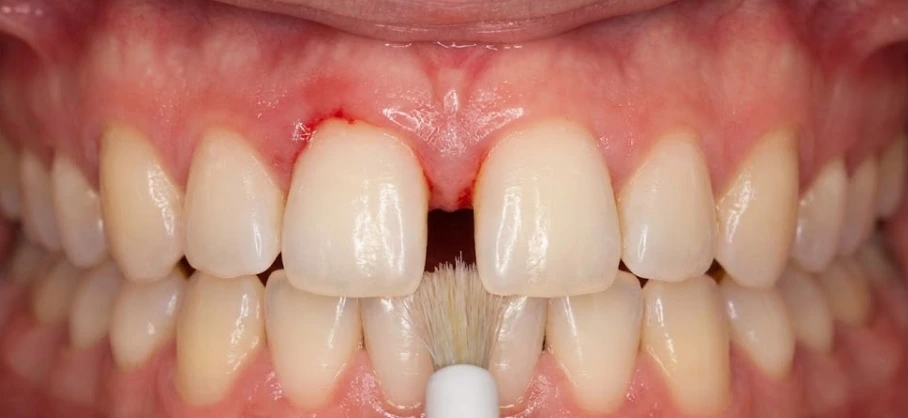
Your teeth are similar to a protective wall for your gums. When teeth are perfectly aligned and touching, they are like a shield, thus no food debris can hit the soft tissue. Whereas, if a gap is there, the shield is gone.
In fact, these gaps frequently turn into “food traps.” Each time you chew, small pieces are forced into the gap and they act like a biological wedge that irritates the gum. Eventually, this continuous trauma may cause inflammation at the site, which is the very early stage of periodontal disease. According to our clinic’s experience, a small gap is usually the start of a deep “pocket” where bacteria can multiply, and the toothbrush cannot reach there.
The Domino Effect of Shifting Teeth
Your teeth are not static objects; they are in a constant state of subtle movement. Dentist Polen Akkılıç and her team frequently explain to our patients that teeth are like books on a shelf. If you remove a book or leave a wide space, the neighboring books eventually tilt and lean into the void. This shifting can ruin your bite alignment (malocclusion), leading to unexplained jaw pain and even chronic headaches.
Comparing the Paths: To Treat or Not to Treat?
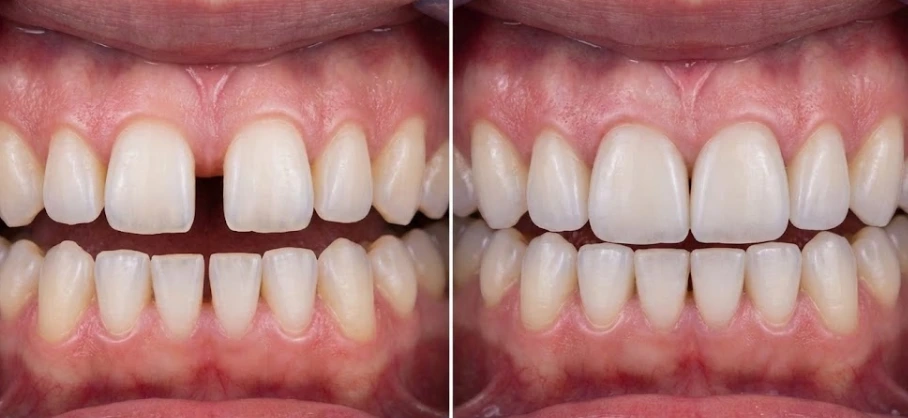
When patients visit us in Istanbul, we assess whether a gap is a stable “quirk” or a progressive health risk. Here is what we look for:
| Feature | Stable/Healthy Gap | High-Risk/Pathological Gap |
| Gum Condition | Firm, pink, and healthy. | Red, swollen, or prone to bleeding. |
| Bone Levels | Stable on X-ray. | Evidence of bone loss between teeth. |
| Tooth Stability | Teeth are firm in the socket. | Teeth feel “loose” or exhibit “drifting.” |
| Speech Impact | None. | Persistent whistling or “lisping” sounds. |
| Treatment Urgency | Low (Aesthetic choice). | High (Medical necessity). |
How We Close the Gap in Turkey
But let’s look closer at the solutions. Closing a gap isn’t just about “filling the hole”; it’s about restoring the biological seal of the mouth. At Lema Dental Clinic, we utilize several high-precision methods:
- Composite Bonding: For smaller gaps, this is like “sculpting” a new edge for your tooth. It’s fast and non-invasive.
- Porcelain Veneers: The gold standard for a permanent, “Hollywood” result. These act like a new, stronger enamel layer.
- Orthodontics: Sometimes, the gap is a symptom of a larger jaw alignment issue. Dentist Polen Akkılıç and her team use clear aligners to move the “foundations” of the teeth back into their correct positions.
The question remains: why come to Turkey for this? Beyond the cost savings, it is the concentration of technology. We use 3D digital smile design to show you exactly how closing a gap will affect your facial proportions before we even touch a tooth.
The “Silent” Risk of Bone Loss
Here is what we see in the clinic: when a gap is left untreated for decades, the bone in that empty space begins to atrophy. Since there is no tooth root to “exercise” that specific patch of bone, it melts away. This can eventually jeopardize the stability of the teeth that are there. By treating a diastema, you aren’t just buying a prettier smile; you are insuring the longevity of your natural teeth.
FAQ: Expert Insights on Teeth Gaps
Not necessarily. If the gap is small, you can keep it meticulously clean, and your bite is stable, it may just be an aesthetic choice. However, if you notice the gap is getting wider, it’s a sign of a deeper issue that needs immediate attention.
Indirectly, yes. If the gap allows for constant food impaction, it leads to gum disease. Severe gum disease is the number one cause of adult tooth loss because it destroys the bone holding the tooth in place.
Most of our gap-closure treatments at Lema Dental Clinic are virtually painless. Bonding and veneers require very little to no tooth reduction, meaning we can often perform the procedure without even needing a needle.
If we use bonding or veneers, we can often transform your smile in just 2 to 5 days. We work quickly to ensure our international patients can return home with a healthy, functional smile.
If the gap is causing documented gum disease or bite issues, it may be considered “restorative” rather than “cosmetic.” We provide all the necessary clinical documentation to help you with your claims back home.
- Al-Zarea, B. K. (2015). Aesthetic and hygiene-related satisfaction with the use of porcelain laminate veneers. Journal of Contemporary Dental Practice, 16(5), 345-350.
- Bernhardt, O., et al. (2007). The association between spacing and periodontal disease: A population-based study. Journal of Clinical Periodontology, 34(3), 214-220.
- Kim, T. S., et al. (2010). Relationship between interproximal contact loss and periodontal health. Journal of Periodontology, 81(11), 1559-1566.
- Oesterle, L. J., & Shellhart, W. C. (1999). Maxillary midline diastemas: A look at the causes. Journal of the American Dental Association, 130(1), 85-92.
- Takei, H. H., et al. (2018). Carranza’s Clinical Periodontology. Elsevier Health Sciences.

