


Yes, you receive temporary teeth.
Digital surgical planning ensures that the implant is positioned with great accuracy and at the same time, the surgical trauma is kept to a minimum. The patient benefits most from the faster healing, less post-operative discomfort, and improved soft tissue preservation around the implant.
Fixing temporary teeth is an integral part of the plan that serves to maintain your good function and appearance throughout the healing process. These temporary teeth not only safeguard the implant site but also help to shape the gums so that the final result appears natural.
Why Temporary Teeth Are Used During Implant Healing
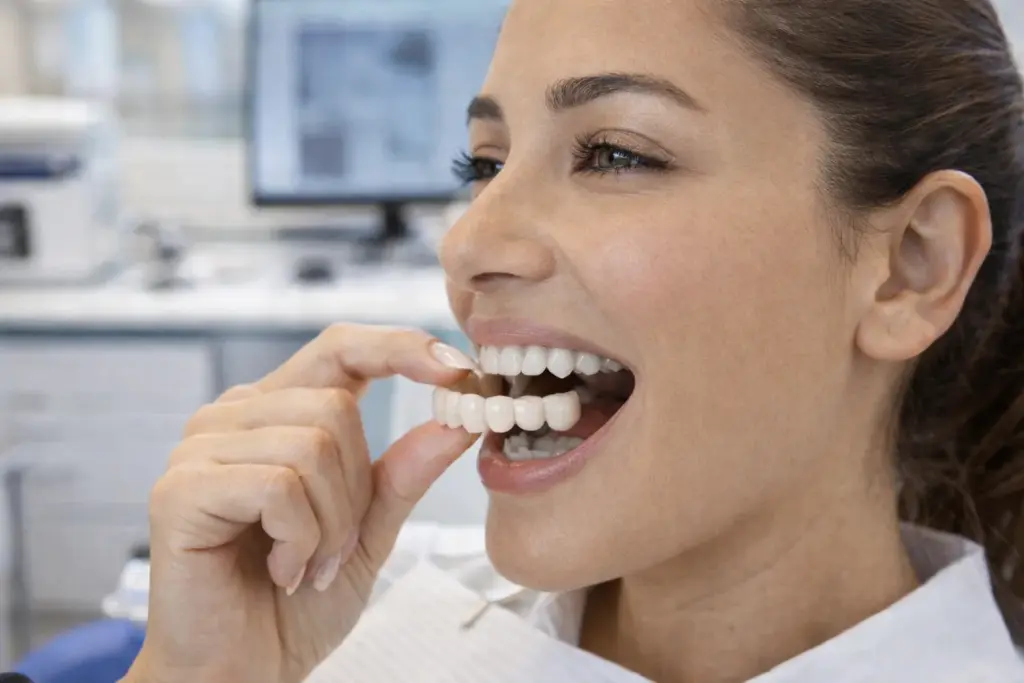
Temporary teeth allow you to continue using your mouth without difficulty and help keep your appearance during healing. The implant physically bonds with the jawbone through a biological process called osseointegration, which is later essential for long-term implant stability and generally takes several weeks to months.
Using temporary restorations also helps to prevent the neighboring teeth from moving and maintains the gum tissues well. When made correctly, temporary teeth also lessen the stress on the implant site thus enabling efficient healing.
Types of Temporary Teeth Used with Dental Implants
Choosing among the temporary teeth options is based primarily on clinical safety and personal comfort. All these options are meant to shield the implant area while at the same time enabling you to carry on with your activities comfortably.
| Temporary Tooth Type | When It Is Used | Key Benefits | Clinical Notes |
| Temporary Crown | If the implant has strong initial stability | Looks natural, permanently fixed | In immediate or early loading cases |
| Temporary Bridge | When multiple teeth are missing | Restores the smile and bite | The implant is not directly loaded. |
| Removable Flipper | When implant pressure needs to be zero | Inexpensive, simple to modify | Taken out during sleep for gum health |
| Temporary Denture | When several teeth are replaced | Chewing and speech functions are maintained | Designed to prevent the implant from being touched |
Immediate Temporary Teeth vs. Delayed Temporary Teeth
The immediate temporary teeth are fixed on the same day as the implant surgery if the primary stability of the implant meets the safety standards of the procedure. In this way, the patients are able to obtain fixed teeth from the clinic and continue their healing under controlled conditions.
When the quality of the bone is poor or the patient’s general health requires special consideration, a more conservative healing period may be required, and the delayed temporary teeth are fitted after the patient has healed enough. Implant success is given the highest priority with this method while also minimizing biological risk.
How Long Do You Wear Temporary Teeth Before Final Implants?
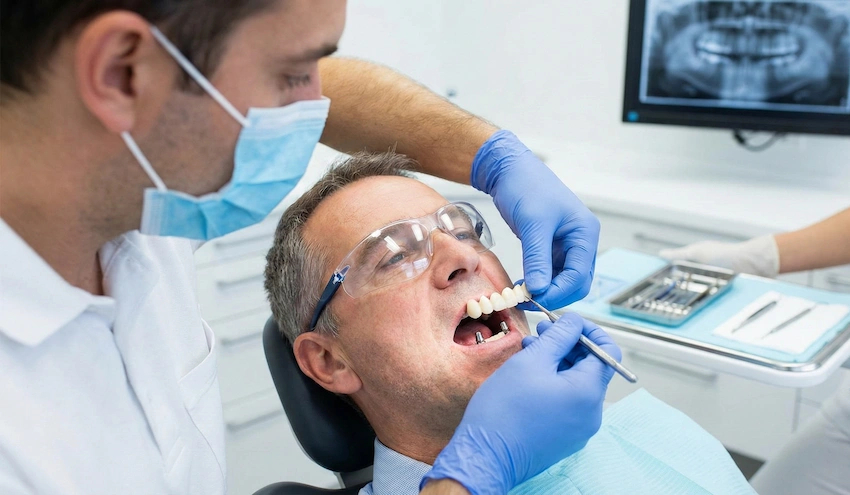
Your temporaries will remain in use until the implant has properly integrated into the bone and will be able to support the permanent crown. Bone density, implant type, and individual healing response determine the duration and it could be anything between 6 weeks to 6 months.
Your dental professional carefully watches the progress of the healing based on clinical exams and imaging to find out when is the safest time for placing the final restoration.
Advantages of Dental Implants at Lema Dental Clinic
Lema Dental Clinic provides the implants from globally acknowledged dental systems that have proven clinical success on many occasions. The choice of implant is determined by the density of the bone, anatomical constraints, as well as the long-term biomechanical performance, in order to facilitate reliable osseointegration.
Your temporaries will remain in use until the implant has properly integrated into the bone and will be able to support the permanent crown. Bone density, implant type, and individual healing response determine the duration and it could be anything between 6 weeks to 6 months.
The patient benefits from healing faster, experiencing less post-operative discomfort, and better soft tissue preservation around the implant because digital surgical planning makes sure that the implant is accurately positioned and that, at the same time, surgical trauma is minimized.
Part of the plan to keep you functioning well and looking good throughout the healing process is the fixing of your temporary teeth. Not only do these temporary teeth protect the implant site, but they are also instrumental in the formation of the gum so that the final result looks natural.
Patient safety is ensured at all stages by the use of sterilization procedures,highly technological surgical rooms, and clinical monitoring. Post-operative care focuses on implant maintenance, oral hygiene instruction, and long-term success.
American Academy of Implant Dentistry. Dental Implant Treatment Guidelines.
American Dental Association. Dental Implants: What You Should Know.
International Team for Implantology. Consensus Statements on Implant Loading Protocols.
FAQs About Temporary Teeth While Waiting for Implants
Mostly, implant treatment plans feature temporary teeth as a way to continue having a chewing function, being able to speak clearly, and looking good until the implant is completely done healing.
Depending on the stability of the implant and the healing requirements, the dentist may use temporary crowns, temporary bridges, removable flippers, or temporary dentures.
Temporary teeth can be completely safe, in fact, when a temporary appliance is designed and properly fitted, it is meant to help the implant site avoid excessive force and thus support good osseointegration.
Wearing temporary teeth depends primarily on how well and how fast your bone heals and also on you and the type of your implant. Usually, the time varies anywhere between 6 weeks and 6 months.
Yes, you will be able to eat, but the dentist will likely advise you to eat soft foods and to use the least amount of force when biting so you don’t hurt or stress your implant during the period of healing.
Yes, temporary teeth, with today’s technology, are crafted to imitate natural tooth aesthetics, including shape and color, thereby allowing one to flaunt a beautiful smile throughout the course of the dental work.
If properly fitted, temporary teeth should be pretty stable; however, they will most likely need to be re-fitted during the course of healing to keep the patient’s level of comfort and safety.

