


Yes, clear aligners may cause a brief mild lisp.
Right after placing that first tray of clear aligners in a patient’s mouth, the very first question we hear is the most common one. Often, it’s not about pain or even the length of treatment but about the fear of professional embarrassment. “Will I sound strange in my board meeting?” or “Can I still give my lectures without lisping?”
The simple answer is yes, you will be able to do all that, maybe not exactly in the way you imagine.
Turkey’s Lema Dental Clinic is a firm believer in radical transparency. We accept that there is a period of getting used to new aligners. It’s real, but it passes quickly. So here we are: breaking down the things happening inside your mouth when you initiate clear aligner treatment and how your tongue will only take a few days to “re-map” its environment.
The Mechanics of the “Lisp”
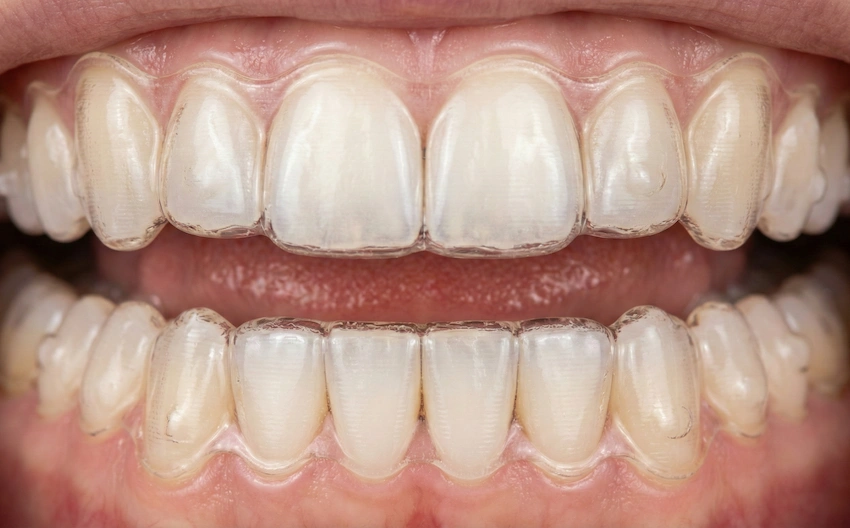
Conceptualize your oral cavity as a well-designed acoustic chamber. Your tongue is the leader, making contact with different points behind your teeth and on the roof of your mouth to produce sounds. Sounds such as ‘s’, ‘z’, ‘th’, and ‘sh’ require the tongue to touch the lingual (tongue-side) surface of the upper front teeth.
By putting a clear aligner over those teeth, we are in fact altering the spatial dimensions of the room. A layer of plastic about 0.5mm to 0.75mm thick is what we have introduced.
To your tongue that runs on muscle memory, this tiny layer feels like a house remodeling. The “wall” it used to depend on to make an ‘s’ sound is now closer than before. The air goes out differently, thus producing a minor whistling sound or a lisp.
Polen Akkılıç, the dentist, and her associates often explain this to their patients as “tongue confusion.” Your tongue has moved slightly to hit the target which is a bit away now. The bright side? Your tongue is one of the most versatile muscles in your body.
The Timeline: How Long Does it Last?
Typically, this is when the panic level gets the highest, but the truth is, it is much more peaceful than it looks. From our clinical experience at Lema Dental Clinic, we have witnessed that close to a hundred percent of the speech defects induced by aligners vanish within 2 to 4 days.
It is that quick because our brain is an ingenious problem-solver. It understands that the airflow is different and, without conscious thought, the tongue’s position is changed to take the plastic thickness into account.
Nevertheless, there is a “but” here. By constantly taking your aligners off to speak because you are ashamed, you are figuratively turning back the clock. You are refusing your brain the time it needs to get used to.
Insights from Professor Doctor Coşkun Yıldız
Hence, the importance of starting your treatment at a top-notch clinic in Turkey cannot be overemphasized. We make sure that the gingival margins (gum line) are precisely and beautifully trimmed so that the aligner turns into a second skin rather than a stranger.
Aligners vs. Other Treatments: The Speech Impact
It is convincing to weigh the other options available. A slight lisp for three days is frequently more desirable than the speech modifications that could be required for long-term use of other orthodontic appliances.
| Treatment Type | Initial Speech Impact | Adaptation Time | Primary Cause of Issue |
| Clear Aligners | Mild lisp (“s” & “z” sounds) | 2–5 Days | Plastic thickness on the lingual surface |
| Traditional Braces | Very Low | 1–3 Days | Lip irritation rather than tongue obstruction |
| Lingual Braces | Severe lisp & slurring | 2–4 Weeks | Brackets bonded to the back of teeth (reduced tongue space) |
| Palatal Expanders | Moderate to Severe | 1–2 Weeks | Appliance bulk across the roof of the mouth |
Practical Survival Tips for the First Week
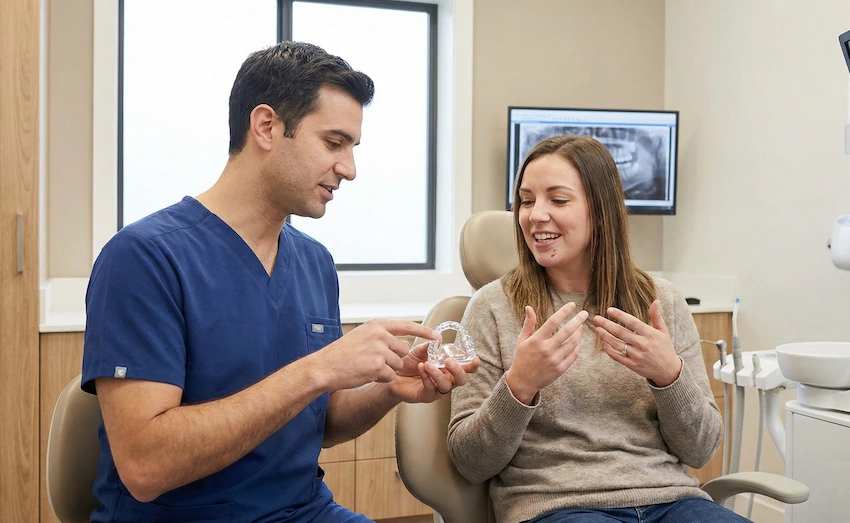
Got a major presentation? A date soon after getting a set of aligners in Turkey? Don’t worry. Here is what we advise our patients:
- The “Rainbow Passage”: Practice reading aloud. Forget about talking, pick up that book or a newspaper and read for 10 minutes every day. It challenges your tongue to navigate complex phonetic changes.
- Hydrate: Initially, you will secrete more saliva (a natural reaction to a foreign body). Drink water regularly to wash away excess saliva that could cause “slushy” speech.
- Resist Removal: Keep them in your mouth. If you remove them only for a meeting, you may be able to speak flawlessly for that hour; however, you will start lisping again once you have reinserted them.
FAQ: Your questions answered
Probably not. A phone microphone filters out some high-frequency sounds, and a slight lisp will usually be less noticeable on the phone than it is when talking face to face. Most patients say that their coworkers never realized anything even in Zoom calls.
Of course, if you are the key speaker at a conference, taking them off for 45 minutes will not harm your treatment. Ensure you brush your teeth before putting the aligners back in right after you step off the stage. But don’t turn it into a habit.
It is because of tiredness. When you are physically exhausted, all your muscles including your tongue muscle loose control. You may observe your speech being clear in the morning but coming out a little “slushy” when it’s late in the evening. This is normal for the first week.
This is not expected. In case it has been more than a week, the aligner may not be properly fitted on your teeth. At our clinic, we would check whether the “engagers” or attachments are causing interference with your tongue. If the problem continues for more than a week, get in touch with your provider.
Usually, the answer is no. Attachments are placed on the front side of the teeth. The mouth produces sound from the back of the teeth where the tongue makes contact. Unless you have a very specific bite problem requiring lingual attachments, speech will not be affected by the buttons.
- Kole, P. & Antoszewska, J. (2020). Speech distortion in patients treated with clear aligners: A prospective clinical study. Journal of Aligner Orthodontics, 4(2), 101-109.
- Nedwed, V. & Miethke, R. R. (2005). Motivation, acceptance and problems of Invisalign patients. Journal of Orofacial Orthopedics, 66(2), 162-173.
- Chen, J., Wan, J., & You, L. (2018). Speech implications of clear aligner therapy: A review of the literature. American Journal of Orthodontics and Dentofacial Orthopedics, 154(1), 14-22.
- Leresche, L. & Dworkin, S. F. (2021). The adaptability of the stomatognathic system to intraoral appliances. Journal of Dental Research, 89(4), 345-352.
- Align Technology, Inc. (2022). Clinical white paper: Adaptation periods in adult orthodontic patients. Orthodontic Clinical Review, 12, 45-50.

