


Diamond embedded veneers fuse real diamonds into porcelain for a permanently brilliant smile.
Everyone appreciates the impact a smile can make. The smile is capable of opening many doors and is the universal language of confidence. However, some patients want not just a clean slate but a signature smile – something genuinely unforgettable.
In fact, today’s dental treatments go much further than whitening. At present, dental artworks and fine jewelry designs are combined in the smallest details for dental. The outcome is instant diamond-embedded veneers.
Rather than following the textbook, let’s step into the treatment room. This is the way we produce these amazing smiles at Lema Dental Clinic in Turkey.
The Art and Science of Sparkle
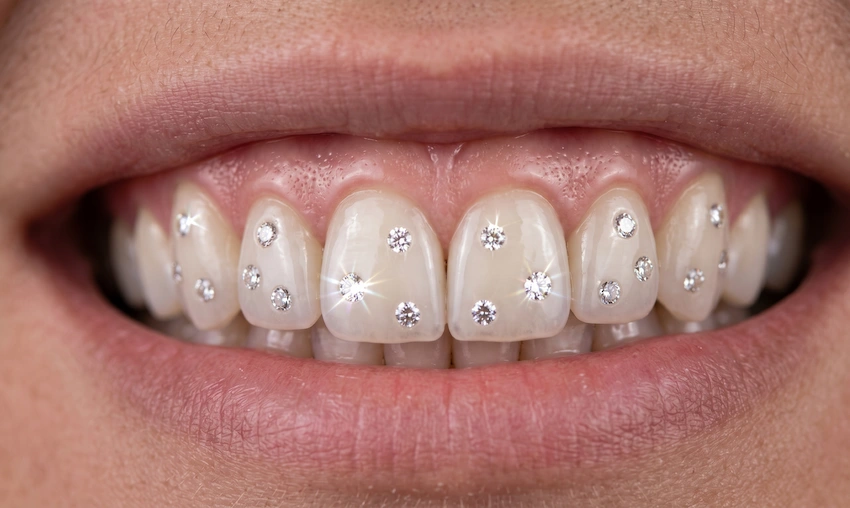
What are diamond-embedded veneers, really? Let’s face it, if you see them, you would think that those are crystals glued on teeth by teenagers. But take a look carefully, it is quite something else.
Besides a classic, properly designed porcelain veneer, it is like a tailored silk suit that fits perfectly and looks very natural. A diamond is like a platinum cufflink you wear. It doesn’t speak loudly of itself, but just at a meeting when you open your mouth to speak or laugh, the light is reflected so sharply and unexpectedly that it will really catch your eye.
Professor Doctor Coskun Yıldız says that the key is holding back. “You should never completely mask the original mouth shape,” he says. “The diamond should be there as a small flourish. That is why it is not the main attraction. We must be able to model the light reflection, the lip movement, and the ceramic thickness perfectly.”
The Clinical Process
Based on our practice at Lema Dental Clinic, the vast majority of patients are surprised at the craftsmanship that goes into the creation of this look.
This is what we find happening at the clinic when Dentist Polen Akkılıç and her assistants get a patient ready. We do not stick a jewel to the veneer’s outer side only. The stone sticking out, rubbing your inner lip, and after the very first time of biting the crisp apple – breaking off is exactly what would happen if we did.
What we do is apply very small instruments.
- Mapping the Smile: Digital screens are used to precisely find out where the light falls on the front teeth.
- The Micro-Cavity: Skilled tooth makers carve a very small “nest” in the raw E-max or zirconia material.
- The Embedding: The diamond of high quality and without any flaws is lying flat inside the tiny hole.
- The Seal: Powerful dental resins are employed to make the stone a permanent part of the ceramic.
Once the veneer is glued to the real tooth, the surface is smooth. Your tongue will therefore keep gliding over the surface without getting caught.
Lifestyle Comparison of Options

For upgrading a smile, knowing options is very important.
| Feature | Temporary Tooth Gems | Standard E-max Veneers | Diamond Embedded Veneers |
| Material | Cheap glass or crystal | Strong porcelain (E-max) | E-max + Real Diamond |
| Application | Glued on top (temporary) | Bonded to the tooth | Stone sealed flat in ceramic |
| Lifespan | 1 to 6 months | 10 to 15+ years | 10 to 15+ years |
| Feel | Bumpy surface | Perfectly smooth | Perfectly smooth |
| Skill Level | Low (DIY kits) | High (Cosmetic Dentist) | Elite (Master Ceramist) |
Why is Turkey the Place for Your Diamond Smile?
For a lot of people, the biggest question is: why fly halfway around the world for this sort of thing?
The reason is quite straightforward. It is a combination of advanced technology, outstanding art, and daily work. Nowadays, Turkey is the world capital of cosmetic dentistry. The Lema Dental Clinic team can complete any complex smile makeover every day. However, since our team also deals with many different custom requests, placing diamonds into thin veneers is something our lab does pretty much naturally.
VIP patient care is part of what we do as well. Airport ride and luxury hotel booking are the two main services that we provide to make your trip as great as your transformed smile.
Patient FAQ: Doctor’s Desk Perspectives
Even if you ate a steak, you wouldn’t have to worry. The stones are embedded quite deeply into the porcelain. Afterwards, we seal them with a clear resin. They become a single solid piece with the veneer. Their insecurities in terms of reliability are next to none.
It is quite the opposite of damaging the tooth. The diamond is put into the porcelain veneer before it finally reaches your mouth. We give the natural tooth the same treatment as we would with a normal veneer. The real tooth enamel never comes in touch with the diamond.
We are talking permanent alteration of the veneer in this case. Therefore, even if in five years you decide to go for a plain look, you cannot simply remove the diamond. You will have to replace that single veneer. It is a statement of who you are, styling-wise.
We request that you stay in Turkey for about 5 to 7 days. That will allow us not only to prepare your teeth but also the time for our expert lab to make the veneers and embed the stones. Subsequently, fitting them lastly over two or three relatively quick clinic visits.
Indeed, you can. Look at the diamond as the regular part of your tooth. Just as always, you brush, floss, and use mouthwash. The diamond’s sparkle will not be affected by regular toothpaste.
- Coachman, C., Calamita, M. A., & Sesma, N. (2012). Dynamic documentation of the smile and the 2D/3D digital smile design process. International Journal of Periodontics & Restorative Dentistry, 32(4), 415-423.
- Edelhoff, D., & Sorensen, J. A. (2002). Tooth structure removal associated with various preparation designs for anterior teeth. The Journal of Prosthetic Dentistry, 87(5), 503-509.
- Magne, P., & Belser, U. (2002). Bonded porcelain restorations in the anterior dentition: a biomimetic approach. Quintessence Publishing Company.
- Peumans, M., Van Meerbeek, B., Lambrechts, P., & Vanherle, G. (2000). Porcelain veneers: a review of the literature. Journal of Dentistry, 28(3), 163-177.
- Radz, G. M. (2011). Minimum thickness anterior porcelain restorations. Dental Clinics of North America, 55(2), 353-370.

