


One of the most important things that a person should take care of is their oral health, which is directly related to his overall well-being. Besides disease prevention, regular dental visits play a major role in the early detection of potential issues. Nevertheless, the high cost of dental treatments is a discouraging factor that keeps a lot of people away from going to the dentist. The situation is relieved a bit by dental plans and dental insurance. These are different forms of protection, and the first step towards making a right decision concerning your dental care and finances would be to understand the distinction between them.
We at Lema Dental Clinic are all about giving our patients the top-notch care they deserve. Our staff, led by Dentist Polen Akkılıç and her team and Professor Doctor Coşkun Yıldız, offer guidance on the most appropriate dental coverage, whether through dental plans or insurance. In this article, we will explore the differences, benefits, and considerations of dental plans vs. dental insurance to assist you in coming up with the right decision based on your requirements.
What Is a Dental Plan?
A dental plan is a simple and economical way to get dental care at a lower cost without going through the complications of insurance. Generally, it works with the patients being allowed to go to a network of dentists who have agreed to provide care at a lower price. Some people will find dental plans suitable, especially when it comes to getting the routine work done like cleaning, checkups, and other preventive procedures. These plans aim to make dental care affordable and reachable by offering fixed prices for the services rendered.
Key Features of Dental Plans:
- Lower Monthly Premiums: In general, dental plans have lower monthly fees than dental insurance and thus are more affordable for the routine care that is characteristic of most people.
- Focus on Prevention: Normally, cleaning, doctor visits, and X-rays are included in such plans, which are basic for keeping oral health for a lifetime.
- Without Deductibles or Co-pays: The majority of dental plans are based on a fixed pricing system, thus there are no deductibles or co-pays for basic services.
If someone is looking to reduce the costs of preventive care, dental plans would be the correct option and without a doubt a great alternative. However, the insurance coverage that the plans provide is typically limited for cases such as restorations, root canals, or orthodontics. Knowing that dental plans will not cover the costs of such treatments is very important, and patients might have to pay for these dental services out of pocket.
What Is Dental Insurance?
Dental insurance, conversely, offers more extensive coverage than the above-mentioned plans. It accepts a larger volume of dental services, including preventive, restorative, and even cosmetic treatments, depending on the policy. Although dental insurance premiums are likely to be higher than those of the dental plans, it entitles the patients to get extensive care, and therefore, they can undergo such treatments as crowns, bridges, implants, and orthodontics.
Key Features of Dental Insurance:
- Full-Service Coverage: Typically, dental insurance covers a variety of treatments, including preventive care, restorative work, and even complex procedural.
- Higher Costs: Dental insurance is associated with higher monthly premiums, but it is meant to reduce these premiums by covering the expensive treatments.
- Annual Maximum Benefits: Most dental plans have an annual maximum that limits the number of covered services or the amount of money an insurer will spend in a given year.
With dental insurance, the worries about costly dental procedures can be put to rest. When a patient has dental insurance, he/she can undergo a certain range of procedures with a lowered out-of-pocket cost and therefore, he/she can put his/her dental health concerns first without being afraid of spending too much.
| Feature | Dental Plan | Dental Insurance |
|---|---|---|
| Coverage | Limited to preventive services | Covers preventive, restorative, and cosmetic procedures |
| Cost | Lower monthly premiums | Higher premiums with more extensive coverage |
| Out-of-Pocket Expenses | Fixed pricing for covered services | Co-pays, deductibles, and coinsurance |
| Ideal For | Routine care and prevention | Comprehensive treatment and major procedures |
| Network Restrictions | Limited network of providers | Larger networks and more flexibility |
The Benefits of Dental Plans and Dental Insurance
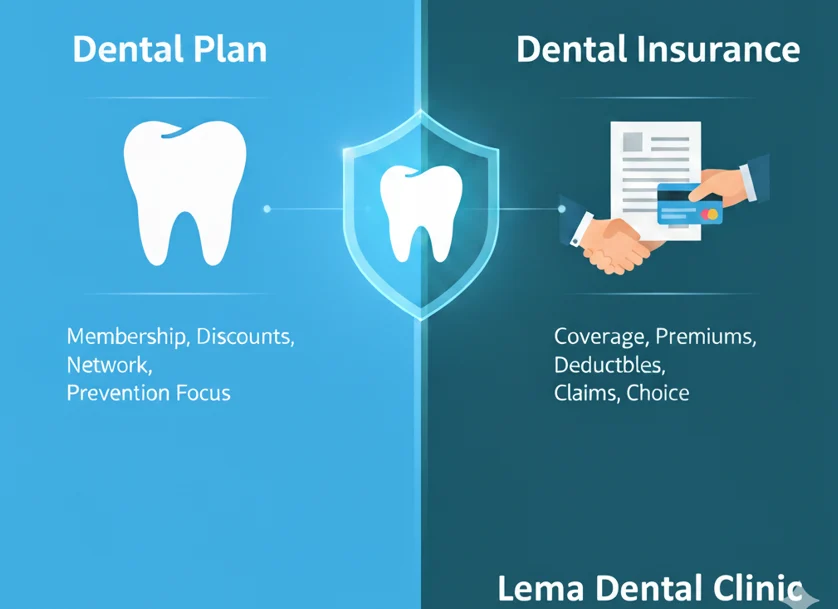
Dental plans and dental insurance both are sources of significant benefits to patients, to the extent that they will decide on them according to their needs. Here is a summary of the main benefits of each:
Benefits of Dental Plans:
- Budget-Friendly: Dental plans are a money-saving option that makes routine dental care available to singles, and families.
- Easy: With set rates, people are free from the stress of complicated insurance paperwork or submission of claims.
- Preventive Care Commitment: The focus of dental plans is on regular care, thus, problems are prevented from becoming costly beforehand.
Benefits of Dental Insurance:
- Extensive Coverage: Dental insurance is a cover that provides the patient with treatment opportunities from various fields; including major dental work normally not covered by dental plans.
- Monetary Safeguard for Major Treatments: The insurance does the role of a protective shield to lessen the financial burden of restorative treatments such as root canal, crown, and implants.
- Versatility: Patients are allowed to choose among a greater number of healthcare providers and have more treatment options.
How to Choose the Right Option for Your Dental Care
Whether to go for dental insurance or a dental plan is a decision that should be made based on one’s oral health needs, budget, and goals regarding the treatment. If it is the case that you are healthy and all you need is a routine care of cleanings and checkups, then a dental plan might be the cheapest and most reasonable alternative for you. At the same time, in case you have complex dental needs or foresee that you are going to be in need of extensive treatments, dental insurance will be a better option as it will enable you to spread the costs over time.
Considerations When Choosing:
- Evaluate Your Oral Health Needs: If preventive care is all that you want to maintain, dental plans will be just right for you. However, individuals with complicated dental requirements may be better off with dental insurance as it offers full coverage.
- Consider Your Finances: Generally, dental insurance premiums are a bit expensive, but the extra coverage can be a great investment if you are planning to have costly procedures. Those who choose dental plans are people with a limited budget and who do not anticipate any major dental works.
- Know the Limitations of Your Coverage: Identify the coverage and non-coverage of the plan by reading the details thoroughly. A dental insurance offers more extensive coverage; however, it may have some limitations, e.g., annual maximums or certain procedures exclusion.
Discussing your concerns with dental professionals at Lema Dental Clinic such as Professor Doctor Coşkun Yıldız or Dentist Polen Akkılıç and her team, will provide you with more clarity about your possibilities and assist you in finding the most suitable coverage for your dental needs.
Dental Plan vs. Dental Insurance: What Works for You?
It is a choice between a dental plan and dental insurance that should ultimately be decided according to your particular dental needs, financial position, and preferences. Those who only require routine dental care will benefit from a dental plan and may see it as enough and more cost-effective, whereas those who need extensive procedures will be in a better position if they have dental insurance which provides wider coverage.
At Lema Dental Clinic, we are aware that dental coverage is not a simple matter, and we can help you understand your options. Whichever you decide on – a dental plan, or insurance – our commitment to you is the same; quality, affordable care, customized to your needs.
Conclusion: Protecting Your Smile
Your smile is a very notable part of your overall health and good condition. Knowing what dental plans are and what dental insurance is will give you a chance to decide in a wise way how to protect your oral health in the best way. With the help of professionals like Dentist Polen Akkılıç and her staff and Professor Doctor Coşkun Yıldız, you can relax knowing that you are getting the best care, be it through preventive treatments or more advanced-handed procedures.
Working with Professor Doctor Coşkun Yıldız, you can be confident that you are receiving the best care, whether that be through preventive treatments or more advanced procedures.
Remember to set a time aside for checking your oral health condition and picking the option that matches your lifestyle and wallet. In line with the well-known saying, “Prevention is better than cure,” if you have the perfect coverage, you will be able to keep your teeth healthy and smile attractive throughout your lifetime.
Dental Plans vs. Insurance: Your Top Questions Answered
Dental insurance covers a wide range of services, including preventive care, restorations, and sometimes cosmetic procedures.
Dental insurance costs vary based on the coverage level but typically have higher monthly premiums than dental plans.
Yes, dental plans usually have lower monthly premiums but offer limited coverage for major treatments.
Some dental insurance plans do cover orthodontic treatment like braces, though coverage may vary.
Dental plans offer discounts for specific services, while dental insurance provides broader coverage, including major procedures.
Yes, many dental insurance plans have a waiting period before certain procedures are covered, especially for major treatments.
Yes, dental plans typically exclude coverage for more complex treatments, such as implants or orthodontics.
Yes, you can switch, but you may need to compare the coverage options and premiums before making a decision.
Evaluate your dental needs and budget. If you need routine care, a dental plan might suffice; for extensive treatments, consider dental insurance.
References
- Allin, S., Farmer, J., Quiñonez, C., Peckham, A., Marchildon, G., Panteli, D., … Henschke, C. (2020). Do health systems cover the mouth? Comparing dental care coverage for older adults in eight jurisdictions. Health Policy, 124(9), 998‑1007.
- Zivkovic, N., Aldossri, M., Gomaa, N., Farmer, J. W., Singhal, S., Quiñonez, C., & Ravaghi, V. (2020). Providing dental insurance can positively impact oral health outcomes in Ontario. BMC Health Services Research, 20, 496. https://doi.org/10.1186/s12913‑020‑4967‑3BioMed Central+1
- Moharrami, M., Sano, Y., Hu, X., Clarke, J., McLeish, S., & Fortin, Y. (2024). Assessing the role of dental insurance in oral health care disparities in Canadian adults. Health Reports.https://doi.org/10.25318/82‑003‑x202400400001‑engwww150.statcan.gc.ca
- Srivastava, P. (2014). Oral health, dental insurance and the demand for dental care: Evidence from Australian adults. Working Paper, Monash University. Retrieved from https://www.monash.edu/__data/assets/pdf_file/0005/896675/workingpaper01‑14.pdf

