


A dental implant is a permanent artificial root that preserves your jawbone, while a bridge only covers the visible gap by relying on neighboring teeth.
Losing a tooth leads you into a rather difficult situation where you will have to make a very drastic decision regarding your oral health. Patients coming to Turkey mostly have only two options in the end: either getting a dental implant or a dental bridge.
Although the initial price and recovery periods may look different on the surface, you need to consider much more than that to choose the most suitable solution for you. Not only about fixing a visible gap in your smile being fixed. Rather, you are actually making a very crucial decision that will have a great impact on the bone of the jaw as well as your remaining natural teeth for a considerable length of time. So, making a right decision is really based on the knowledge of what’s happening below the surface.
Understanding the Differences
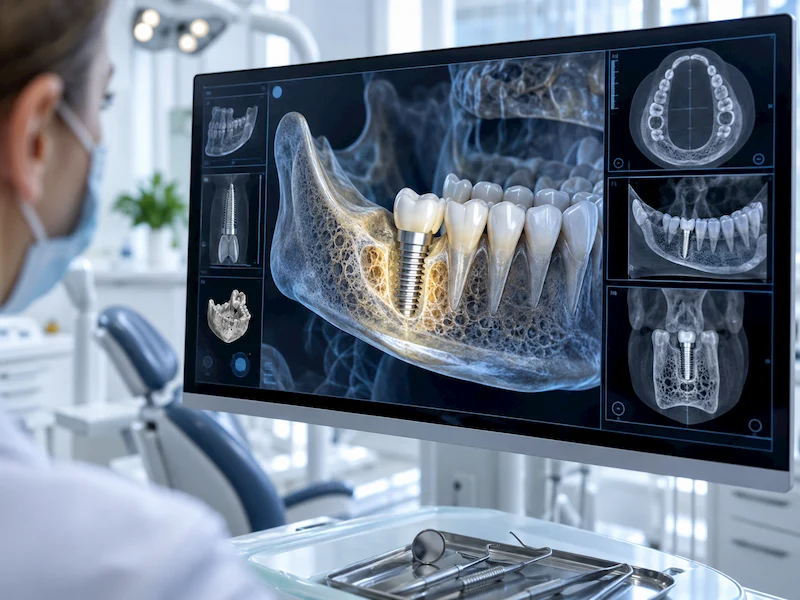
It’s only natural to think in terms of tooth replacement: they are not only missing one tooth but also the bone which would normally hold it. The major distinction between dental bridges and dental implants is the way how they restore the missing tooth. A dental bridge actually is quite self-explanatory as the name implies – it spans the gap or fills it. The dental implant is a separate one that does not depend on the neighbouring teeth in order to stay in place.
To make the dental bridge the false tooth is held by the two dental crowns. In order to keep this false tooth firmly in place you actually cement the crowns onto the two natural healthy teeth which are sitting on either side of the gap.
A dental implant supports itself completely. Unlike a bridge, it doesn’t rely on your other teeth for anchorage. Instead, a surgical procedure will allow the placement of a tiny titanium post directly into your jawbone as a substitute for a tooth root. This bone will eventually surround the post really tightly and once it reaches this point a custom-made ceramic crown is fixed on top.
Awareness of Biological Cost Hidden in the Bridge
In the past, a dental bridge had a reputation of being the tooth replacement method that was absolutely best. Their aesthetic appeal as well as the functionality of chewing restoration was the main reason. Unfortunately, they do come with a very significant biological downside about which not a lot patients are informed at the initial stages.
In getting the dentist to place a traditional bridge for you, two of your most important teeth would be permanently altered because your dentist can no more use their shape and function and has to reshape them. Basically you are giving up the two perfectly healthy teeth to make the one single tooth come alive again.
Also because the false tooth is just laying on the top of the gums it isn’t sending any messages to the body below the gum line about a chewing force being applied on the surface below. As Professor Doctor Coşkun Yıldız usually emphasizes to our clients, the jawbone needs chewing as a source of mechanical strain to stay strong. If there is no tooth root at all, then the jawbone around it gets very loose, the process leads to facial shape changing and early aging.
The Reason why Implants Are the Preferred Option nowadays
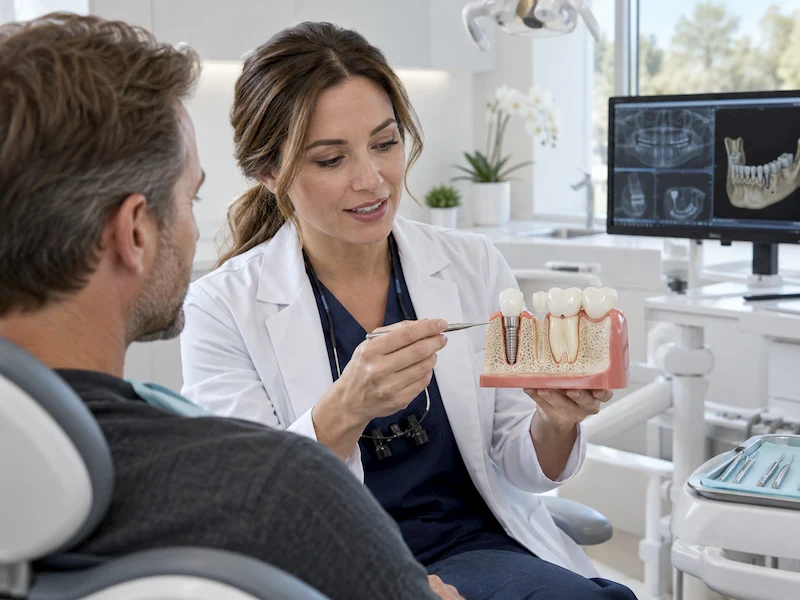
Dental implants eliminate the disadvantages of the bridge, the bone is saved from any loss. As a consequence of being directly embedded in the bone, the titanium implant behaves exactly like a natural root.
The fact that it can prevent bone loss is one of the biggest achievements here, each chewing movement, which is translated through the implant to the bone, will do it. More importantly, dental implants allow your neighbouring natural teeth to retain their health and not to have any changes.
Our clinic Lema Dental Clinic sees a high number of international clients who decide on the preservation of their jawbone in case of the extraction of a single tooth as the main reason for choosing implants. Dentist Polen Akkılıç and our surgical department use high-resolution 3D volumetric scanning technology to place each titanium root with mathematical accuracy and it is a factor of the high comfort and a long lifespan of the implant that we want for our patient.
Feature Comparison at a Glance
| Feature | Dental Implant | Dental Bridge |
| Jawbone Preservation | Stops bone loss by acting as an artificial root. | Does not prevent bone loss beneath the gap. |
| Impact on Other Teeth | Zero impact. Adjacent teeth are left entirely untouched. | High impact. Healthy neighboring teeth must be shaved down. |
| Average Lifespan | Designed to last a lifetime (15-20+ years for the crown). | Typically needs replacement every 10 to 15 years. |
| Treatment Timeline | 3 to 6 months (requires bone healing time). | 1 to 2 weeks (immediate cosmetic result). |
Making the Right Choice
A dental bridge might be the better choice if:
- The teeth adjacent to your missing tooth are already heavily decayed or filled, meaning they already need crowns anyway.
- You have suffered severe jawbone loss in the area and are not a candidate for bone grafting surgery.
- You need a faster fix and cannot wait the months required for an implant to heal.
A dental implant is the superior choice if:
- You want a permanent, lifetime solution.
- The teeth next to the gap are completely healthy.
- You want to preserve your natural jawbone structure and facial aesthetics.
- You want a replacement that feels, flosses, and functions exactly like a real tooth.
Dental implants are certainly the best investment option the majority of people making a one-time payment for the improvement of their dental health would ever have.
Frequently Asked Questions
1. Are dental implants much more expensive than bridges in Turkey?
Historically, implants have a higher upfront cost because they involve oral surgery and premium titanium materials. However, because a bridge typically needs to be replaced every 10 to 15 years, an implant is almost always more cost-effective over a lifetime.
2. Is the dental implant procedure painful?
Most patients are surprised to find that implant surgery involves very little discomfort. Because the jawbone has very few pain receptors, placing the titanium post under local anesthesia is highly tolerable. Preparing a tooth for a bridge, which involves grinding down sensitive enamel, often requires more aggressive numbing.
3. How do I clean a dental bridge versus an implant?
An implant is cleaned exactly like a natural tooth—you simply brush and floss normally around it. A bridge requires a bit more effort; you have to use special floss threaders or water flossers to clean underneath the false tooth to prevent gum disease.
4. Can I get an implant years after having a tooth pulled?
Yes, but the longer a tooth has been missing, the more your jawbone will have shrunk. If you wait several years, you may require a minor bone grafting procedure to build the jaw back up before it can safely support a titanium post.
Academic References
- Misch, C. E. (2007). Contemporary Implant Dentistry (3rd ed.). Mosby Elsevier.
- Pjetursson, B. E., Brägger, U., Lang, N. P., & Zwahlen, M. (2007). Comparison of survival and complication rates of tooth-supported fixed dental prostheses (FDPs) and implant-supported FDPs and single crowns (SCs). Clinical Oral Implants Research, 18(S3), 97-113.
- Torabinejad, M., Anderson, P., Bader, J., Brown, L. J., Chen, F. M., Goodell, G. G., … & Walton, R. E. (2007). Outcomes of root canal treatment and restoration, implant-supported single crowns, fixed partial dentures, and extraction without replacement: a systematic review. The Journal of Prosthetic Dentistry, 98(4), 285-311.
- Buser, D., Sennerby, L., & De Bruyn, H. (2017). Modern implant dentistry based on osseointegration: 50 years of progress, current trends and open questions. Periodontology 2000, 73(1), 7-21.

