


Say goodbye to dark edges on your crowns.
It typically begins with looking briefly in the mirror. You see a narrow, dark line slowly appearing at the bottom of your dental crown, exactly where the tooth connects with the gum. Initially, you may assume it is some food or stain that can be removed by brushing. However, truth be told, this “black line” is one of the most common aesthetic annoyances that have affected millions of people worldwide.
In our clinical experience at Lema Dental Clinic in Turkey, patients often come to us feeling embarrassed, as if their dental work is a “giveaway” rather than a natural part of their smile. The question remains: why does a beautiful crown suddenly develop a dark border?
The Culprit: The Shadow of Old Technology
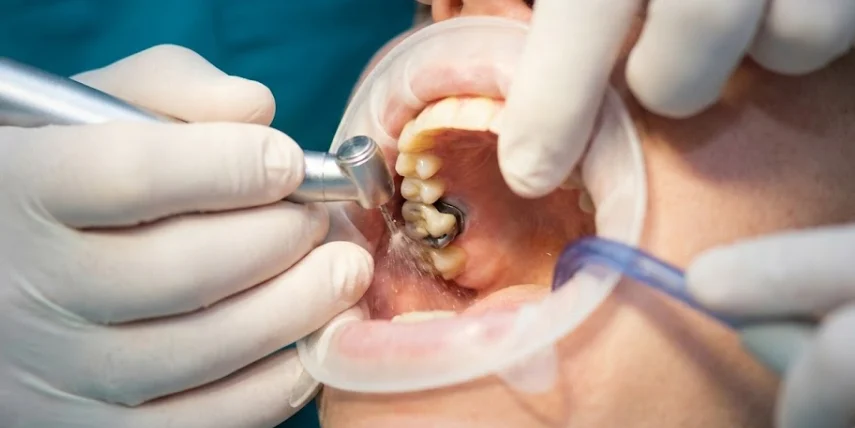
The vast majority of black lines are not caused by decay or poor hygiene, though those are factors we always check. Instead, the shadow is typically a design flaw of older dental materials—specifically, the Porcelain-Fused-to-Metal (PFM) crown.
Think of a PFM crown like a luxury coat with a heavy, dark lining. The “lining” is a metal alloy base used for strength, which is then covered by a layer of porcelain for aesthetics. While this was the gold standard for decades, it has a significant drawback. Professor Doctor Coşkun Yıldız often notes that the metal substructure acts like a permanent shadow. As the gum tissue matures or recedes—even by a fraction of a millimeter—that dark metal edge is unmasked.
Why the Line Appears: The Anatomy of Recession
But let’s look closer at the biology. Your gums are not static; they are like the tide, subtly shifting over the years. When gums recede, they expose the “margin” of the crown. If that margin is made of dark metal, you get a black line.
Another thing we observe in the clinic is the “tattooing” of the gum. Sometimes, microscopic metal particles from the crown can actually leach into the surrounding tissue, staining the gum itself. This is why simply cleaning the area never works.
How We Fix the Shadow: The Zirconia Revolution
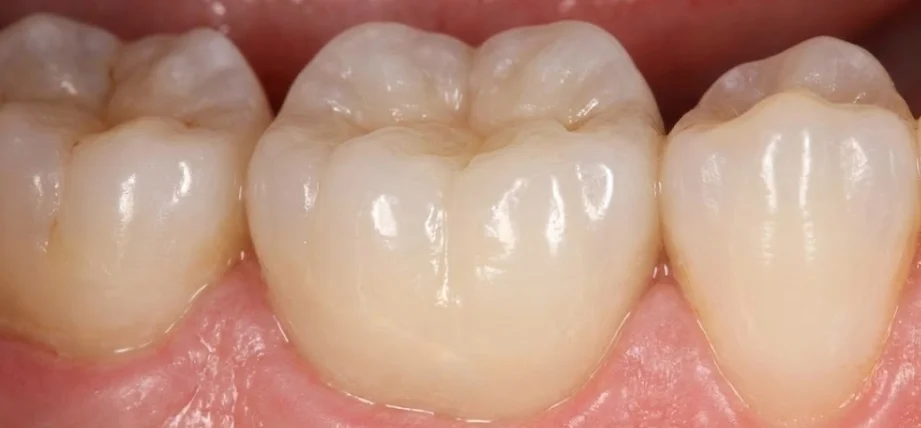
The good news is that modern dentistry has moved beyond the need for metal skeletons. At Lema Dental Clinic, Dentist Polen Akkılıç and her team almost exclusively utilize metal-free materials like Zirconia and E-max.
Zirconia is the “diamond” of the dental world. It possesses the strength of metal but the translucency of a natural tooth. Because there is no metal base, there is no black line to reveal, even if your gums recede slightly over the next decade. It’s like switching from a heavy, lined coat to a single, solid piece of high-tech silk.
Comparing Your Options: PFM vs. Modern Ceramics
When deciding how to restore your smile, it helps to see the data.
| Feature | Porcelain-Fused-to-Metal (PFM) | Zirconia / E-max |
| Aesthetics | Opaque; prone to “black lines” | Translucent; looks like a natural tooth |
| Gum Compatibility | Opaque; prone to “black lines.” | Biocompatible; promotes healthy gums |
| Durability | High, but porcelain can chip off metal | Extremely high; monolithic strength |
| Light Reflection | Blocked by metal (looks “dead”) | Natural light passage (looks “alive”) |
| Precision | Hand-layered (more room for error) | CAD/CAM Digital design (perfect fit) |
The Lema Approach: Digital Precision in Turkey
Here is what we see in the clinic: fixing a black line isn’t just about replacing the crown; it’s about correcting the “fit.” Dentist Polen Akkılıç and her team use 3D digital scanning to ensure the new crown fits the “foundation” of your tooth like a puzzle piece.
In Turkey, we have the advantage of combining this high-end technology with master ceramists who hand-finish every Zirconia crown. We don’t just want the black line gone; we want the new crown to be indistinguishable from the teeth you were born with.
FAQ: Advice from the Surgeons at Lema
Not necessarily. In most cases, it is just the metal edge of the crown showing. However, if the line is accompanied by a bad taste or sensitivity, it could mean the seal has broken. We always perform a digital X-ray to ensure the foundation is healthy before we discuss aesthetics.
The reality is no. Because the metal is inside the structure, no amount of surface treatment will hide it. The only permanent solution is to replace the old crown with a modern, metal-free alternative.
Actually, it’s a very straightforward process. We gently remove the old crown, clean the ‘pedestal’ tooth, and take a digital impression. Most patients find the replacement process much easier than the original fitting.
Zirconia is incredibly durable. While no dental restoration lasts forever, Zirconia is less likely to chip or crack than the porcelain-on-metal variety. With proper care, they are a 15 to 20-year investment in your confidence.
Many of our patients find that for the cost of a single crown in London or New York, they can receive a full smile makeover in Istanbul. But beyond cost, it’s about the specialization. We replace hundreds of old PFM crowns every month; our team has seen every complication and mastered every solution.
- Al-Wahadni, A., & Gutteridge, D. L. (2002). An investigation of the prevalence and indications for replacement of crowns and bridges in a British university hospital. British Dental Journal.
- Beuer, F., et al. (2008). Zirconia in fixed clinical prosthodontics: A systematic review. Journal of Dentistry.
- Edelhoff, D., & Kappert, H. F. (2002). All-ceramic restorations: a review of the current status. Compendium of Continuing Education in Dentistry.
- Sailer, I., et al. (2007). A systematic review of the survival and complication rates of all-ceramic and metal-ceramic reconstructions. Clinical Oral Implants Research.
- Zarone, F., et al. (2011). Zirconia-based restorations, light transmission and soft tissue health: A clinical report. International Journal of Dentistry.

