


Porcelain veneers stay white longer than composite veneers.
You may have spent so much time trying to hide your smile in photos or even covering your mouth when you laugh. That’s all in the past now and you are ready for a change. But one worry still haunts you: What if I put money into a new smile only for it to get yellow again in two years?
It is the thing that we hear most of the time at Lema Dental Clinic in Istanbul. People want a smile straight from Hollywood that not only looks dazzling on the first day but also stays fresh after drinking numerous cups of Turkish coffee and red wine. In order to find out which material has the greatest resistance to stains, we have to dive into the science of the materials.
The Porosity Problem: Why Composite Struggles
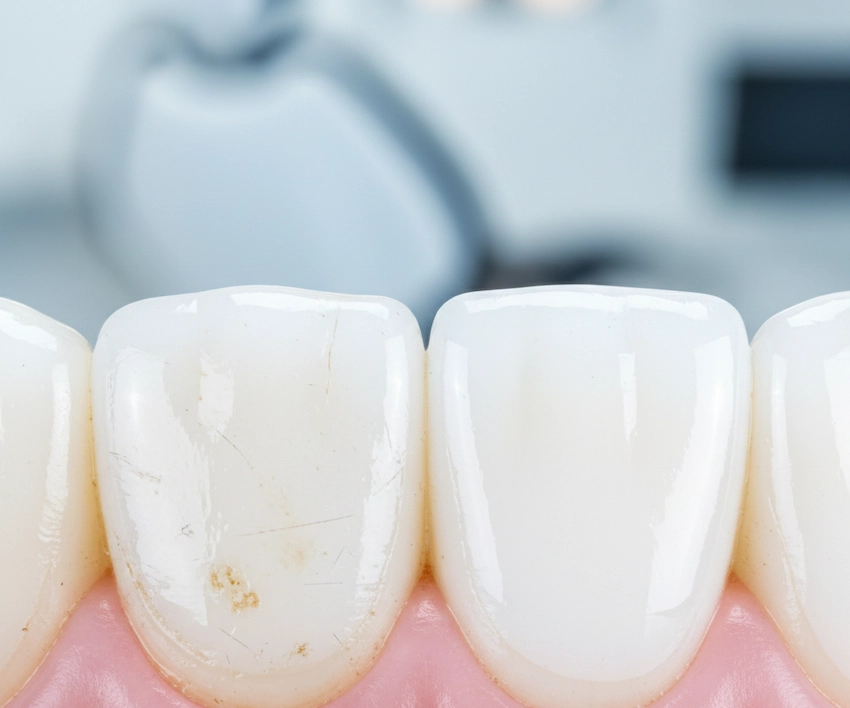
Imagine a first-class composite resin being like a polished wooden deck. It seems smooth and pretty right after finishing, but it contains microscopic “pores.” Gradually, the pigments in your food – the tannins in tea, the acids in berries, or the nicotine – will get through these tiny holes.
Dr. Polen Akkılıç and her crew explain to clients that composite is basically a type of plastic. Even though today’s resins are remarkably sophisticated, they are still chemically softer than ceramics. Hence they get “micro-scratches” from everyday brushing. These scratches then serve as tiny hooks for plaque and stains.
Porcelain: The “Glass Shield” of Dentistry
Porcelain in reality is something completely different. According to our experience at Lema Dental Clinic, we consider porcelain similar to fine China or glass handling.
Professor Doctor Coşkun Yıldız a son of the highest quality dental ceramics is a non-porous one. Kong the ceramic is heated to a very high temperature in a furnace and the resulting surface is so Ari Tai that even pigments cannot enter the material. When you consume coffee candy with porcelain veneers the stain acts in the same way as water drops on a waxed car; it only remains on the surface of the veneer. Normally, one professional cleaning is enough to get rid of it.
Comparing the Two: At a Glance
Both solutions are actually feasible by themselves, but their performance varies greatly over five years.
| Feature | Composite Veneers | Porcelain Veneers |
| Material Base | Synthetic resin (plastic-based) | High-fired ceramic (glass-based) |
| Stain Resistance | Low – stains over time | High – highly stain resistant |
| Surface | May lose shine and become rough | Maintains glossy, smooth surface |
| Service Life | 5–7 years | 15–20+ years |
| Care | Requires periodic polishing | Routine cleaning is sufficient |
| Repair | Easily repairable with bonding | Usually requires full replacement |
The “Turkey Advantage” at Lema Dental Clinic

They say that knowing the proper material is only half the battle; what truly distinguishes the finish is the skill of the operator. A dental trip to Turkey will open up not only the world of dental artistry but also premium E-Max and Zirconia porcelains at a fraction of the cost of either the UK or the USA.
Nonetheless, we must turn to the process more closely. At Lema Dental Clinic, our lab technicians are not just “making teeth” when they layer the porcelain; they are recreating the translucency of your original enamel. Only then will the veneers not only remain white but also believable.
FAQ: Straight Talk from Our Doctors
Longevity is still the main issue here, but the composite will most probably discolor within 12 to 18 months if you smoke. On the other hand, we recommend porcelain to smokers because the nicotine cannot break through the ceramic glaze.
In the opinion of our clinic, conventional whitening gels are good for natural teeth but do not affect dental fillings. When your composite is stained, then it is time to have it professionally polished or replaced. Porcelain, however, shouldn’t require whitening at all.
Not at Lema. Dr. Polen Akkılıç emphasizes the “natural brilliance.” We use shade guides compatible with your skin tone and age so that your smile will be healthy and not like a row of piano keys.
Advanced local anesthesia and accurate digital mapping mean that any discomfort will be minimal. From experience, most patients say they simply get bored rather than suffer pain. Moreover, you get the chance to be in a dental chair in lovely Istanbul—we strive to make your experience comfortable.
Simply treat them as you would your natural teeth, only make sure to brush with a non-abrasive toothpaste. Avoid whitening toothpaste with grit as these may scratch the composite. For the porcelain, all you have to do is brush, floss and just go on with your life. “This is what the doctors at our office have instructed us to give to you.
- Alghazzawi, T. F. (2016). Advancements in CAD/CAM technology: Options for practical implementation. Journal of Prosthodontic Research, 60(2), 72-84.
- Gresnigt, M., & Ozcan, M. (2011). Fraction of field-applied laminate veneers: A 10-year retrospective study. Journal of Dentistry, 39(11), 777-784.
- Korkut, B. (2018). Smile rejuvenation with direct composite laminate veneers: 2-year follow-up. Case Reports in Dentistry, 2018.
- Lasserre, J. F., Popelut, A., & Archien, J. P. (2020). Comparison of the aging of dental composite resins and porcelain. International Journal of Esthetic Dentistry, 15(3), 282-295.
- Walls, A. W. (1995). The use of composite laminate veneers: A clinical evaluation. British Dental Journal, 179(4), 131-136.

