


Cleaning reveals your brightest enamel.
For many people, the day would not be complete without the ritual of drinking a coffee, rich and dark, having the first cup. But the same drink that gets the mind going is also gradually taking your smile away. In Lema Dental Clinic Istanbul’s consultation rooms, one of the most common worries expressed is just a plain, irritated question: “I brush my teeth twice a day, but still the coffee has turned them yellow. Will I get rid of it through professional cleaning?”
As clinical partners to surgeons and restorative experts, we have to manage expectations with total honesty. The short answer is: Yes and no.
A professional cleaning can be nothing less than miraculous for certain types of coffee stains. However, let us dig deeper into the biology of a stain, because the comprehension of the difference between teeth that are “dirty” and those that are “discolored” is the key to the smile you desire, here in Turkey.
The Anatomy of a Stain: The “Dirty Window” Metaphor
To understand what our hygienists can do, you must first understand what coffee does to your enamel. Coffee contains tannins—organic compounds that perform a “double whammy” on your teeth. First, they stain. Second, the acidity in coffee creates microscopic rough patches on the enamel, providing a perfect surface for those stains to adhere to.
The text instantiates a particular clinical experience that considers this as divided into two kinds of discoloration. If you will conceptualize a tooth with regard to a window in an active city.
1. Extrinsic Stains (The Dirt on the Glass)
This is surface-level debris. It is the brownish-yellow buildup that accumulates where the tooth meets the gumline or in the tiny crevices between teeth. It comes from coffee, tea, tobacco, and food. This is the “dirt on the window.” You can scrub it off, and the glass underneath is revealed.
2. Intrinsic Stains (The Tinted Glass)
This is deeper. Over years of coffee consumption, tiny pigment molecules penetrate the enamel rods and the underlying dentin layer. The tooth structure itself becomes saturated with color. Furthermore, as we age, our enamel naturally thins, revealing more of the yellowish dentin beneath. This isn’t dirt on the window; the glass itself is tinted.
What Professional Cleaning Actually Does
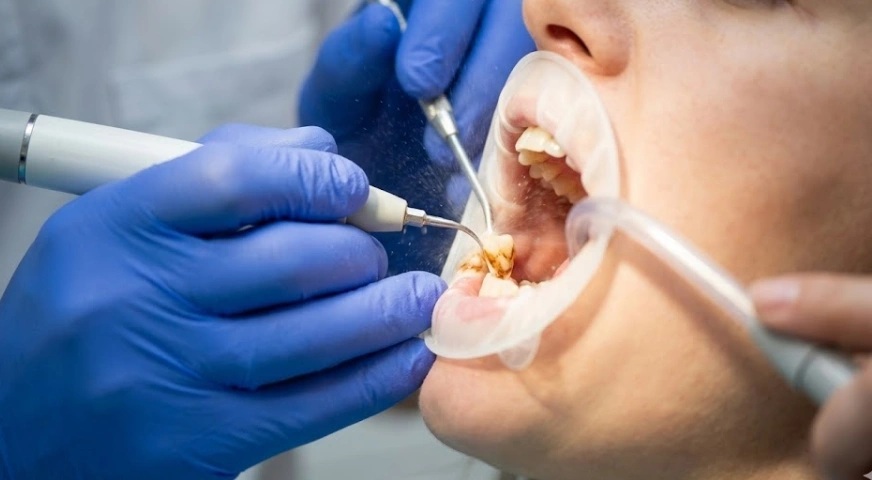
If you happen to be with Dentist Polen Akkılıç and her team, their main aim during cleaning (dental prophylaxis) will be medical rather than simply cosmetic. They are getting rid of plaque and tartar (calculus)—the solidified bacterial groups that lead to gum diseases.
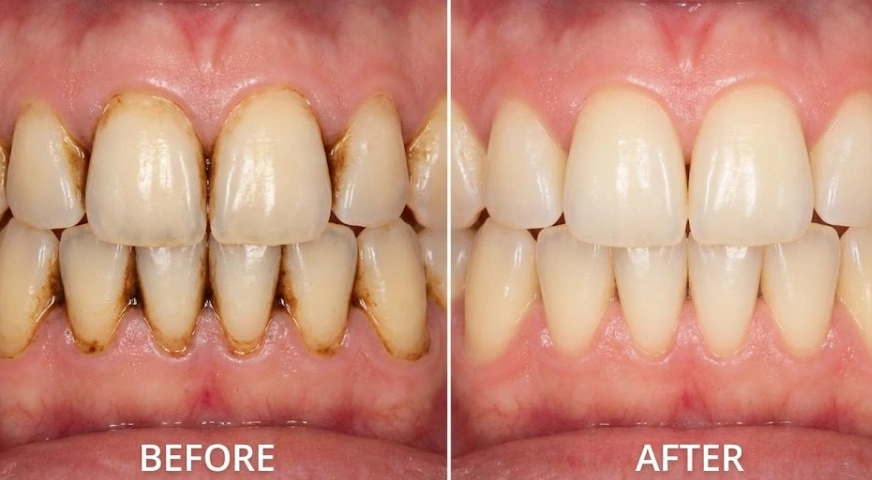
However, a marvelous side effect of this medical cleaning is the removal of extrinsic stains. Using ultrasonic scalers that vibrate tartar loose, followed by professional-grade polishing pastes and air-flow technology, they effectively power-wash the “dirt off the window.”
Here is what we see in the clinic continually: patients are shocked by how much brighter their smile looks simply by removing that external layer of coffee residue. For many, this is enough. The teeth feel smooth as glass, and the dark shadows between teeth vanish.
The “Coffee Shadow”: When Cleaning Isn’t Enough
But here is the crucial distinction where many patients get confused. A professional cleaning will restore your teeth to their natural baseline color. It will not make them whiter than they naturally are.
If you have been drinking strong coffee for twenty years, and you have intrinsic discoloration (the “tinted glass”), a cleaning will only reveal that cleaner, albeit still yellowish, surface.
Professor Doctor Coşkun Yıldız often notes that patients sometimes feel disappointed after a cleaning because they were expecting a Hollywood-white result. A cleaning removes the debris on the tooth; it does not change the color within the tooth. If the “tinted glass” is still too dark for your liking after a thorough cleaning, we have moved from the realm of hygiene into the realm of cosmetic whitening (bleaching).
Comparing the Solutions: Hygiene vs. Cosmetics
Selecting the appropriate tool for the task is crucial. The following is a comparison of the various methods provided in Turkey and what you can expect from each of them.
| Feature | Professional Cleaning (Prophylaxis) | Professional Teeth Whitening (Bleaching) |
| Primary Goal | Gum health, tartar removal, surface stain removal. | Changing the inherent color of the tooth structure. |
| Action on Stains | Mechanical removal of extrinsic (surface) stains. | Chemical penetration to break down intrinsic (deep) stains. |
| Typically, every 6 months for health. | No. It reveals the natural tooth brightness by cleaning it. | Yes. It bleaches the enamel and dentin to a lighter shade. |
| The Coffee Verdict | Excellent for removing recent surface coffee buildup. | Necessary for reversing years of deep coffee discoloration. |
| Frequency | Typically every 6 months for health. | As needed for aesthetics (results last 6 months to 2 years). |
The Lema Dental Clinic Approach
The reality is that most severe coffee drinkers need a two-step approach. You cannot whiten dirty teeth. Therefore, at Lema Dental Clinic, a thorough professional cleaning by Dentist Polen Akkılıç’s staff is the non-negotiable first step. We must clear the “window” before we can decide if the glass needs “de-tinting.”
Only once the teeth are spotlessly clean and healthy do we evaluate the shade. If the natural color revealed beneath the coffee stains is still unsatisfactory, we then discuss advanced whitening options available here in Turkey to tackle those deep-set intrinsic pigments.
FAQ: From the Patient’s Chair
While the standard recommendation is every six months, heavy coffee drinkers often develop stains faster. We might suggest coming in every three to four months for a quick polishing to keep the buildup under control and your gums healthy.
It is possible, especially if you have receding gums covered by tartar. When that tartar is removed, the root surface is exposed to air and cold. This sensitivity is usually temporary. We use specialized desensitizing pastes during the treatment to minimize discomfort.
We strongly advise against this. Baking soda and charcoal are highly abrasive. While they might scrub off some coffee stains, they do so by scratching away microscopic layers of your enamel. Once enamel is gone, it never grows back, making your teeth yellower in the long run as the darker dentin shows through.
Yes, but with a caveat. The first 48 hours after whitening are critical; your enamel pores are wide open and will absorb coffee instantly. After that window, you can resume drinking coffee, but realize that the staining process begins again immediately. Using a straw for iced coffee can help bypass the front teeth.
No. Professional cleaning and even professional whitening only work on natural tooth structure. Dental materials like composite fillings or porcelain crowns do not change color. If a filling has stained around the edges, it usually indicates the bond is failing and it needs to be replaced.
- Joiner, A. (2006). The bleaching of teeth: A review of the literature. Journal of Dentistry, 34(7), 412-419.
- Nathoo, S. A. (1997). The chemistry and mechanisms of extrinsic and intrinsic discoloration. Journal of the American Dental Association, 128, 6S-10S.
- Watts, A., & Addy, M. (2001). Tooth discolouration and staining: a review of the literature. British Dental Journal, 190(6), 309-316.
- Addy, M., & Moran, J. (1995). Mechanisms of stain formation on teeth, in particular associated with chlorhexidine. Advances in Dental Research, 9(4), 450-456.
- Viscio, D., Gaffar, A., Fakhry-Smith, S., & Xu, T. (2000). Present and future technologies of tooth whitening. Compendium of Continuing Education in Dentistry, 21(28), S36-S43.

