


Choice depends on your goals.
That tiny millimeter of space between your teeth can sometimes feel like it weighs a ton. Clinically, we call it a diastema, but to you, it’s just that “black triangle” that pops up in every photo or the annoying spot where food always gets stuck. It’s a small detail that can have a massive impact on your confidence.
In our consultation rooms at Lema Dental Clinic in Istanbul, the question is rarely if we can fix it, but how. Patients often ask us, “Do I really need years of braces for one small gap?” or “Can’t you just fill it in today?”
The reality is that there is no “one size fits all” answer. The right solution depends entirely on the architecture of your mouth. As clinical partners in your dental journey, we don’t just look at the gap; we look at the foundation.
The Reality of the Gap: Why Is It There?
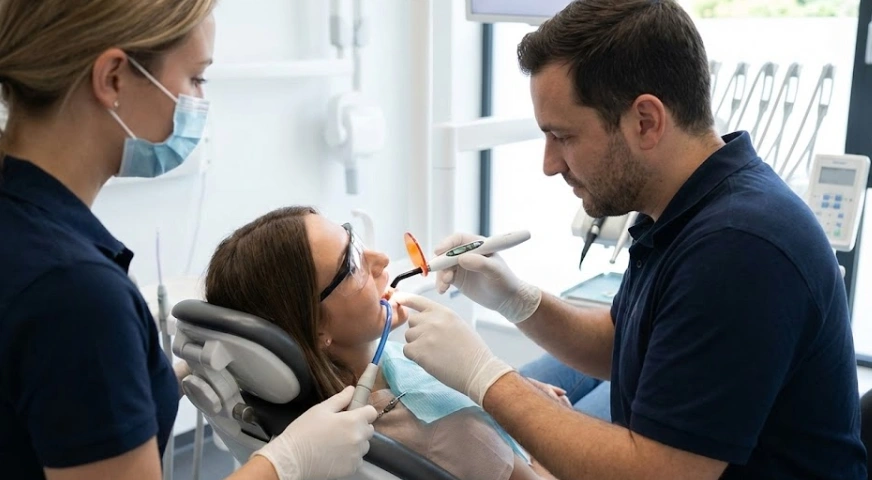
You have to know why it is there before we talk about repairing the space. Prof. Dr. Coşkun Yıldız frequently states to our team that addressing a gap in a wall without understanding its cause is akin to applying paint over a crack without inspecting the foundation of the house.
Usually, gaps come down to a few biological factors. Sometimes it’s a “room and furniture” problem—you have a large jaw (the room) but small teeth (the furniture), leaving natural spaces. Other times, it’s a missing tooth causing others to drift, or even a piece of tissue called the frenum that’s acting like a physical wedge between your front teeth.
Once we use our 3D imaging here in Turkey to see what’s happening beneath the surface, we can choose the right tool for the job.
Option 1: Orthodontics (The Architect’s Path)
If your teeth are perfectly shaped but simply sitting in the wrong “zip code,” moving them is the most natural way to go. We aren’t just closing a gap here; we are reorganizing your entire bite.
Clear aligners have changed the game for our adult patients. You get to keep your natural tooth structure completely intact. But let’s look closer at the trade-off: time. Orthodontics is a marathon, not a sprint. It requires months of discipline and a lifetime of wearing retainers to keep those teeth from wandering back to their old spots. For many of our international guests, this timeline is the biggest hurdle.
Option 2: Composite Bonding (The Artist’s Touch)
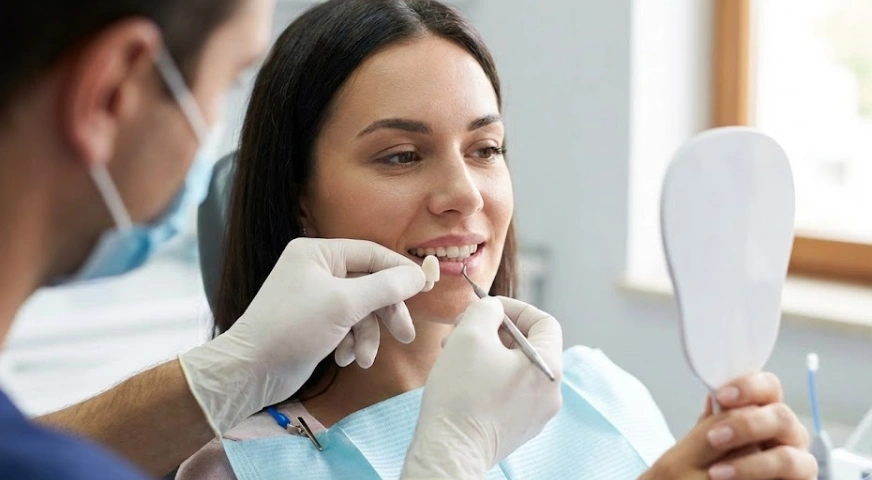
It’s like you’re making a new edge on your tooth, you are shaping it, Polen Akkılıç and Associates at her dental practice use a high-quality resin that mimics the reflective nature of natural enamel. We use this stuff on the sides of your teeth. We make this with our hand then they fix it on with a special light.
It is pure, immediate gratification. You walk in with a gap and walk out an hour later without one. It’s non-invasive and incredibly budget-friendly.
The question remains, however: how long will it last? Bonding is a bit like a high-quality patch on a garment. It looks great, but over five or seven years, that resin can pick up stains from coffee or red wine. It’s a fantastic “quick-fix,” but it isn’t a “forever-fix.”
Option 3: Porcelain Veneers (The Ultimate Upgrade)
When patients come to us looking for that “Hollywood” transformation, veneers are almost always the answer. These are ultra-thin, custom-made ceramic shells that we bond to the front of your teeth.
Because we design them from scratch in our lab, we can bridge gaps while simultaneously fixing the color and shape of the teeth. They are stain-resistant and incredibly durable.
But here is what we see in the clinic: veneers are a commitment. To make them look natural and not “bulky,” we usually have to remove a tiny sliver of your enamel. It’s an irreversible step, but for those who want a permanent, flawless result in just a few days here in Turkey, it’s the gold standard.
Which Path is Yours? A Quick Comparison
| Feature | Orthodontics (Braces/Aligners) | Composite Bonding | Porcelain Veneers |
| The Process | Moves the teeth you have. | Adds material to the teeth. | Covers the teeth with ceramic. |
| Time in Turkey | Requires multiple long-term visits. | Done in a single hour. | Completed in 5–7 days. |
| Invasiveness | None (natural teeth remain). | Minimal (no drilling). | Moderate (slight enamel prep). |
| Durability | Permanent (with retainers). | 3–7 years (can stain). | 15–20+ years (stain-proof). |
Direct Answers: From the Specialist’s Desk
This is a common worry. If you only widen the two front teeth, they can look like ‘bunny teeth.’ That’s why Dentist Polen Akkılıç uses digital smile design. We often distribute the space across four or six teeth so the proportions stay perfectly balanced and natural.
Usually, no. Bonding is for small spaces. If a whole tooth is missing, we need to look at a dental implant or a bridge. We need to fill the ‘room,’ not just widen the ‘furniture’ next to it.
Not at all. We use local anesthesia during the preparation phase, so you won’t feel a thing. You might have some mild ‘zingers’ or sensitivity to cold for a few days after, but that’s just your nerves adjusting to the new restorations
I’d wait at least 48 hours. The resin is at its most porous right after it’s set. Give it time to fully ‘seal’ before you introduce dark pigments like coffee or tea.
Here is what we see in the clinic every day: patients who want high-end results without the clinical ‘coldness’ of a hospital. We combine advanced tech with an artistic eye. Whether it’s the precision of our lab-made veneers or the hand-sculpted bonding, we treat every smile as a unique piece of art.
- Al-Shammary, A. (2023). Clinical approaches to midline diastema. Journal of Orthodontic Science.
- Gurel, G. (2003). The Science and Art of Porcelain Laminate Veneers. Quintessence Publishing.
- Heymann, H. O. (2018). Sturdevant’s Art and Science of Operative Dentistry. Elsevier.
- Proffit, W. R. (2018). Contemporary Orthodontics. Elsevier Health Sciences.
- Radz, G. M. (2011). Diastema Closure: Conservative Solutions for Esthetic Challenges. Compendium of Continuing Education in Dentistry.

