


Clear braces are discreet, while metal braces are stronger for complex cases.
Imagine you are about to get braces first thing that probably comes to your mind is “To what extent will this be visible on me?” I mean, this is a very sensible question. No matter who you are, a work pro who needs to impress in boardrooms or a teen who lives one day at a time through social media, the type of braces you wear is a concern.
One of the things we talk about most with our patients at Lema Dental Clinic is what it means to have your lifestyle radically changed by beautiful teeth. They come from all over the world and when they land in Turkey, it is not just straight teeth they only want but a complete change of their lives. Our team keeps hearing from Professor Doctor Coşkun Yıldız that patients would not even want to cover their mouths when laughing just because of a treatment that involves moving bones.
The Traditional Powerhouse: Metal Braces
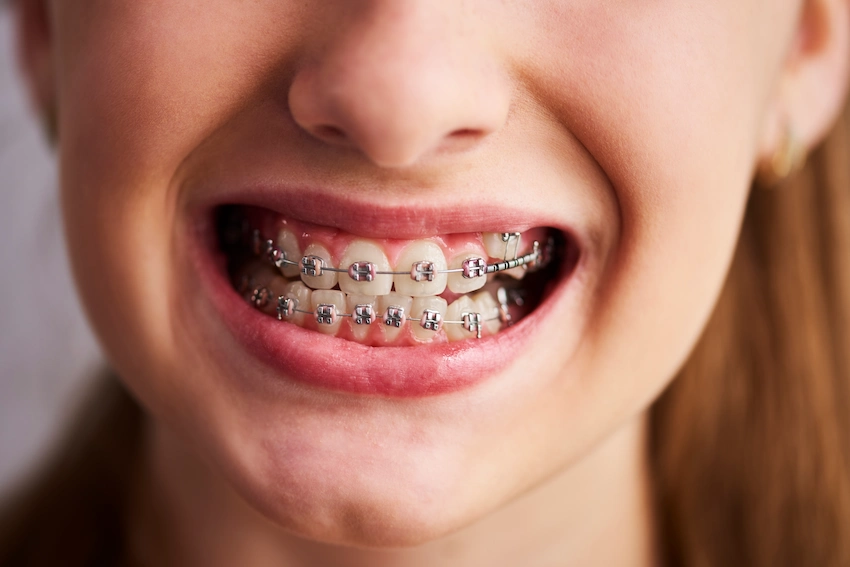
Metal braces have been the “trusted and tested” orthodontic solution for a very long time. You can compare the basic metal braces to the strong and dependable base of a very tall building. Although they have gotten smaller over the past ten years, what the braces do is still the same: each tooth has to be fitted with stainless steel brackets, which are then joined by a thin archwire.
Seriously, if you are considering handling an aggressive bite or really packed teeth, metal is the way to go that we mostly recommend. Forget just strong; they can take a beating and still look good. At our clinic, we see Dentist Polen Akkılıç and her staff often use these on very young patients or those in whom major changes are needed and that is when the use of the metal that exerts the right amount of force comes in.
The Discreet Alternative: Clear (Ceramic) Braces
If metal braces represent the solid base, clear braces reflect the shining glass exterior. These brackets are composed of polycrystalline alumina and are architecturally superimposed on natural tooth enamel with their translucent nature.
Besides, they say a lot about your personality that you chose invisible braces. At the same time, the truth is, for the most part, the wire running through the brackets will be metal (however sometimes it is white coated). The attractiveness of the product lies in the fact that they hardly make themselves felt. Lema Dental Clinic is the place where we pick up from our experience the fact that clear braces are the first choice of our adult patients who want the accuracy of fixed braces but not the “teenager with braces” look trade-off.
Comparing the Two: At a Glance
The question remains: which one actually performs better? Here is what we see in the clinic every day.
| Feature | Metal Braces | Clear (Ceramic) Braces |
| Visibility | High (Silver/Metallic) | Low (Translucent/Tooth-colored) |
| Durability | Extremely High | Moderate (Can chip if handled roughly) |
| Staining | No staining on brackets | Brackets don’t stain, but “ties” can |
| Treatment Speed | Often slightly faster for complex cases | Standard |
| Comfort | Can cause initial cheek irritation | Generally smoother on the soft tissues |
The “Staining” Myth and Reality
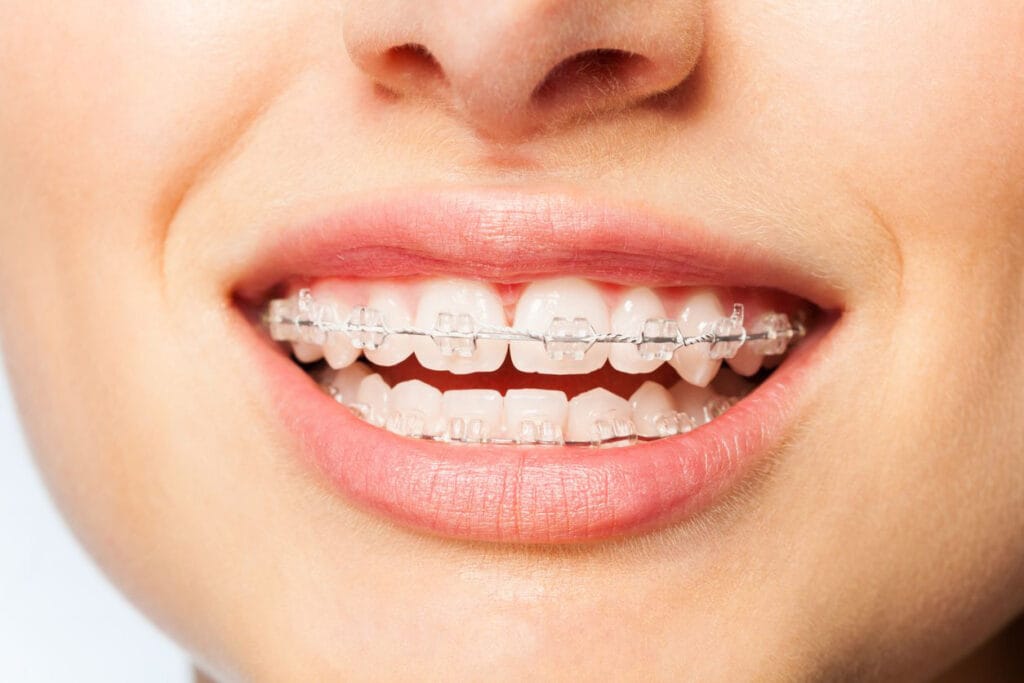
There are a lot of patients who are concerned about the fact that clear braces will turn yellow after having coffee. Here is the clinically proven fact: the ceramic part of the braces is color-stable and will not change. On the other hand, the very small elastic rings (ligatures) that attach the wire to the bracket can take in pigments from turmeric, red wine, or tobacco.
Positive part? We replace those ligatures at every tweak. If you want to have a big event, we can just put new ones on, and your smile is as good as new.
Why Pick Turkey for Your Orthodontic Treatment?
When you decide to get your orthodontic treatment at Lema Dental Clinic in Turkey, it is much more than just technology; it is care to the fullest. Orthodontics is like a super slow-motion architecture project. You must have a team that can interpret the “soil” (your jawbone density) and the “climate” (your overall oral health).
Professor Doctor Coşkun Yıldız makes sure that every treatment plan is not only accompanied by 3D imaging but also is in great agreement with facial harmony.
FAQs: Clear Braces vs. Metal Braces: Which One?
Really, the difference is usually very minor in the case of an expert Dentist Polen Akkılıç. Nevertheless, since metal is a little bit stronger, in certain difficult cases, we can put a little more “tension” which might shorten the total time by a few months when compared to ceramic.
Not really. The pain or discomfort that you experience mostly results from the movement of the teeth rather than the bracket material. However, there are some patients who claim that ceramic brackets are a bit bigger whereas some argue that the smooth surface feels nicer against the lips.
For sure. It is one of the most commonly utilized techniques at the Lema Dental Clinic. We clear-brace the “social six” (the teeth that appear when you smile) and put the metal ones on the bottom that are basically the less visible and more exposed to wear and tear from usage.
It is very simple really: you should rinse your mouth after every meal. As the brackets’ color is similar to that of your teeth, it is easier to see when food gets stuck to your brackets. Simply rinsing with water after eating helps in retaining that “invisible” look.
In lots of Western countries, there is a huge price difference. Here at our clinic, we are always trying to make our finest ceramic options available at a reasonable price in Turkey, even though they do involve a somewhat higher material cost than traditional steel.
- Proffit, W. R., Fields, H. W., & Sarver, D. M. (2018). Contemporary Orthodontics. Elsevier Health Sciences.
- Russell, J. S. (2005). Aesthetic orthodontic brackets. Journal of Orthodontics, 32(2), 146-163.
- Gkantidis, N., et al. (2012). Aesthetic sensors in orthodontics: A review of ceramic brackets. European Journal of Orthodontics.
- Rosvall, L. C., et al. (2009). Attractiveness, acceptability, and value of orthodontic appliances. American Journal of Orthodontics and Dentofacial Orthopedics, 135(3), 276-277.
- Yıldız, C. (2023). Advanced Materials in Modern Orthodontics: A Clinical Perspective. International Journal of Dental Research.

