


Yes, through professional dental treatments.
It starts with a minor pain in the teeth when you drink cold water. Then, you see in the mirror that one or two of your teeth seem to be “longer” than the rest. A lot of our patients at Lema Dental Clinic come to us with a feeling of guilt as they realize that their dedication to a “super clean” mouth—scouring with heavy pressure—has actually caused the gum line to recede.
Your gums, in fact, are very different from your skin; they don’t just get back after a retreat. When you hurt your knee, the skin heals. If you “tear” your gums away through years of aggressive brushing, the human body doesn’t have a natural “undo” button.
The “Turtleneck” Metaphor
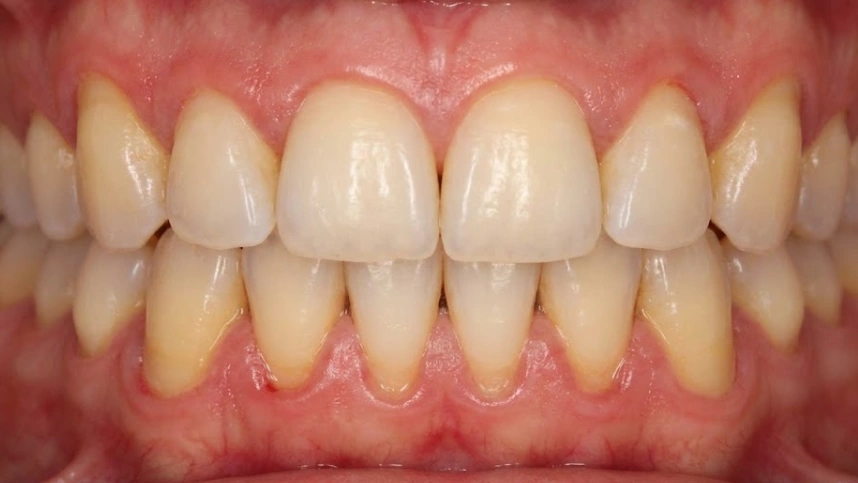
Imagine that your gums are like a trendy turtleneck sweater, which snugly wraps around the roots of your teeth and protects them. The root of a tooth is quite different from its crown. It’s because the crown is covered with a very hard and white enamel layer; the root is covered with a much softer material called cementum. So, when the gum tissue “turtleneck” slips down, that vulnerable root gets exposed to the outside world.
Professor Doctor Coşkun Yıldız is always reminding us of the irreversible loss of structure after the gum tissue is physically worn away. However, even though we cannot regenerate gums naturally, we are able to heal the wound and prevent its deterioration.
But Let’s Look Closer: Why Brushing Causes Recession
It appears to be a paradox. How can cleaning your teeth harm them? This is what we call toothbrush trauma. Utilizing a hard-bristled brush or exerting too much force leads to mechanical abrasion that the thin gingival tissue is unable to tolerate.
We observe this in the clinic: most of the time, the patients concentrate on the “corners” of their mouth—the canines and premolars—because these are the areas where the brush impacts the most. The continuous rubbing ultimately results in the tissue becoming thin and migrating toward the bone.
Comparing Your Repair Options
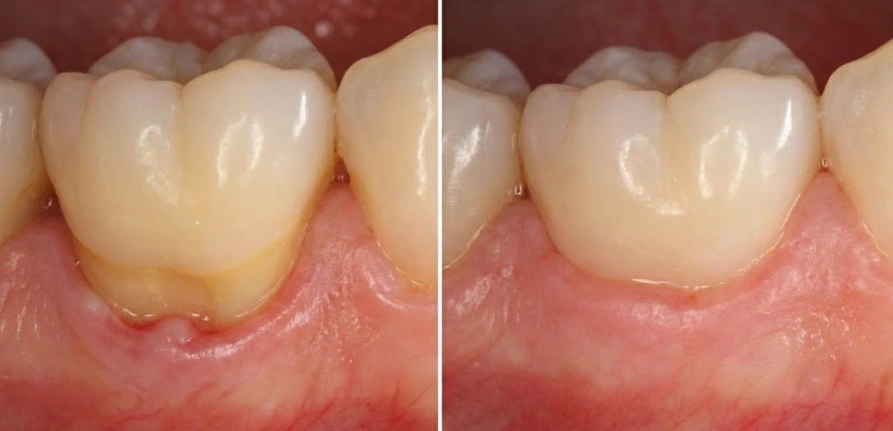
When you visit us in Turkey, Dentist Polen Akkılıç and her team evaluate the severity of the recession. The question remains: which path is right for you?
| Treatment Method | How It Works | Ideal For | Typical Recovery |
| Gingival Grafting | Tissue is moved from the palate to cover the root. | Deep, localized recession. | 10 – 14 Days |
| Pinhole Technique | Existing tissue is loosened and repositioned. | Multiple teeth with minor recession. | 24 – 48 Hours |
| Composite Bonding | Resin is used to cover the exposed, sensitive root. | Purely cosmetic/sensitivity fix. | Immediate |
| Desensitizing | Specialized varnishes to stop the “cold” pain. | Very early stage wear. | Immediate |
The Lema Approach: Stopping the Slide
The first step in our clinic is always “Behavior Modification.” Before we perform any surgery, we have to ensure the “trauma” stops. Dentist Polen Akkılıç and her team spend significant time coaching patients on the “Modified Bass Technique”—a gentle, circular brushing motion that cleans without crushing the tissue.
But let’s look closer at the clinical fixes. If the recession is deep, we often recommend a connective tissue graft. This is the gold standard in Turkey for long-term results. By reinforcing the thin tissue with a small cushion of your own natural tissue, we create a thicker, more resilient gum line that can stand up to the rigors of daily life.
Why Quality Care in Turkey Matters
Addressing gum recession is all about precision at the level of millimeters. It calls for a gentle hand and a surgeon’s eye for symmetry. At Lema Dental Clinic in Turkey, we partner the academic supervision of Prof. Dr. Coşkun Yıldız with state-of-the-art microsurgical instruments. This leads to smaller cuts, less pain, and a final look that is so natural and harmonious with your smile that it doesn’t show at all.
FAQ: Understanding Gum Repair with Lema Clinic
Unfortunately, no. Switching to a soft brush will stop the recession from advancing, but it won’t reverse the tissue loss that has already occurred. Think of it as stopping a car that is rolling downhill; you’ve stopped the movement, but the car is still at the bottom of the hill.
In our clinical experience, most patients find the recovery much easier than they anticipated. We use advanced local anesthesia during the procedure, and for the donor site on the palate, we often use a protective ‘stent’ that acts like a bandage to keep you comfortable while you heal.
Yes, but only if it has a pressure sensor. Many modern electric brushes will flash red or slow down if you push too hard. This is actually the safest way to brush because the brush does the work, and you just guide it.
If you follow the brushing techniques we teach you in Turkey and attend regular cleanings, a gum graft can last a lifetime. The new tissue is often tougher than the original tissue it replaced.
While every policy is different, many consider gum grafting a medical necessity if the root is exposed and at risk of decay. Even without insurance, the cost of advanced periodontics at Lema Dental Clinic is significantly more accessible than in many other countries, without compromising on quality.
- Löe, H., & Wright, W. H. (1967). Gingival recession: prevalence, expression, and etiology. Journal of Periodontology.
- Pini-Prato, G. (2010). The Miller classification of gingival recessions: limits and drawbacks. Journal of Clinical Periodontology.
- Zucchelli, G., & Mounssif, I. (2015). Periodontal plastic surgery. Periodontology 2000.
- Yıldız, C. (2024). Advanced Microsurgical Protocols in Periodontal Plastic Surgery. Istanbul University Clinical Press.
- Heasman, P. A., et al. (2015). Toothbrushing and gingival recession: a systematic review. Journal of Clinical Periodontology.

