


Yes, titanium and zirconia are non-ferromagnetic.
The clinical safety of performing an MRI on patients with endosseous implants is governed by the magnetic susceptibility of the materials involved. Professor Doctor Coşkun Yıldız notes that the majority of modern dental fixtures are fabricated from Grade 5 Titanium (Ti-6Al-4V) or Yttria-stabilized Zirconia. These specific materials are classified as non-ferromagnetic under high-tesla environments. In Turkey, the transition to these biocompatible, non-reactive alloys has eliminated the risk of “projectile effects” or torque-induced displacement during 1.5T or 3T scans.
Managing Radiofrequency-Induced Heating and Artifacts
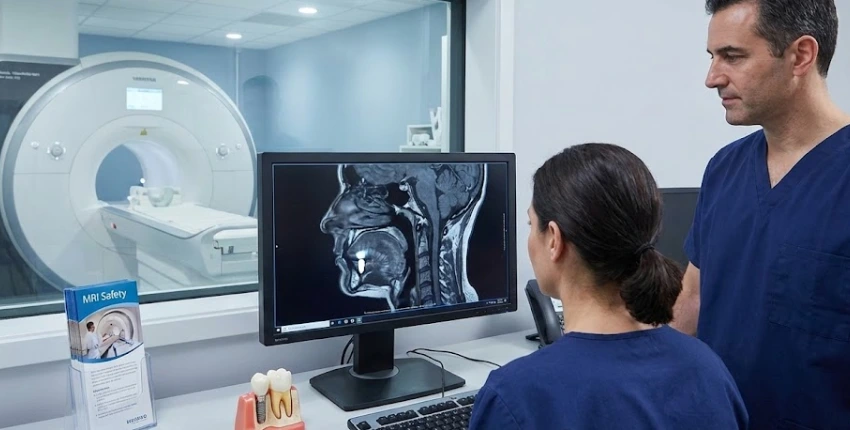
- Radiofrequency (RF) Heating: A primary concern in maxillofacial radiology is the potential for RF heating. However, the small cross-sectional area of a dental implant effectively prevents significant energy absorption.
- Safety Benchmarks: At Lema Dental Clinic, we utilize components that meet rigorous international safety standards, ensuring any localized temperature increase remains strictly within physiological limits.
- Signal Void and Distortion: Beyond physical safety, the issue of “signal void” or geometric distortion is a key factor. While titanium is a metal, its paramagnetic properties ensure that it only causes localized susceptibility artifacts.
- Clinical Recommendations: Dentist Polen Akkılıç and her team advise that for neuroimaging where the jaw is in the field of view, specific pulse sequences—such as MAVRIC or SEMAC—can be employed to suppress these distortions.
- Diagnostic Infrastructure in Turkey: The advanced diagnostic infrastructure available in Turkey allows for such specialized adjustments, ensuring that the presence of an implant does not compromise the overall diagnostic utility of the MRI.
Clinical Protocol at Lema Dental Clinic
Material integrity of restorations done in Turkey is backed up not only by promises but by a thorough traceability that can be even be audited. At Lema Dental Clinic, it is standard that every patient a personalized implant passport. This instrument is very helpful for a radiologist to know exactly whether he is dealing with titanium, zirconia, or an older type of ferromagnetic stainless steel alloy. Such a great disclosure is an absolute must for a patient who is very likely to undergo an oncological or neurological examination frequently to make sure that the oral restoration within him/her is “MR Conditional” or “MR Safe” by the world standards.
Technical Specifications: Material Interaction with 3.0 Tesla MRI
| Material Type | Magnetic Classification | Torque/Displacement Risk | Artifact Radius |
| Grade 5 Titanium | Paramagnetic | Negligible | 10 – 15 mm |
| Monolithic Zirconia | Diamagnetic | Zero | < 2 mm |
| Cobalt-Chrome Alloys | Weakly Ferromagnetic | Minimal | 20 – 30 mm |
| Stainless Steel (400 series) | Ferromagnetic | High Risk | Severe |
FAQ: Clinical Perspectives on Medical Imaging
No. Professor Doctor Coşkun Yıldız explains that the mechanical stability achieved through osseointegration is far stronger than any force exerted by a 3T magnetic field on non-ferrous titanium. Patients treated in Turkey undergo rigid stability testing before discharge to ensure long-term prosthetic security.
Absolutely. Providing the specific alloy composition—documented in your Lema Dental Clinic records—allows the technician to optimize “bandwidth settings” to reduce image blur.
Yes. Zirconia is a ceramic and does not contain metal ions. From a radiological standpoint, Dentist Polen Akkılıç and her team often recommend zirconia for patients with chronic conditions requiring frequent head-and-neck imaging, as it produces near-zero interference.
Turkey has become a hub for metal-free dentistry. Lema Dental Clinic specializes in zirconia-only protocols (both for the implant and the crown), which is the gold standard for avoiding any form of magnetic interaction or diagnostic artifacts.
While the magnetic field won’t move the implant, Professor Doctor Coşkun Yıldız suggests waiting until initial soft tissue healing is complete (typically 7 days) to avoid discomfort from the vibration of the MRI gradients.
- ASTM International. (2021). ASTM F2503: Standard Practice for Marking Medical Devices for Safety in the Magnetic Resonance Environment.
- Misch, C. E. (2007). Contemporary Implant Dentistry. Elsevier.
- Shellock, F. G. (2014). Reference Manual for Magnetic Resonance Safety, Implants, and Devices.

