


Yes, diamond tooth gems can be safely removed by a dentist without damaging enamel.
A sparkling diamond can instantly add a flash of beauty to the smile of anyone. In fact, tooth gems were just a tiny, underground trend at first. Nowadays, however, they have turned into a major fashion statement.
But what if you want to go back to your natural smile?
Can professionals remove the gems safely? Will they leave any permanent marks on your teeth? These are typical questions for anyone who has fallen for the sparkle.
In fact, these are exactly the sorts of issues we hear from our patients every day. People are attracted to the style, but they also definitely have concerns about tooth enamel. The truth is quite straightforward. Dentists, in essence, can remove diamond tooth gems 100% safely. Nevertheless, it is a clinical procedure that has to be done with great accuracy.
The Anatomy of a Tooth Gem Attachment
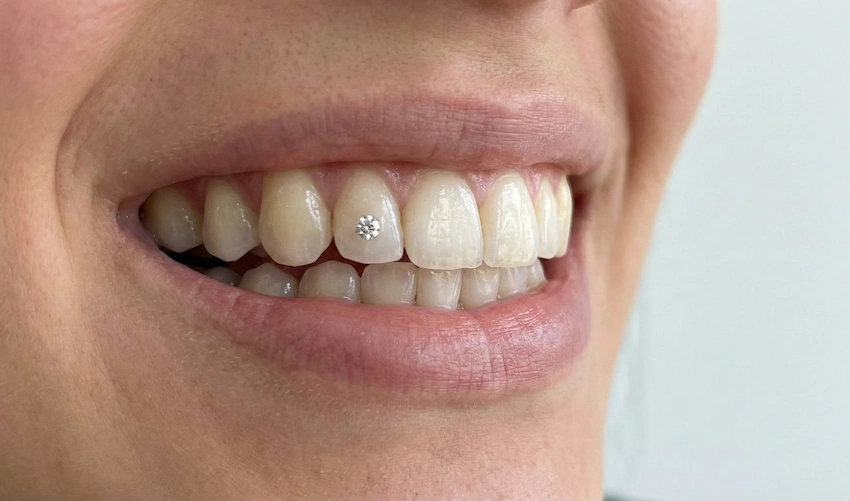
Looking into the way a gem is held in place will clarify the way it can be taken out. We at Lema Dental Clinic in Turkey literally never use drilling for the right application.
Your tooth enamel is like a blue, shining, tough protective microscopic warrior suit. To attach the diamond, the dentist applies a mild etching gel which causes the enamel to create tiny, microscopic holes. This new surface is very much like that of a frosted glass.
After that, our personnel opts for a particular composite resin. In fact, it’s also the one used for tooth-colored dental fillings. The resin acts as a microscopic anchoring system by penetrating the small pores and effectively locking the diamond onto the surface.
Since we do not cut through the tooth, your inner tooth structure is completely protected and unaffected.
The Removal Process: How Professionals Do It Safely
You cannot just yank or pry your tooth gem off at home. In fact, that is exactly what leads to the removal of enamel layers. The effect is like trying to peel off flimsily the adhesive tape stuck onto a nicely decorated wallpaper, which, in the process, is also torn.
But let us see how, together with Dentist Polen Akkılıç, safe extraction is done at our clinic:
- Mechanical Debonding: The dentist has a pair of specially-made, smooth dental pliers. With these, they gently apply a small, specific lateral pressure at the base of the gem. This eventually causes the bond between the diamond and the resin to snap cleanly. The process results in residual adhesive spotted on the tooth.
- Resin Cleanup: The dentists’ eyes detect the leftover resin as a slight patch of transparent plastic. They use a slow-speed dental handpiece along with an extremely effective tungsten carbide bur. This combination carefully and gently takes away the synthetic resin. It does absolutely nothing to the natural, hard enamel.
- Polishing: Once the resin has been removed, the dentist may polish the surface of the tooth until it shines like before. We employ high-quality polishing pastes for this procedure.
- Re-mineralization: Last of all, by applying a highly potent fluoride treatment, our facility is capable of re-enforcing the microscopic pits on the tooth surface.
DIY Removal vs. Professional Removal: The Hidden Risks
Very often, the internet is a source of dangerous tutorials. People suggest that it is okay to go with some home extraction kits and household tools. Professor Doctor Coşkun Yıldız frequently points out that home removal results in irreversible cosmetic as well as structural damage.
In fact, household tools have no capability of very precisely controlling the process. They cannot tell the difference between the hardness of composite glue and human enamel.
Below is a professional clinical removal vs. DIY attempts risk comparison:
| Feature or Risk | Professional Clinical Removal | DIY Home Removal |
| Primary Tool Used | Tungsten carbide burs & polishing tools | Tweezers, metal files, or fingernails |
| Enamel Damage Risk | Exceptionally low; enamel stays protected | Extremely high risk of fractures or scratches |
| Adhesive Residue | Completely removed and polished away | Stays on the tooth, causing dark stains |
| Pain & Sensitivity | Painless surface treatment | High risk of acute pain and nerve sensitivity |
| Post-Care Support | Fluoride therapy is applied instantly | None; leaves microscopic pores vulnerable |
What Happens to Your Enamel After Removal?
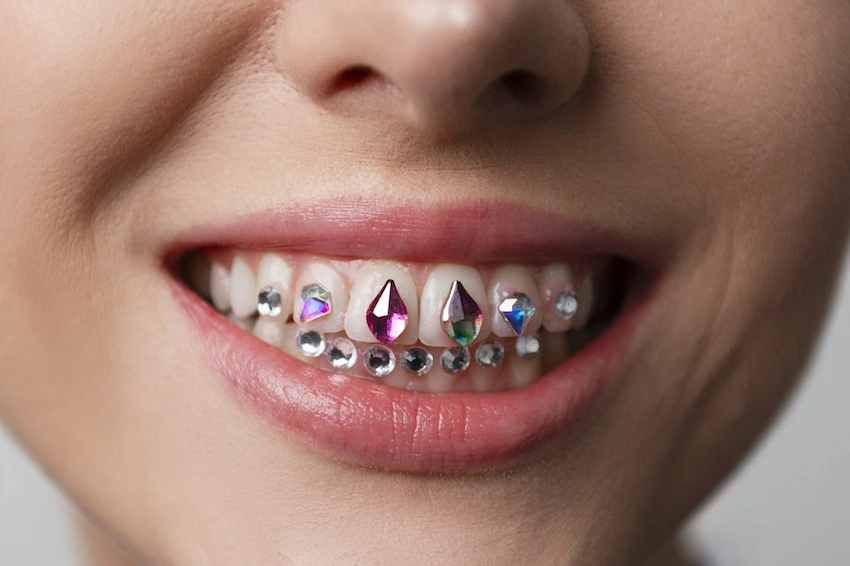
Your enamel will be the same in appearance and texture as before the placement of the gem. Dentist Polen Akkılıç and her staff can guarantee that the surface will come back to its original state.
Clinical Insight: A professional clean-up leaves the enamel intact. However, the area just exposed may be a bit more prone to staining only for 48 hours after the procedure. Consider it as a freshly deep-cleaned ceramic tile. Before coming in contact with dark pigments, it needs a little bit of time to settle.
We request that all our patients coming to Turkey that they refrain from indulging in dark berries, black coffee, red wine, and smoking for two days. This is to make sure that their smile is perfectly even and bright.
Frequently Asked Questions
Not at all. It is a bit of a vibration feeling you note as well as the resin residue is polished off. But we work only on the outermost surface layer where no nerves are present, so it really doesn’t cause pain, and the removal of the diamond does not require anesthesia or numbing.
That is a very short appointment. Doing the actual removal of the diamond takes a moment. Only the erasing of the dental glue and finishing polishing will take you somewhere around 15 to 20 minutes per tooth. We mainly use this time to polish the enamel to make it look like the other teeth.
If you have both the installation and removal done professionally, there will be no staining. But if you let the salon people phrase it, or cheap DIY kits can, create microscopic gaps under the gem that, over time, become a home for bacteria and food particles that result in localized tooth decay. However, our clinic can easily take care of the spot by doing minor cosmetic restoration.
You are allowed to adorn that tooth with a gem again. But if you ask us, the enamel will always need a break. Usually, the healthiest way for your smile is to leave the tooth surface alone and let it re-mineralize for a few weeks.
Of course. We do get a lot of patients who have used hobby resins or superglue at home anyway. In case you want to get rid of these chemicals by yourself, please do not scrape them off by hand. Our clinic team has a specialized method of safely breaking down adhesives, which are not made for dental purposes, without damaging your natural enamel.
- Al-Marzok, M. I., & Al-Azzawi, H. J. (2019). Evaluation of dental health awareness and practices regarding tooth jewelry among young adults. Journal of International Oral Health, 11(3), 142-147.
- Bhatia, R., & Sharma, A. (2021). Aesthetic dental trends: Clinical complications and removal protocols for bonded tooth ornaments. International Journal of Cosmetic Dentistry, 14(2), 89-95.
- Featherstone, J. D. (2008). The science and practice of caries prevention. Journal of the American Dental Association, 131(7), 887-899.
- Pini, N. P., Sundfeld-Neto, D., & Berger, S. B. (2015). Enamel surface aspects after enamel debonding: A systematic review. Brazilian Dental Journal, 26(4), 315-322.
- Swift, E. J., & Perdigão, J. (2022). Effects of rotary instrumentation on enamel morphology during orthodontic adhesive resin removal. Journal of Esthetic and Restorative Dentistry, 34(1), 204-211.

