


No, porcelain cannot be whitened.
In the field of restorative dentistry, there is a fundamental law of chemistry that every patient should understand: Bleaching agents are designed for organic matter, not inorganic ceramics. At Lema Dental Clinic, we often see patients who have spent significant resources on over-the-counter whitening kits, only to find their crowns or veneers standing out like a “sore thumb” against their newly brightened teeth.
Professor Doctor Coşkun Yıldız frequently points out that while modern dentistry can mimic nature perfectly, it cannot change the molecular structure of a porcelain restoration once it has been fired in a furnace. To understand why, we have to look past the surface of the smile and into the laboratory.
The Molecular Barrier: Porcelain vs. Enamel
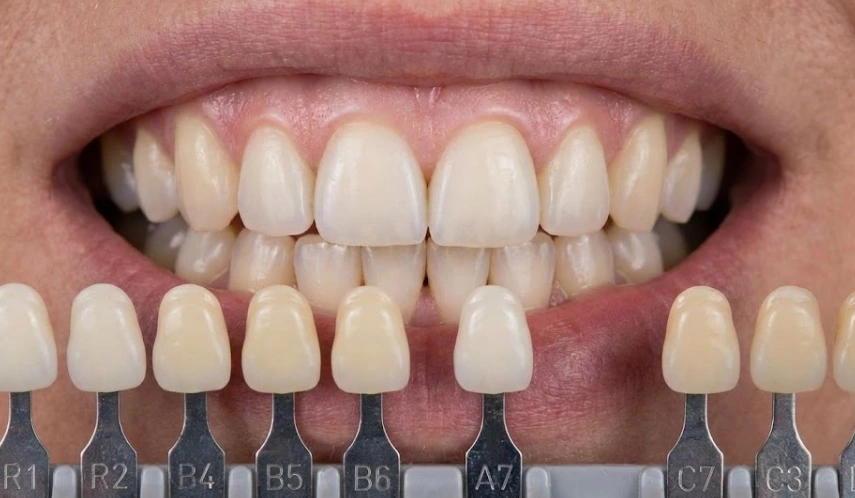
Imagine your natural tooth enamel as a thick, dense forest on a microscopic level. It has a lot of tiny canals (dentinal tubules) through which peroxide can go down deep into the tooth to disintegrate the organic stains. On the other hand, a dental crown or veneer is similar to a smooth, polished volcanic glass shield.
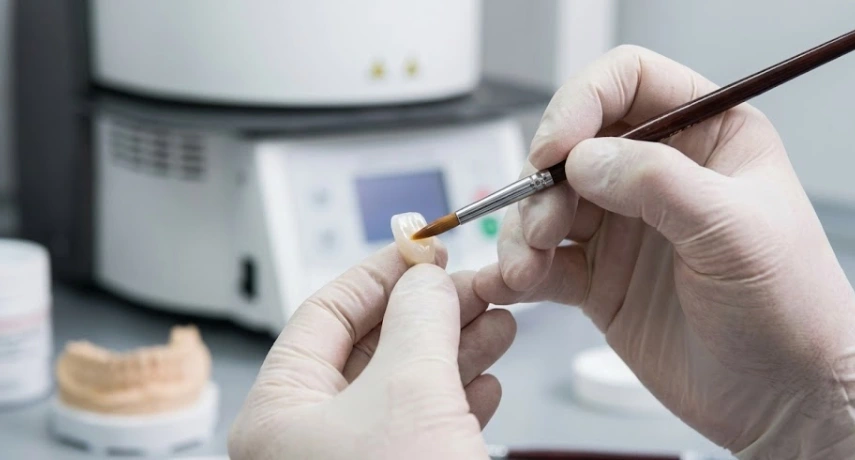
The truth is that dental ceramics—be it Zirconia, E-max, or traditional porcelain—are made through a sintering process. This process tightly fuses the particles making them absolutely non-porous. The whitening gel has no “pores” to get inside.
Let’s also check out the chemical reaction here. The bleaching agents in the gels emit oxygen molecules to break the double carbon bonds in the stains. Porcelain, however, being an inorganic glass-ceramic, simply lacks these carbon bonds. The gel on the veneer surface is like water on a glass window; it may clean the dust, but it will never change the color of the glass.
The “Mismatched Smile” Trap
In our clinical experience at Lema Dental Clinic, the danger isn’t just that the crown won’t whiten—it’s the aesthetic imbalance that follows. If you whiten your natural teeth, the contrast between the new “Bright White” enamel and the “A2 or A3” shade of an older crown becomes jarring.
Dentist Polen Akkılıç and her team utilize a strict clinical protocol to avoid this. Here is how the materials compare in a clinical setting:
Clinical Properties: Restorative Materials vs. Organic Enamel
| Material Property | Natural Human Enamel | E-max / Zirconia Restorations |
| Material Base | Hydroxyapatite (Organic) | Lithium Disilicate / Zirconium (Inorganic) |
| Porosity | 3-5% (Permeable) | 0% (Impermeable) |
| Stain Absorption | High (Coffee, Tobacco, Wine) | Virtually Zero |
| Chemical Response | Oxidative Decolorization | Chemically Inert |
| Color Fixation | Fluctuates with age/diet | Permanent (Baked-in Shade) |
Strategic Restoration: How We Solve the Problem in Turkey
The question remains: If you can’t whiten the crown, how do you fix a dull smile? At Lema Dental Clinic, we don’t believe in “one-size-fits-all” solutions. We look at the smile as a complete architectural project.
If a patient arrives in Turkey with older, yellowed restorations, our approach is twofold. First, we stabilize the shade of the natural teeth using professional-grade laser whitening. Once that “canvas” is set, we replace the outdated porcelain with modern, high-translucency materials. Dentist Polen Akkılıç focuses on the refractive index of the new crown, ensuring it bends light exactly like the surrounding natural teeth, creating a seamless transition that whitening gels could never achieve.
Inside the Clinic: Expert Answers to Your Whitening Concerns
Scientifically, no. Any product claiming to whiten porcelain is misleading. However, we can perform a professional mechanical polishing that removes extrinsic surface stains (like stubborn tobacco film) to restore the crown’s original ‘out-of-the-box’ luster.
If you have composite fillings on your front teeth, they will behave like porcelain—they won’t change color. After whitening, we usually need to ‘re-face’ those fillings with a new shade of composite to match your brighter smile.
When performed correctly at Lema Dental Clinic, no. However, if there is underlying gum recession or an aging margin, the peroxide can reach the sensitive root of the tooth. This is why a clinical exam is mandatory before any whitening begins.
We recommend a ‘stabilization period’ of at least 7 to 14 days. Oxygen levels in the tooth remain high immediately after whitening, which can interfere with the bonding of a new crown or veneer.
Absolutely. Zirconia is incredibly dense. While your natural teeth will inevitably yellow over the next decade due to diet, your Zirconia restorations will remain the same shade, potentially creating a new mismatch later on. This is why consistent hygiene is vital.
- Alqahtani, M. Q. (2014). Tooth-bleaching procedures and their effects on restorative materials: A review of the literature. Journal of Contemporary Dental Practice.
- Moraes, R. R., et al. (2021). Effect of whitening toothpastes on surface roughness and microhardness of dental ceramics. Journal of Esthetic and Restorative Dentistry.
- Yıldız, C. (2023). Optical Properties of Dental Ceramics: A Guide for Clinical Practice. Istanbul University Press.
- Joiner, A. (2010). The bleaching of teeth: A review of the literature. Journal of Dentistry.
- American Academy of Cosmetic Dentistry (AACD). (2022). Whitening and Restorative Failures: Clinical Guidelines.

