


Turkey offers fast, effective solutions for brighter teeth.
Why Your Smile is Worth Another Sparkling Phase
A smile is usually referred to as one’s non-verbal first impression. However, when teeth get dull and discolored—yellowed by age, stained by lifestyle habits or genetically darkened—this first impression may be something you don’t really want to make. Lema Dental Clinic located in the middle of Turkey shows more than just the stained teeth; we see the person whose smile has started to hide because laughing has become difficult.
Actually, discoloration of teeth is hardly ever just a “surface matter.” It results from a complicated biological, lifestyle, and sometimes chronological interaction.
Figuring Out What Makes Teeth Turn Yellow
Here at Lema Dental Clinic, from our clinical work, we treat discoloration as being either extrinsic or intrinsic.
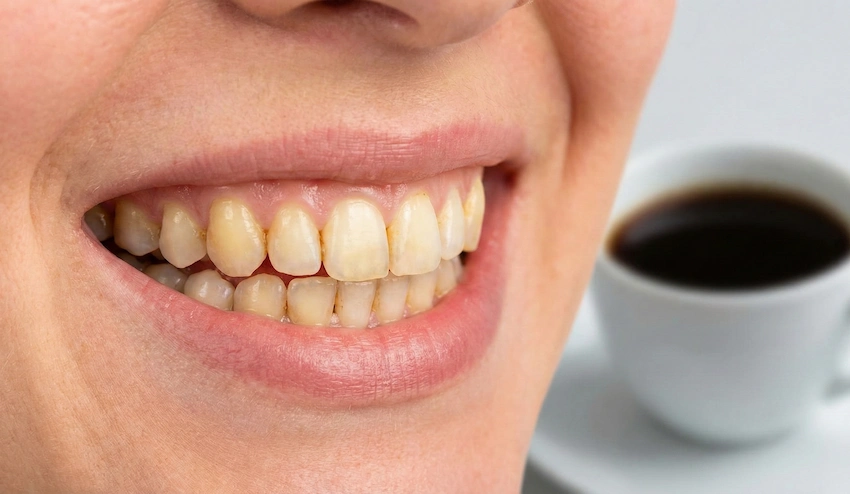
If you picture your tooth as a luxurious white linen shirt, then extrinsic staining is like coffee or red wine stains left on the fabric-they stay on the surface (the enamel) and therefore, can usually be easily washed off by professional cleaning tools. Intrinsic stains, on the other hand, are probably like a dye that has saturated the very fibres of the cloth (dentin). These deep-lying alterations, which are typically the result of medication or trauma, need a more complex treatment.
Prof. Dr. Coşkun Yıldız frequently compares treating discoloration without finding the root of the problem to covering a damp wall with paint; the problem will sooner or later come out again. Therefore, we perform a thorough diagnostic phase.
The Lema Way: From Laser Whitening to the “Hollywood Smile”
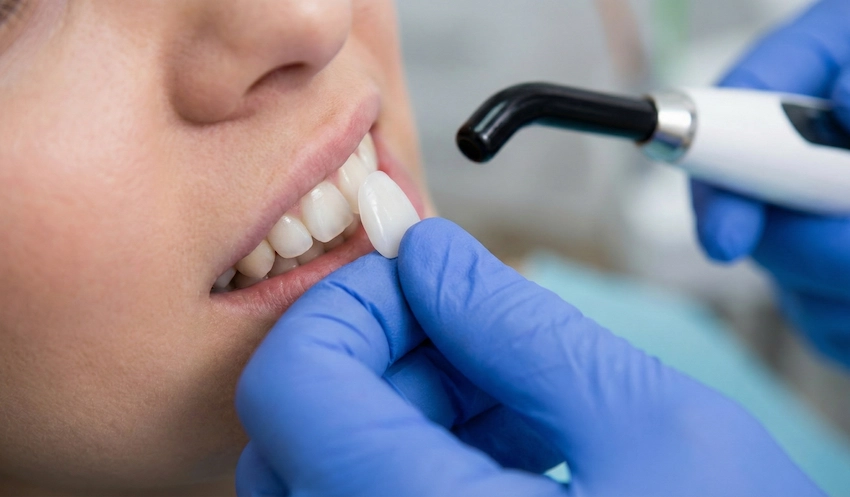
Upon arrival at our clinic in Istanbul, you aren’t simply going for a cleaning; rather, it is a place where Dentist Polen Akkılıç and her team are using the most advanced aesthetic technologies to erase years of stains in only one session.
Professional Office Whitening
If you have extrinsic stains, our powerful laser whitening treatments at the clinic can serve as a “reset button”. Our clinical-grade systems are sort of a very powerful spotlight, unlike strips one can only get from a drug store which can be compared to a flashlight with very weak light, thus, carbon bonds, which are the main cause of the yellowing, are being broken while the enamel is not affected.
Porcelain Veneers and Lumineers
What if the discoloration is actually a part of the natural look of the teeth? For individuals with tetracycline-stained teeth or teeth that have been internally darkened to such an extent that whitening is not a viable option, we depend on the artistry of porcelain. Dentist Polen Akkılıç expertly crafts E-Max veneers that are only as thick as a contact lens but are just as strong as natural enamel.
But let’s look closer at how these options stack up:
| Treatment | Primary Goal | Duration of Results | Best For |
| Laser Whitening | Lifting surface stains | 1–2 years (with care) | Coffee, tea, and tobacco users |
| Composite Bonding | Hiding minor spots | 5–7 years | Small chips or single-tooth stains |
| Porcelain Veneers | Total color/shape overhaul | 15+ years | Deep intrinsic stains & “Hollywood Smile.” |
| Zirconium Crowns | Restoring strength & color | 15–20 years | Heavily decayed or damaged teeth |
Why Turkey Has Become the Global Hub for Aesthetic Dentistry
The question that keeps coming up is: what is it with Istanbul that people are ready to hop on a plane to get a whiter smile? It is simply an upgrade of locale for the already beautiful love affair of “top-tier” technology with the clinical in-depth knowledge (deep clinical expertise) of professionals such as Professor Doctor Coşkun Yıldız. In Turkey, we can obtain the highest grade of dental ceramics and the very latest CAD/CAM technology, thus we are able to produce outcomes that resemble natural teeth rather than “piano keys”.
The way we usually explain it to people is that of a master sculptor. In lots of countries, a dental treatment is basically a “one-size-fits-all” product. At Lema Dental Clinic, however, we think the smile is a piece of art that should be individually tailored to the client, by the character of the translucency and “mamelons” (the natural tooth ridges) being maintained your smile will be full of life rather than plastic.
Frequently Asked Questions (From Our Doctors to You)
Dr. Polen Akkılıç: “Actually, no. You may experience an instant ‘zing’ or a slight sensitivity for 24-48 hours, but this is because of the nature of the treatment. There is nothing to worry about as we always use agents that reduce sensitivity and high-quality barrier gels which protect your gums and the nerves. That fleeting feeling is the price we ask you to pay for an everlasting radiance.”
Professor Doctor Coşkun Yıldız: “Internal bleaching or a single E-Max veneer is a great solution. We perfectly match the color of the treated tooth with the surrounding teeth so well that, even you, will not remember which one was the ‘problem tooth’.
Answer: “Usually, a complete smile makeover can be done in 5 to 7 days. The time frame is there for high-precision scanning, lab work, and a ‘trial smile’ phase to check the new look before it becomes official.”
One major benefit of top-quality porcelain is that it is non-porous. Actually, it will quickly become clear to you how unlike natural enamel, porcelain will not soak up coffee or red wine. Nonetheless, it is pretty much our standard recommendation to keep up with good oral hygiene so that you can have healthy gum tissue holding your teeth in!
“Clinical practice has made us see to it that patient comfort is our top priority. Local anesthesia is always administered for whatever it might be, a simple whitening or the preparation for the veneers, and in cases of a patient’s request, sedation is also offered.
- Joiner, A. (2006). The bleaching of teeth: A review of the literature. Journal of Dentistry, 34(7), 412-419.
- Kihn, P. W. (2007). Vital tooth whitening. Dental Clinics of North America, 51(2), 319-331.
- Tredwin, C. J., Rezazadeh, S., & Bulman, A. D. (2005). Color measurement of African-American and Caucasian teeth. Journal of Dentistry, 33(1), 43-47.
- Watts, A., & Addy, M. (2001). Tooth discolouration and staining: a review of the literature. British Dental Journal, 190(6), 309-316.
- Zarone, F., et al. (2019). Current status on lithium disilicate and zirconia: a narrative review. BMC Oral Health, 19(1), 1-14.

