


Teeth become crooked due to genetics and harmful oral habits.
Bad Genes or Bad Habits: Why Do Teeth Become Crooked?
Walk into any luxurious dental office, and you will find the question almost always the same: “Is this something I did, or have I just been unlucky?” At Lema Dental Clinic in Turkey, we are used to hearing it every day. Patients come and stare at their smiles in the mirror, questioning if those crowded lower incisors or that stubborn overbite are the result of their genes or if they are due to childhood habits.
The truth is hardly ever that simple. It is a complicated interaction between the genetic code that your parents handed down to you and the way you have led your life.
The Genetic Blueprint: When Your Jaw is the Architect
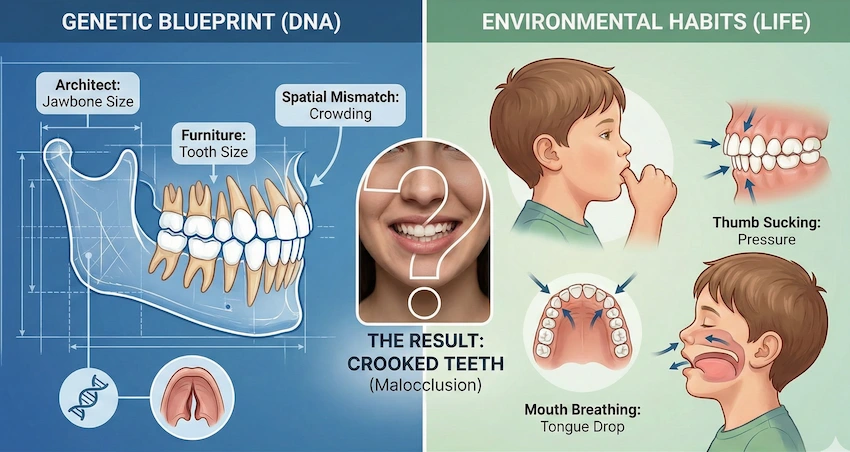
Think of your mouth as a house. Your genes are like the architect who decides the measurements for the foundation (your jaw) and the size of the furniture (your teeth).
Professor Doctor Coşkun Yıldız is used to explaining to our patients that malocclusion, which is medically termed as crooked teeth, is basically one of a few “spatial mismatch” issues. For example, you may get your mom’s small skull/jaw structure but also your dad’s big, strong teeth. In such a situation, there is literally no space for the teeth to get straight. They begin to twist, overlap, and shove each other just like people in a packed subway.
Genetic factors frequently determine:
- The dimensions and shape of the jawbone.
- The number of teeth (some people are born with extra teeth, while others are missing).
- The existence of a cleft lip or palate.
The Influence of Habits: Shaping the Soft Bone
While DNA is the main contributor, your habits are the ones that really make the difference. During childhood, the jawbone is very “plastic”—it is soft and changes in response to the application of pressure over time. This is why Dentist Polen Akkılıç and her crew pay special attention to the evaluation of the patient’s habits during the preliminary visits.
Even a perfect genetic set-up can be spoiled by unhappy circumstances in the environment. One of the most frequent offenders that we notice in the patients at our Istanbul clinic is the habit of thumb sucking for too long. If a child keeps on sucking the thumb or using a pacifier after the age of three, the constant presence of the thumb against the upper part of the mouth will push the upper teeth in the front and will cause the lower teeth to be retracted.
And then there is the “silent” habit: Mouth breathing. If a child is forced to breathe only through their mouth because of allergies or tonsils that are too big, the tongue will be placed in the lower part of the mouth instead of on the palate. By doing so, the tongue is no longer able to guide the upper arch to widen, hence the possibility of the jaw staying narrow, which can lead to severe crowding.
Comparing the Roots of the Problem
Here is how these two forces typically manifest in a patient’s smile:
| Feature | Genetic Causes (DNA) | Environmental Habits (Life) |
| Primary Cause | Inherited jaw size/tooth size ratio. | Thumb sucking, mouth breathing, tongue thrusting. |
| Typical Onset | Becomes apparent as adult teeth erupt. | It can begin in early childhood with “baby” teeth. |
| Common Outcome | Crowded teeth, underbites, or overjets. | Open bites or narrowed dental arches. |
| Prevention | Hard to prevent, requires early intervention. | It can be mitigated by breaking habits early. |
| Clinic Solution | Braces, Invisalign, or Jaw Surgery. | Habit-breaking appliances + Orthodontics. |
Lema Dental Clinic Perspective: A Modern Solution in Turkey
It is more than just making repairs that we think about; in fact, we get to the core of the problem. When you come to see us in Turkey, we include you completely in the solution. Dentist Polen Akkılıç emphasizes that orthodontic treatment should not focus on mere aesthetics but also on functional aspects.
Suppose we only align the teeth of a child who breathes through the mouth without addressing the breathing issue; later on, the child will have the same problem again because the teeth will change- reshift. Therefore, the clinical team not only visually assesses the “soft tissue” area but also the functionality of the mouth. How you swallow, breathe, and the movement of your jaw muscles are some of the factors that are considered. By combining top-of-the-range orthodontic equipment with a deep understanding of facial anatomy, we promise that the results will not only be beautiful but also enduring.
What Can You Do Now?
The truth is, to some extent, you cannot change your genetic makeup through DNA alteration and you also cannot go back to your childhood and stop yourself from thumb-sucking. But you can surely have a smile that reflects a different and better future. In fact, contemporary dentistry especially the medicine and techniques that Professor Doctor Coşkun Yıldız and our team bring to the table, can deal with the most complicated cases of genetic crowding.
The goal is to harmonize your “genetic foundation” with your “lifestyle habits.”
Whether it is Invisalign, traditional ceramic braces, or a more comprehensive smile design.
Frequently Asked Questions (FAQ)
This is something that many people believe, but according to scientific research, there is no significant evidence. While it is true that wisdom teeth can put pressure, most of the crowding that people in their twenties notice is due to jaw growth. Nevertheless, here at Lema Dental Clinic, we look at each case and decide whether the extraction is necessary for the protection of the alignment.
Definitely. Teeth are not fixed like concrete but are instead in a living environment that is constantly undergoing changes. Your teeth may get misaligned as a result of physiological drift, which is when tooth loss, gum disease, or natural changes in bone density, as we grow older, cause the position of the teeth to change.
To a certain degree yes. If a child has been breathing through the mouth for a long period of time, this could cause the “long face syndrome”. This is when the face grows in a vertical direction rather than one that is horizontal, and as a result, teeth might get crowded and the chin may look recessed.
Genes work in a way that you never know what you will get. For example, you might get a gene for a small jaw from a grandfather and a gene for big teeth from a grandmother. It is not just your parents’ smiles that matter genetically because in the end, it is the mixture of the genes that you have received that determines your smile.
It all depends on the individual case. In less complicated situations, a person can be done with their treatment in 6 to 12 months by using clear aligners, however, those who need to undergo jaw surgery due to complex genetic issues will, unfortunately, be subjected to longer durations of treatment. Our staff will determine and let you know your treatment duration during your first visit when you come in for a digital scan with us.
- Grippaudo, C., et al. (2016). Relationship between malocclusion and environmental factors. European Journal of Paediatric Dentistry.
- Lombardo, G., et al. (2020). Genetic and environmental influences on dental arch dimensions. Journal of Orofacial Orthopedics.
- Proffit, W. R., Fields, H. W., & Sarver, D. M. (2018). Contemporary Orthodontics. Elsevier Health Sciences.
- Mossey, P. A. (1999). The heritability of malocclusion: Part 1—Genetics, principles and terminology. British Journal of Orthodontics.
- Jefferson, Y. (2010). Mouth breathing: Adverse effects on facial growth, health, academics, and behavior. General Dentistry.

