


All-on-4 suits full-arch restoration, while traditional implants are best for individual tooth replacement.
Between All-on-4 and traditional dental implants, the choice has to be made in each case after the clinical examination, analysis of the bone structure, consideration of the patient’s general condition, and assessment of the function of the teeth over a long time. Both techniques help to replace lost teeth and increase the efficiency of the chewing mechanism, ensure the clarity of the speech, and maintain the stability of the jawbone, but they vary in the surgical layout, the number of implants inserted, and the time for the user to be fully functional. At LEMA Dental Clinic, every treatment plan is initiated based on cone-beam computed tomography, periodontal evaluation, and occlusal analysis.
The implant cases are submitted for consultation and kept under the supervision of Dentist Polen Akkılıç and her team or Professor Doctor Coşkun Yıldız, depending on the degree of difficulty of the surgery. The clinical aim is to regain the lost function in a way that is safe, to protect the tissues around the implant and to ensure the preservation of the bone for a long time. Both All-on-4 and traditional implants hold scientific evidence if they are applied to the right patient.
What Are Traditional Dental Implants?
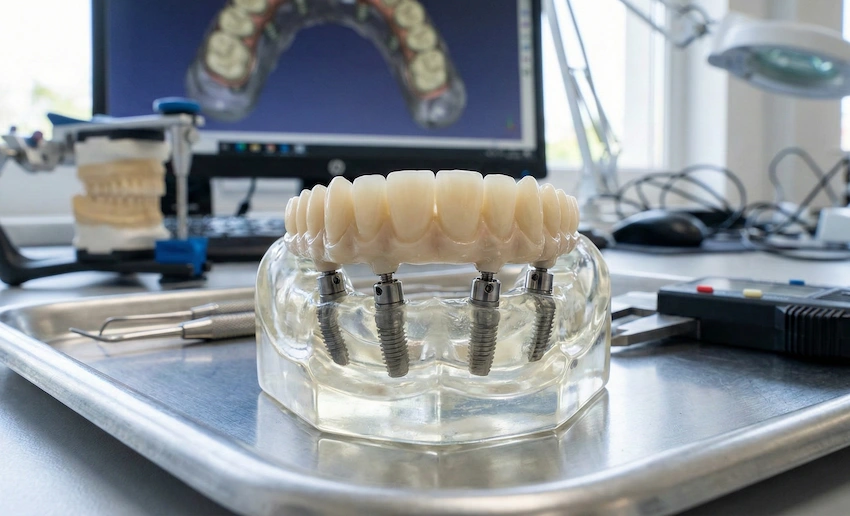
Traditional dental implants are biocompatible titanium fixtures that are used to replace the missing tooth roots. An implant is placed in the jawbone and allows for a single crown or one-tooth prosthesis segment to be very precisely anatomically placed. This type of treatment is quite common.
Once the implant has been placed a period of controlled healing is required to allow the bone to be firm and well integrated with the implant. Meanwhile, the cortical (outer) bone of the alveolar ridge is being preserved. On the other hand, under the guidance of Dentist Polen Akkılıç and her team, traditional implant protocols emphasize gingival contour health, bone volume maintenance, and the securing of the prosthetic element’s durability over time.
What Are All-on-4 Dental Implants?
All-on-4 dental implants can replace a full arch of teeth with only four implants that are cleverly placed to take advantage of the best bone areas. Two implants are placed in the front, and the two implants in the back are slanted in order to get maximum bone from the area and improve primary stability. In most cases, this layout negates the requirement for advanced bone grafting procedures.
Within the first 24 hours, the fixed temporary prosthesis is generally set up, so the patients can quickly return to normal eating function and have a beautiful smile again. Surgical comfort is secured by local anesthesia and, if necessary, conscious sedation under the clinical supervision of Professor Doctor Coşkun Yıldız. Post-operative care will most likely involve taking antibiotics as a preventive measure, using chlorhexidine mouthwash, and having follow-up appointments regularly to check on tissue healing and implant stability.
All-on-4 Dental Implants vs. Traditional Implants: Which Is Right for You?


Patients who have lost all of their teeth, have highly progressed periodontitis or very badly damaged dentitions are the typical candidates for all-on-4 dental implants. This method offers a fixed, non-removable solution for the full arch with fewer implants, thus it decreases the number of surgeries and the overall time of the treatment. All-on-4 is especially a suitable method for patients who want a full-mouth rehabilitation but do not want to go through multiple implant surgeries.
Partial tooth loss patients with sufficient bone volume are better candidates for traditional dental implants. With this method, every missing tooth can be replaced separately, thus granting the most restorative flexibility and the natural bite dynamics. At LEMA Dental Clinic, the dentist Polen Akkılıç and her team perform thorough assessments of bone density, occlusal forces, and oral hygiene capacity to make a final recommendation.
Benefits of All-on-4 Implants
All-on-4 implants make it possible for a patient to get immediate living restoration as only 4 implants are used to support a fixed full-arch prosthesis which is attached shortly after the surgery. Patients can thus quickly enjoy the benefits of the procedure such as good quality mastication, clearer pronunciation, and better facial support. Having fewer implants also means less invasive surgery and the recovery process is easier.
From a medical point of view, All-on-4 implants help to distribute occlusal forces evenly over the jaw, thus preventing excessive stress on any small area of the bone. Long-haul implant care inLEMA Dental Clinic is based on regular professional cleaning, monitoring of peri-implant tissues, and patient education to keep implants healthy.
Clinical benefits cover:
- Shorter overall treatment time
- Less bone grafting
- Immediate fixed dentures
- Highly predictable full-arch case stability
Benefits of Traditional Dental Implants
Conventional dental implants are an excellent method for a single tooth restoration, which is very similar to that of natural tooth anatomy.
Moreover, each implant is independent which means that it balances the bite forces and hygienically it is a simple routine. In addition, the neighboring healthy teeth are not affected so the natural tooth structure is preserved.
Long-term clinical studies indicate that traditional implants exhibit very high survival rates if the patients are diligent about their oral hygiene and maintenance. The traditional implant treatments under the guidance of Prof. Dr. Coşkun Yıldız at the LEMA Dental Clinic are focused on bone preservation, gingival health, and durable prosthetic outcomes.
Clinical Comparison Table: All-on-4 vs. Traditional Dental Implants
| Clinical Criteria | All-on-4 Dental Implants | Traditional Dental Implants |
| Number of implants | 4 per arch | One per missing tooth |
| Restoration timing | Immediate provisional teeth | Delayed final crown |
| Bone grafting | Often unnecessary | May be required |
| Indication | Full-arch tooth loss | Partial tooth loss |
| Maintenance | Full-arch hygiene protocol | Individual implant care |
FAQ Questions About All-On-4 vs. Traditional Dental Implants
Both are safe options if carried out properly. However, for full-arch cases, All-on-4 is what the majority of people would go for mainly because of a shorter healing time and better controlled force distribution.
In fact, if they maintain perfect oral hygiene and also regularly get professional treatments, All-on-4 implants can easily last their whole lifetime.
It has been found that single implants give the closest replica of natural teeth because each one acts as a root of the tooth.
Both treatments require regular care. However, the patients of All-on-4 implants should keep a structured full-arch hygiene routine to ensure the health of peri-implant tissues.
After a thorough examination of the patient by Dentist Polen Akkılıç and the staff or Professor Doctor Coşkun Yıldız, taking into consideration bone quality, oral health, and functional requirements, they would be able to give their opinion or the final decision would be given to them.
- Malo, P., Rangert, B., & Nobre, M. (2003). All-on-4 immediate-function concept with Brånemark system implants for completely edentulous mandibles: A retrospective clinical study. Clinical Implant Dentistry and Related Research, 5(Suppl 1), 2–9.
- Esposito, M., Hirsch, J. M., Lekholm, U., & Thomsen, P. (1998). Biological factors contributing to failures of osseointegrated oral implants: Success criteria and epidemiology. European Journal of Oral Sciences, 106(1), 527–551.
- Buser, D., Sennerby, L., & De Bruyn, H. (2017). Modern implant dentistry based on osseointegration: 50 years of progress, current trends, and open questions. Periodontology 2000, 73(1), 7–21.

