


AI dental X-ray analysis increases accuracy and precision.
AI for Dental X-Ray Analysis: Complete Guide
The human eye is amazing, but even surgeons can only do so much with their eyes. When we are in the dim room where we check the scans, a very small shadow on a grayscale image might mean a complex infection or just a reflection, a trick of the light.
Practically, interpreting X-rays has always depended on the “clinical intuition” of the physician. Naturally, experience is the most important asset, but human tiredness and faint visual differences may occasionally allow “watch and wait” situations which actually could have been “treat and cure.” For this reason, Lema Dental Clinic has incorporated Artificial Intelligence (AI) into our diagnostic procedures in Turkey.
Imagine AI as the ‘second pair of eyes’ that never gets tired and never blinks, rather than being the replacement of a doctor. It is like having a ‘super lighthouse beam’ that is capable of cutting through the fog.
The Digital Sentinel: How AI Transforms Your Diagnosis
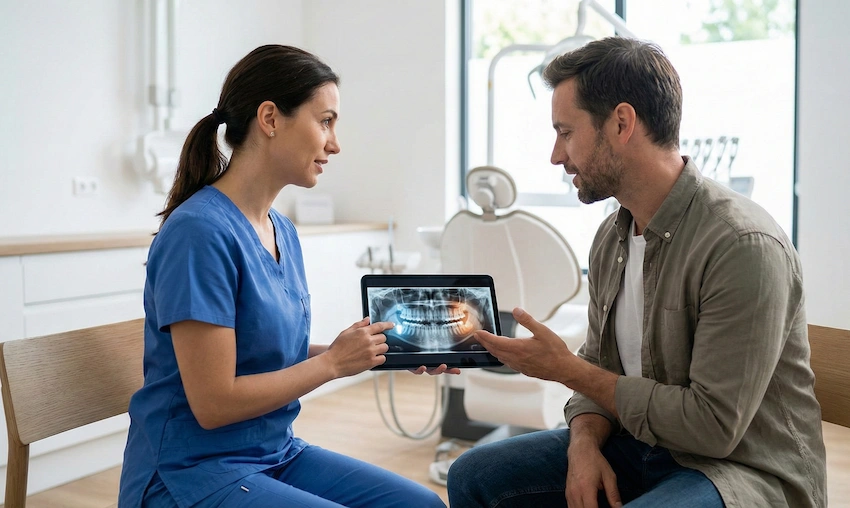
Professor Doctor Coşkun Yıldız, who is one of the surgeons at our clinic, always tells us that the success of the surgery is data-dependent even years before the scalpel actually touches the gum. The data of your 2D panoramic or 3D CBCT scans are passed through the AI analysis system ours which then flags the possible problems by precisely color-coding the differences.
The Eagle Eye for Hidden Decay
Sometimes even the best X-rays cannot spot ‘interproximal’ caries at their initial stage, leaving your teeth with cavities developing through the roofs of the thinning enamel between your teeth. Our AI system trained on a vast number of past cases is capable of detecting the slight change in pixel density that indicates the beginning of demineralization. Therefore, your teeth are being inspected by a super sleuth with a magnifying glass very close to the point that the glass is capable of seeing beyond the walls.
Measuring the Foundation
We have often been describing your jawbone to the foundation of the skyscraper: it’s the unstable soil that is to be blamed if the building is shifting. AI aids Dentist Polen Akkılıç and her crew in measuring the bone loss with such precision that even the millimeter is not omitted. This comes as a great help for dental implant patients in Turkey as we make sure that we are not installing the heavy ‘structure’ on a weak ’foundation.’
Traditional Analysis vs. AI-Assisted Diagnosis
How does this actually change your experience in the dental chair? Let’s look at the numbers and the clinical reality.
| Feature | Traditional X-Ray Review | AI-Assisted Analysis (Lema Clinic) |
| Detection Accuracy | 70% – 85% (Variable by fatigue) | 95%+ (Consistent & Objective) |
| Processing Speed | 5 – 10 Minutes | Under 30 Seconds |
| Early Caries Detection | May miss subtle shadows | Highlights 0.5mm density changes |
| Patient Transparency | Hard for patients to see “gray areas” | Clear, color-coded visual reports |
| Treatment Planning | Manual measurements | Automated, precise digital mapping |
Why “Human” Expertise Still Leads the Way
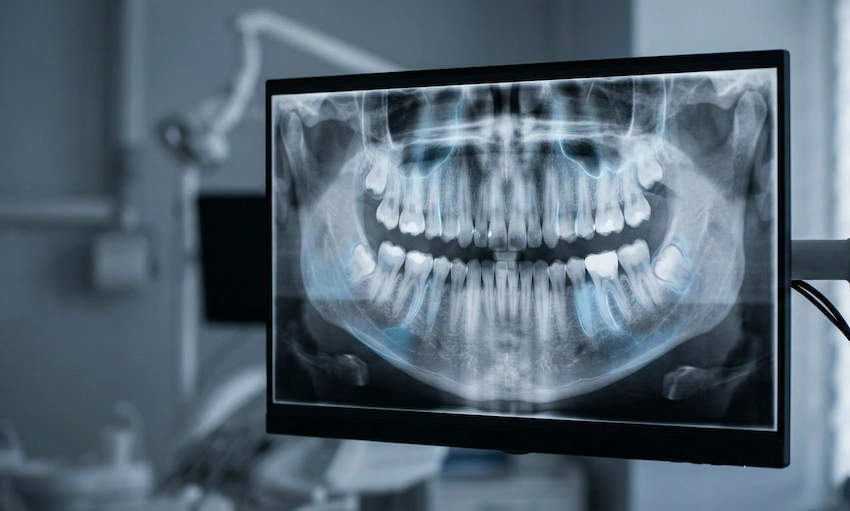
You may think: if the AI is really clever, then why do I still need a human doctor?
This question is about the surroundings. AI can simply identify and say, “This is most probably an abscess (with the probability of 80%).” However, it cannot tell from your medical history, your needle phobia or the feeling of your particular bite when you wake up. This is the beauty of Dentist Polen Akkılıç’s work. She treats the AI data as a map, but she is the one who takes the car.
According to the clinical experience at Lema Dental Clinic, we have discovered that patients feel much more comfortable seeing the AI’s results on the display. It turns the discussion from “I am the doctor, trust me” to “Let’s consider this data together.” This openness is a major principle of how we do medical work in Istanbul.
A Safer Path to Your New Smile
When you come to Turkey for dental treatment, your time is very valuable, but you still cannot compromise your safety for speed. We can greatly shorten the diagnostic stage by using AI analysis while still adhering to the rules. Potential complications—such as an extremely thin sinus membrane similar to the eggshell or a nerve path very close to the implant area—can be discovered in the first few seconds of your arrival.
FAQ: Your Questions Answered by Our Experts
“Not at all. The AI is a software layer that analyzes the image after it’s taken. In fact, because it’s so accurate, it often prevents the need for ‘retake’ X-rays, actually reducing your overall exposure.” — Professor Doctor Coşkun Yıldız.
“Never. We view AI as a sophisticated assistant. It flags areas of concern, but the final diagnosis and the surgical plan are always crafted by my hands and my clinical judgment.” — Dentist Polen Akkılıç.
“Yes. Whether you are here for a simple filling or a full-mouth Smile Design, we use these digital tools to ensure nothing is overlooked.”
“It helps us map your bone density with incredible detail. It’s like having a GPS for your jaw, ensuring we place the implant in the exact spot where it will be strongest.”
“At Lema Dental Clinic, we see this being part of our standard of care. We put our money into such technology as it results in better treatment and fewer occurrences of complications. This, in turn, saves us all the time and stress involved.”
- Hwang, J. J., et al. (2019). Development of a deep learning-based automated detection system for alveolar bone loss. Journal of Periodontology, 90(12), 1512-1521.
- Schwendicke, F., et al. (2020). Artificial Intelligence in Dentistry: Chances and Challenges. Journal of Dental Research, 99(7), 769-774.
- Krois, J., et al. (2019). Deep Learning for the Detection of Periodontal Bone Loss and Grading of Periodontitis. Journal of Clinical Periodontology, 46(8), 799-806.
- Tandon, D., et al. (2021). AI in Dental Radiology: A New Era of Diagnostic Precision. International Journal of Computerized Dentistry, 24(2), 115-125.
- Yıldız, C. (2023). Integrating Digital Workflows in Modern Implantology: A Clinical Perspective from Istanbul. Journal of Aesthetic & Restorative Dentistry (Regional Case Study Series).

