


A bad tooth can cause pain, infection, swelling, and damage to nearby teeth if left untreated.
This is a typical example. A dentist might even say a tooth is seriously damaged without the patient realizing. It is because it might stop hurting, and the patient thinks the problem has gone away.
That toothache, which sometimes gets worse and worse and then strangely stops completely is a common scenario.
Receiving such silence for many people feels like a victory. The body is thought to be the winner of the fight. The truth, however, is much more frightening.
If a tooth that has a very bad infection stops aching, the infection is hardly ever treated. In fact, it usually means that the nerves inside the tooth have died. The alarm system is off; however, the fire is still there.
Keeping a dead tooth in your mouth is a serious hazard. Not only does it wreck your smile, but it can also harm your health in general. The following is what we observe in a patient who neglects a bad tooth.
What Happens Beneath the Surface?
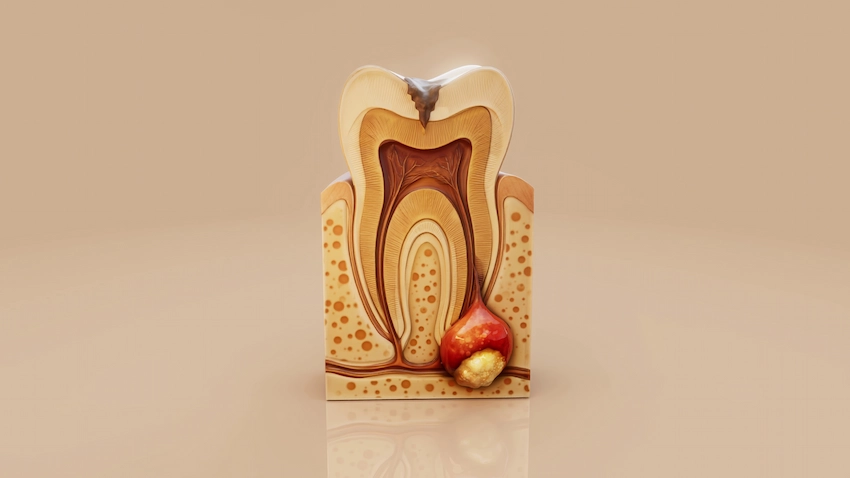
In order to understand the threat, we need to examine the inside of the tooth.
Tooth decay begins on the outer enamel. If not treated, it penetrates the hard layers and damages the pulp. The pulp is the vital core of the tooth. It carries blood vessels and nerves. Once bacteria get into this place, the infection can be very serious.
Referring to the anatomy of the tooth, Professor Doctor Coşkun Yıldız highlights an important point. Besides being a tight, closed space, the pulp chamber also cannot swell like your skin in case of inflammation. This rise in pressure inside causes the blood supply to be cut off. Hence, the tooth dies from the inside to the outside.
After the death of the tooth, bacteria remain. They follow the root canals downwards. Finally, they manage to get out through the minute opening at the bottom of the root. That is why a minor toothache can ultimately develop into an infected bone.
The Domino Effect on Your Mouth
Your mouth is not just a collection of isolated parts but a connected one. One bad tooth can ruin the rest of the mouth.
1. A Melting Foundation
Imagine your jawbone as the concrete foundation of a house. Teeth are firmly held in this bone. When an infection escapes from a dead root, it creates an dental abscess. This is a pouch of pus that actively dissolves the actual bone.
At Lema Dental Clinic, we constantly witness serious problems as a result of postponing the appointment. A very simple extraction can be at the start of a complicated surgery. If you happen to lose quite a lot of bone, then you will have to consider a bone graft before an implant is possible.
2. Sashing the Sinus Cavity
How about a diseased tooth being located in the upper jaw?
In that case, the anatomy would be the most challenging factor.
Figuratively speaking, the roots of the upper molars are so close to the sinuses that there is hardly any bone layer between them. The sinus membrane is very thin and delicate, like the shell of an egg.
In fact, infection may lead to the destruction of this thin bone. Once the bacteria reach the sinus cavity, they will cause chronic sinusitis, the main symptoms of which are headache, nasal discharge, and fatigue.
3. Damaging Healthy Neighboring Teeth
One bad tooth serves as a harbor for the bacterial strains that cause destruction. These bacteria are able to spread out to the entire oral cavity very conveniently. They speed up the infection to get through the roots and cause the gums to become inflamed. The bone grows flimsy, and the teeth that are next to the bad tooth may become loose and start to move.
When a Tooth Infection Enters Your Bloodstream
However, let’s shed light on the most significant threat that most people are unaware of. Your oral health is connected to the health of your whole body.
In fact, the blood vessels located in your jawbone are connected to the main circulatory system. Should bacteria overgrow in the bone tissue, there is a risk that they may enter your bloodstream.
Dr. Polen Akkılıç and her team frequently warn their patients about this risk. A dental abscess can be described as a ticking time bomb. The ongoing presence of bacteria in your blood can lead to several severe health issues:
- Cardiac Problems: Oral bacteria have been shown to lodge on the fatty deposits of the inner surface of blood vessels. This greatly increases the likelihood of stroke and can also contribute to heart valve infections.
- Difficulty Breathing: An infected lower molar tooth may cause the infection to spread to the floor of the mouth. In rare cases, this infection leads to the blockage of the airway, paralyzing the patient momentarily.
- Sepsis: Sepsis is a systemic reaction to infection, and in the worst case,e it is fatal.
Timelines: Neglect vs. Timely Treatment
Below is a very brief overview of how a bad tooth gets worse over time if untreated by a dentistry vs. our clinic treatment possibilities.
| Timeline | What is Happening Underneath | The Health Risks | The Solution at Lema Dental Clinic |
| 1 – 3 Months | The tooth nerve dies. Bacteria exit the root tip. | Localized pain, bad breath, and early bone loss. | Advanced Root Canal or a quick, comfortable extraction. |
| 3 – 12 Months | A chronic abscess forms. The jawbone dissolves. | Sinus issues, shifting teeth, and constant fatigue. | Gentle extraction combined with socket preservation and bone graft. |
| 12+ Months | Massive bone loss occurs. Cysts develop. | Facial changes, chronic sinus pain, and heart strain. | Complex surgery, extensive bone rebuilding, and dental implants. |
Why Extraction in Turkey is Easy and Stress-Free
A lot of people do not attend the dentist simply because they are afraid. Fear of pain, surgery, and even losing the smile causes this.
The fact is that modern dentistry is very comfortable these days. At Lema Dental Clinic in Turkey, we have actually changed the extraction to a completely different experience.
First of all, we avail ourselves of the most up-to-date 3D CT scans to very precisely map your jaw before surgery. This enables our doctors to understand exactly where the nerves and bones are.
Visiting Dentist Polen Akkılıç and her associates means that your well-being will be put first. We employ a light, contemporary method to loosen the tooth. This keeps your natural bone intact and shortens recovery time.
Yet, the question remains: how can the replacement be sorted? Going to Turkey gives you the chance not only to have an extraction but also an immediate replacement. Our clinic is one of the ones that specializes in immediate dental implants.
It may be that you have to come in a few times, but mostly we can extract the bad tooth and put the implant in the same appointment. We can also add a temporary crown, which looks lovely. You can walk out of the clinic with a full smile and a healthy mouth.
Frequently Asked Questions
Yes. The tooth,h after the pain disappears, is without any nerves to live with. The dental infection is still going on in the bone and will keep on damaging your body until the tooth is removed.
Yes the roots of your upper back teeth are so near to your sinuses that being infected can cause a big toothache. Through a root infection, the thin bone barrier can be broken, causing an ongoing sinusitis.
After tooth extraction, the bone around the extraction site is the first to resorb (shrink). To counter that, the socket is immediately grafted with a small amount of bone material. This keeps the bone in good condition so that it will be suitable for a dental implant.
Never. In fact, we use very effective anesthetics and sedation to make you very relaxed. You might feel some pressure during the procedure, but no pain at all. Your recovery will be quick and without trouble.
Most of the time, in just one trip to Turkey, you can have an extraction, bone grafting, and top-class implants,s and thacostsst you far less than getting waste dental services in the UK or US at Lema Dental Clinic, Turkey facilities.
- Nair, P. N. R. (2006). Pathogenesis of apical periodontitis and the causes of endodontic treatment failure. Critical Reviews in Oral Biology & Medicine, 15(6), 348-381.
- Siqueira, J. F., & Rôças, I. N. (2008). Clinical implications and microbiology of bacterial persistence after treatment procedures. Journal of Endodontics, 34(11), 1291-1301.
- Mattila, K. J., Nieminen, M. S., Valtonen, V. V., Rasi, V. P., Kesäniemi, Y. A., Syrjälä, S. L., … & Huttunen, J. K. (1989). Association between dental health and acute myocardial infarction. BMJ, 298(6676), 779-781.
- Mehra, P., & Murad, H. (2004). Maxillary sinusitis of odontogenic origin. Current Infectious Disease Reports, 6(3), 199-204.
- Troullos, E. S., Erdmann, S. H., & Goldstein, R. G. (2014). Systemic manifestations of acute and chronic periapical dental infections. Journal of the American Dental Association, 145(4), 331-339.

